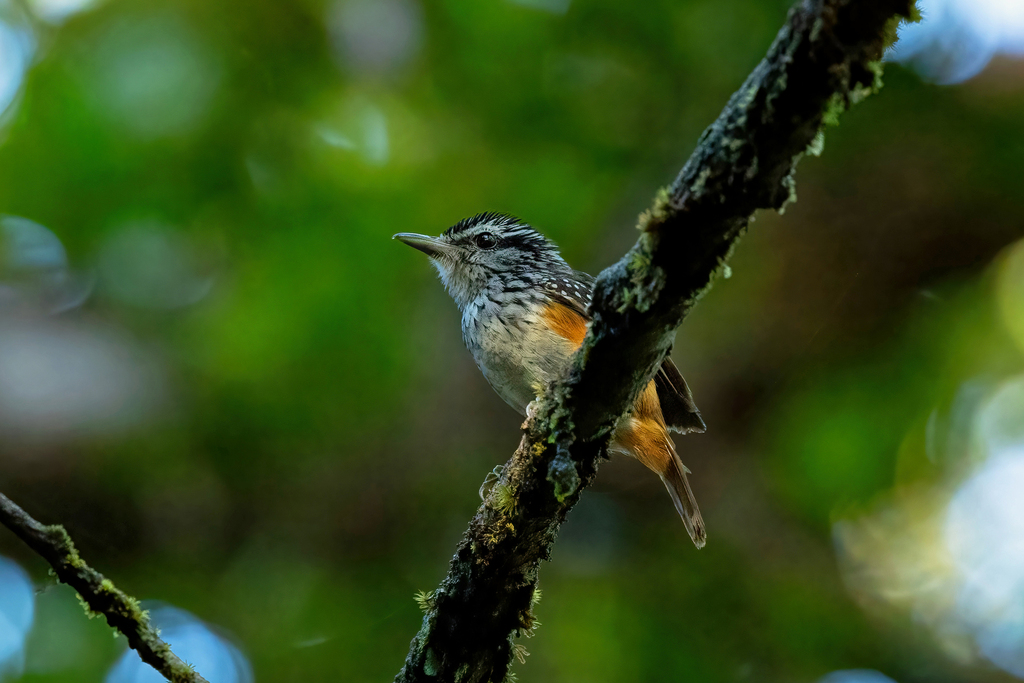
Guianan Warbling Antbird
Photo © Thibaud Aronson
Photo © Thibaud Aronson — CC BY-SA 4.0 — Source: iNaturalist photo #428404474The Guianan warbling antbird, or Guianan antwarbler, (Hypocnemis cantator) is an insectivorous bird in subfamily Thamnophilinae of family Thamnophilidae, the "typical antbirds". It is found in Brazil, French Guiana, Guyana, Suriname, and Venezuela. == Taxonomy and systematics == The French polymath Georges-Louis Leclerc, Comte de Buffon described the Guianan warbling antbird in his Histoire Naturelle des Oiseaux in 1779. The bird was also illustrated in a hand-colored plate engraved by François-Nicolas Martinet in the Planches Enluminées D'Histoire Naturelle which was produced under the supervision of Edme-Louis Daubenton to accompany Buffon's text. Buffon did not include a scientific name with his description but in 1783 the Dutch naturalist Pieter Boddaert coined the binomial name Formicarius cantatar in his catalogue of the Planches Enluminées. Its present genus Hypocnemis was introduced by the German ornithologist Jean Cabanis in 1847. The specific epithet is from the Latin cantator "a singer". The Imeri (Hypocnemis flavescens), Peruvian (H. peruviana), yellow-breasted (H. subflava), and Spix's warbling antbird (H. striata) were all formerly treated as subspecies of what is now the Guianan warbling antbird. That multi-subspecies taxon was simply called the warbling antbird. A study published in 2007 found that there were significant vocal differences as well as…
Viruá National Park
Brazil
+389 birds+6 mammals
Across the northern frontier of Roraima, where the forest canopy rises from ancient Amazonian lowlands, Viruá National Park protects nearly 3,700 square kilometres of terra firme…
VIEW NATIONAL PARKMonte Roraima National Park
Brazil
+226 birds+1 mammals
Where the tepuis rise from the Amazon basin like islands in a sea of forest, Monte Roraima National Park sprawls across 3,714 square kilometres of one…
VIEW NATIONAL PARKAnavilhanas National Park
Brazil
+468 birds+8 mammals
Across the Rio Negro in central Amazonas, an archipelago of over a thousand islands rises from the world's largest rainforest river system, creating a labyrinth of…
VIEW NATIONAL PARKNo community photos yet. Log in to add the first one.
No community observations of this species yet.