Identification
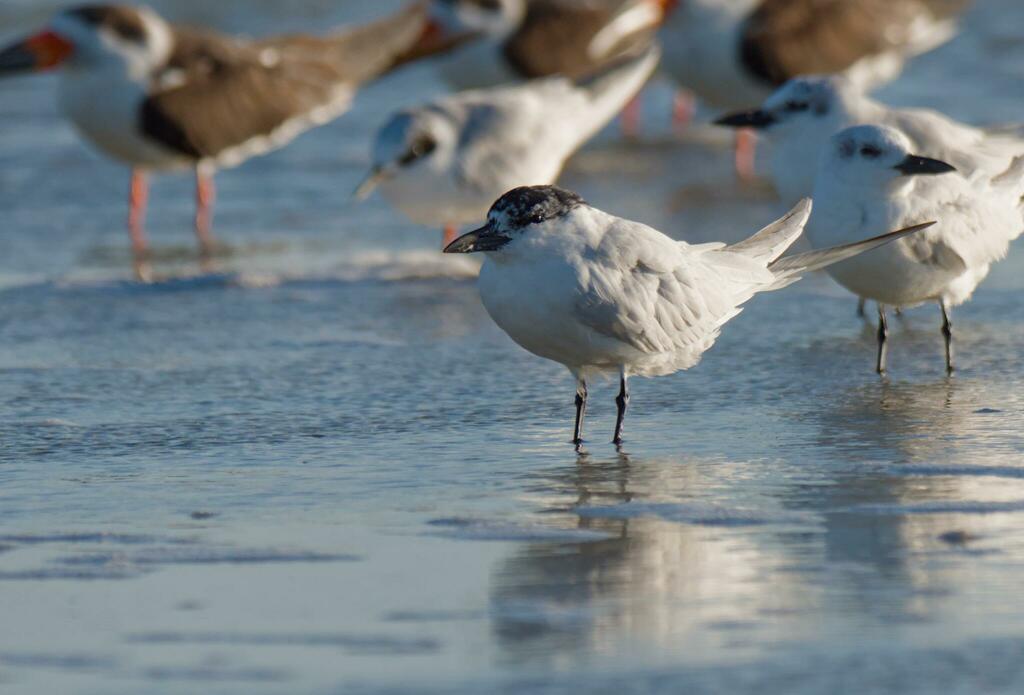
The gull-billed tern is a fairly large and powerful tern, measuring 33–42 cm in length with a wingspan of 76–91 cm. It closely resembles a Sandwich tern in size but is immediately recognisable by its distinctive short, thick gull-like bill, broad wings, long legs, and robust body. Summer adults display grey upperparts and white underparts, with a striking black cap, strong black bill, and black legs. The characteristic call is a distinctive ker-wik.
In winter plumage, the black cap is lost and replaced by a dark patch through the eye, similar to Forster's tern or Mediterranean gull. Juvenile birds have a fainter mask but otherwise resemble winter adults. Where the gull-billed tern is uncommon, young Sandwich terns with their short bills are frequently mistaken for this species, particularly along coasts such as the North Sea.
Range & Habitat
The gull-billed tern is widely distributed across the warmer parts of the world, breeding in scattered localities throughout southern Europe, temperate and eastern Asia, and both coasts of North America, as well as eastern South America. Several geographical races are recognised, differing mainly in size and minor plumage details. The species shows considerable post-breeding dispersal, with northern breeders being highly migratory and wintering south to Africa, the Caribbean, northern South America, southern Asia, and New Zealand.
The species breeds in colonies on lakes, marshes, and coasts, including bays and earthen levees. While widely associated with freshwater areas across Eurasia, it is almost exclusively tied to saltwater coastal environments in North America. This species is covered by the Agreement on the Conservation of African-Eurasian Migratory Waterbirds (AEWA).
Behaviour & Diet
The gull-billed tern nests in ground scrapes and lays two to five eggs per clutch. Unusually for a tern, its feeding habits are atypical of the genus. Rather than plunge-diving for fish like most white terns, it employs techniques more similar to marsh terns, with a considerably broader diet.
This opportunistic feeder hunts primarily for insects taken in flight and frequently ranges over wet fields and brushy areas to capture amphibians and small mammals. It has even been observed picking up and feeding on dead dragonflies from the road, demonstrating remarkable dietary flexibility for a tern species.
Best Time & Places to See It
Gull-billed terns are present year-round in breeding areas, with the best viewing opportunities during the breeding season when colonies are active. Northern populations are highly migratory, so timing depends on location. In winter, look for the species in Africa, the Caribbean, northern South America, southern Asia, and New Zealand, where northern breeders disperse.
Coastal areas, marshes, and large lakes are the most productive habitats. In North America, focus on saltwater coastal regions, while in Eurasia, freshwater areas are equally productive. Colonies provide the most reliable sighting opportunities during the breeding season.
Photography Tips
The gull-billed tern's distinctive thick bill and robust build make it a rewarding subject to photograph, particularly when it allows direct comparison with similarly-sized Sandwich terns. The black cap and facial pattern in summer plumage provide strong contrast and are most striking in bright overhead light.
Capture the species' characteristic feeding behaviour in flight over marshes and wet fields—a behaviour uncommon among terns and likely to produce distinctive images. Winter birds with their characteristic eye-stripe offer different photographic opportunities. Breeding colonies offer chances to photograph nesting birds, eggs, and chick-feeding behaviour.