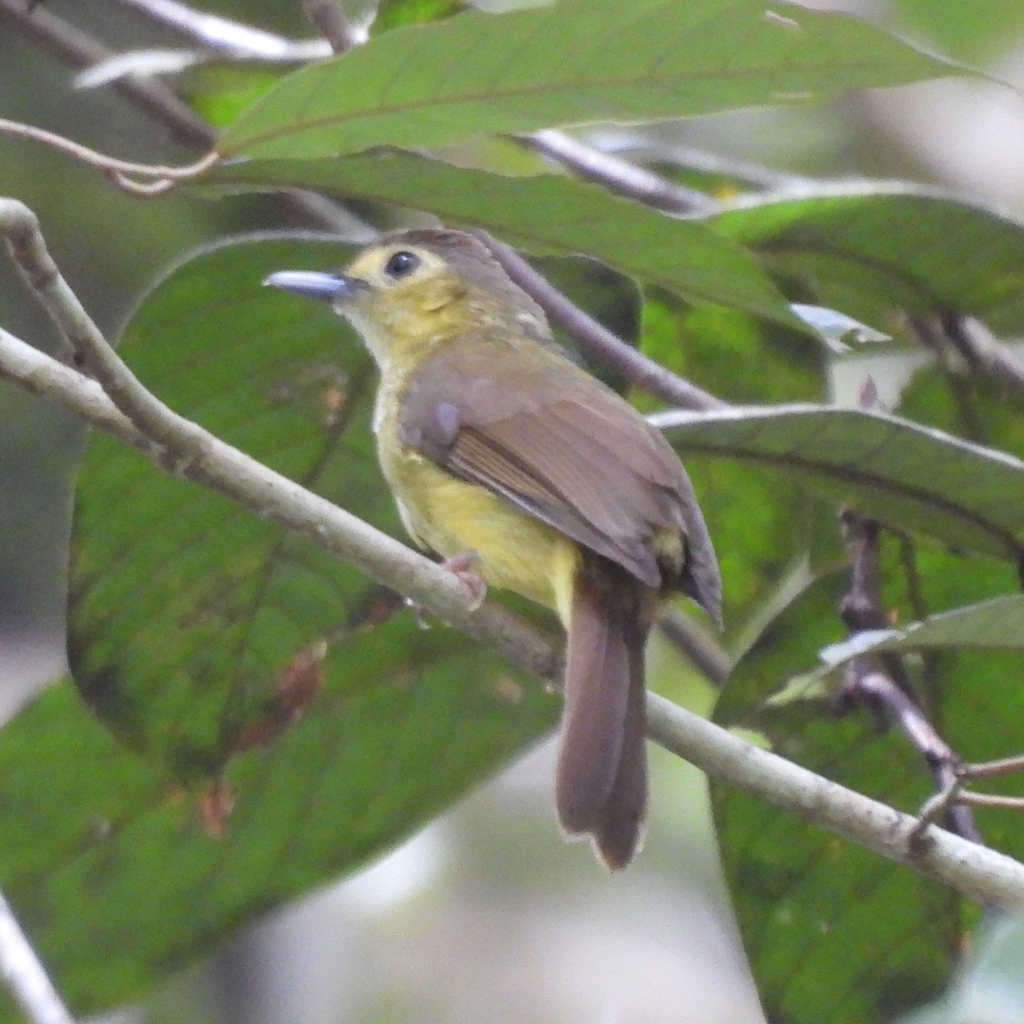
Hairy-backed Bulbul
Photo © Seno Nur Rohman
Photo © Seno Nur Rohman — CC BY-SA 4.0 — Source: iNaturalist #202215601Identification
The hairy-backed bulbul is a small songbird, measuring just 16–17 cm in length and weighing a mere 12–21 grams, making it one of the more diminutive members of the bulbul family. It is relatively quiet and unobtrusive, with a slightly rounded tail and distinctive strong rictal bristles around the bill. The species is named for the hair-like filoplumes on its back, though these are often concealed beneath the regular plumage and may be difficult to observe in the field.
Plumage-wise, the hairy-backed bulbul presents a warm, earthy palette: olive-green upperparts contrasted with yellowish underparts. Look for a dark rufescent olive-brown cap and neck, pale yellowish lores, and a broad eye ring that gives the bird a characteristic expression. The tail is particularly striking—bright rufous-brown with creamy white tips. The chin and throat are creamy white, merging into a bright yellow breast. Sexes are similar in appearance, though females are slightly smaller than males. Juveniles are distinguishable by their grey-brown iris and pale fleshy pink legs, in contrast to the adult's dark brown iris and light blue-grey bill.
Range & Habitat
The hairy-backed bulbul is found across Southeast Asia, occurring on the Malay Peninsula, Sumatra, and Borneo. Three subspecies are recognized across this range: the nominate T. c. criniger inhabits the Malay Peninsula and eastern Sumatra; T. c. sericeus is found on western Sumatra and is larger with duller yellow undertail-coverts; and T. c. viridis occurs on Borneo, displaying brighter upperparts than its congeners.
This species is strictly a lowland forest bird, occupying subtropical and tropical moist lowland forests throughout its range. It is a specialist of dense, humid forest environments and is unlikely to be encountered in disturbed, open, or drier habitats.
Behaviour & Diet
The hairy-backed bulbul is a relatively quiet and unobtrusive species, less vocal than many other bulbuls. Its weak legs and feet suggest a lifestyle adapted to detailed foraging among foliage rather than vigorous terrestrial locomotion. Though specific dietary preferences are not detailed in available sources, like most bulbuls it likely forages for small fruits and insects in the canopy and mid-storey layers of the forest.
Best Time & Places to See It
Birders and wildlife enthusiasts seeking the hairy-backed bulbul should focus on protected lowland forest reserves within the Malay Peninsula, Sumatra, and Borneo. The species is forest-dependent and uncommon in disturbed habitats, making pristine moist lowland forests the most productive search locations. No specific information is available regarding seasonal movements or optimal viewing times, suggesting the species may be relatively sedentary throughout the year.
Photography Tips
Photographing the hairy-backed bulbul presents challenges owing to its quiet, unobtrusive nature and preference for dense forest understory and mid-storey vegetation. A telephoto lens is essential for capturing images from a distance without disturbing the bird. The species' small size and tendency to remain within vegetation demands patience and careful positioning. Early morning light filtering through the forest canopy can beautifully illuminate the bird's warm rufous and olive tones. Focus on the distinctive bright tail and eye ring, as these features are diagnostically important and visually striking.
Taman Negara National Park
Kampong Samas, Malaysia
+393 birds+48 mammals
Where ancient rainforest meets limestone peaks, one of Southeast Asia's oldest protected wilderness preserves sprawls across 4,343 square kilometers of primordial landscape. Dipterocarp giants tower overhead,…
VIEW NATIONAL PARKPenang National Park
Balik Pulau, Malaysia
+107 birds+2 mammals
Granite peaks rise abruptly from the Andaman Sea where tropical rainforest clings to steep slopes in one of Malaysia's oldest protected landscapes. Mangrove forests fringe the…
VIEW NATIONAL PARKGunung Mulu National Park
Long Seridan, Malaysia
+280 birds+39 mammals
Where granite monoliths pierce the rainforest canopy of Sarawak, an ancient limestone karst landscape reveals one of Southeast Asia's most biodiverse strongholds. Soaring peaks cloaked in…
VIEW NATIONAL PARKKerinci Seblat National Park
Kerinci, Indonesia
+228 birds+16 mammals
Across nearly 67,000 square kilometres of Sumatra's spine, a mountainous realm of equatorial rainforest rises from steaming lowlands to volcanic peaks shrouded in cloud. Kerinci Seblat…
VIEW NATIONAL PARKGunung Palung National Park
Kayong Utara, Indonesia
+38 birds+1 mammals
Rainforest swells across the steep terrain of West Kalimantan, where ancient volcanic ridges rise abruptly from lowland swamps and weathered plateaus. Gunung Palung National Park encompasses…
VIEW NATIONAL PARKWay Kambas National Park
Lampung Timur, Indonesia
+237 birds+20 mammals
Across the low swamplands of eastern Lampung, where freshwater wetlands merge into tidal mangrove forests along the Sunda Strait, sprawls one of Sumatra's most vital sanctuaries.…
VIEW NATIONAL PARKNo community photos yet. Log in to add the first one.
No community observations of this species yet.