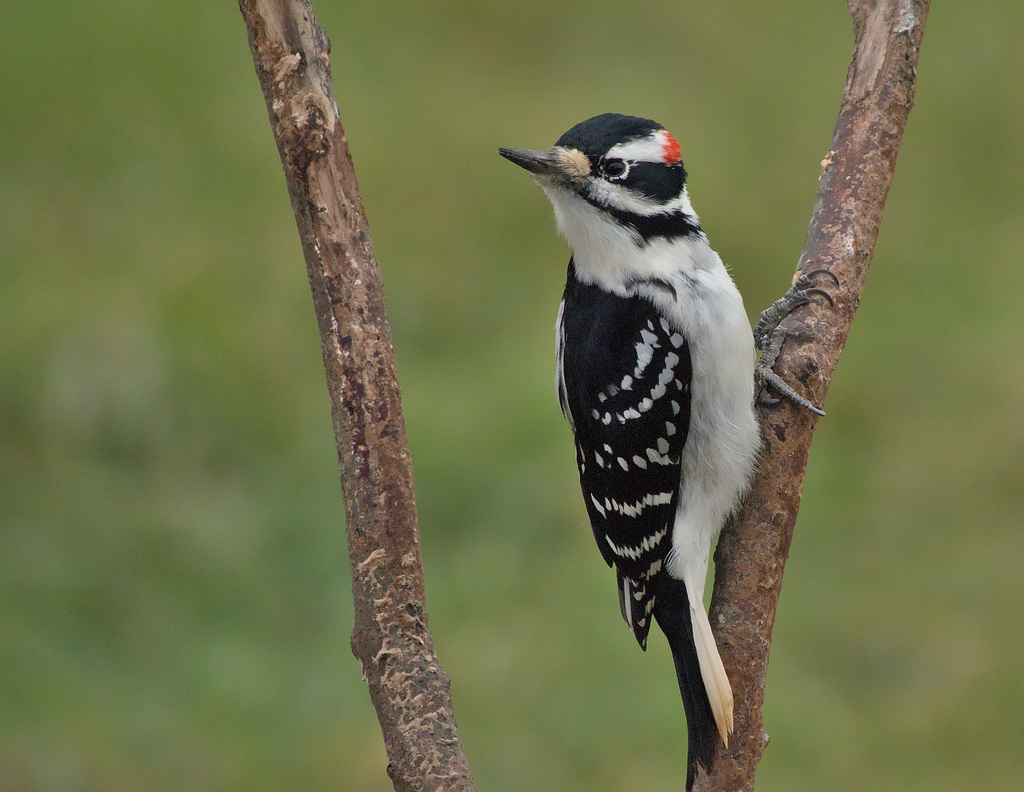
Hairy Woodpecker
Photo © Blake Ross
Photo © Blake Ross — CC BY 4.0 — Source: iNaturalist photo #248588440Identification
The hairy woodpecker is a medium-sized woodpecker measuring 18–26 cm in length with a wingspan of 33–43 cm. Adults are mainly black on the upper parts and wings, with a distinctive white or pale back and white spotting on the wings. They display a white bar above and below the eye, a black tail with white outer feathers, and lack spots on their white tail feathers. Adult males are identified by a red patch or two side-by-side patches on the back of the head, while juvenile males display red or rarely orange-red on the crown.
The hairy woodpecker is virtually identical in plumage to the smaller downy woodpecker, representing a spectacular example of convergent evolution. The most reliable field distinctions are size, the hairy woodpecker's proportionally longer bill relative to head size, voice, and the absence of spots on its white tail feathers. Despite their similar appearance, these two species are not closely related and likely belong to different genera, and ecological competition between them is slight due to their considerable size difference.
Range & Habitat
The hairy woodpecker is found over a large area of North America, with seventeen recognized subspecies distributed from south Alaska through Canada and the continental United States, extending south through Mexico, Central America, and into Panama, as well as the Bahamas. The species inhabits mature deciduous forests and is a vagrant to Puerto Rico and the Turks and Caicos Islands. These birds are mostly permanent residents, though those in extreme northern regions may migrate further south, and birds in mountainous areas may move to lower elevations seasonally.
Mating pairs excavate holes in trees for nesting, where they lay an average of four white eggs. With an estimated population of almost nine million individuals, the hairy woodpecker is listed by the IUCN as a species of least concern.
Behaviour & Diet
Hairy woodpeckers forage actively on trees, often turning over bark or excavating into wood to uncover insects. While insects form the basis of their diet, they supplement their feeding with fruits, berries, nuts, and occasionally tree sap. Notably, these woodpeckers are predators of the European corn borer, a destructive moth species that costs the US agriculture industry more than one billion dollars annually in crop losses and population control efforts.
Best Time & Places to See It
Since hairy woodpeckers are mostly permanent residents throughout their range, they can be observed year-round in suitable mature deciduous forest habitat across North America. The species is widely distributed from Canada and Alaska through the United States, Mexico, and Central America to Panama. Birdwatchers in coastal regions of the Atlantic and Pacific, as well as interior forests, have good opportunities to encounter these woodpeckers, particularly where mature trees with suitable foraging substrate are available.
Photography Tips
The hairy woodpecker's striking black-and-white plumage, particularly the distinctive white back contrasting with black upper parts and the white facial bars, creates excellent photographic opportunities. The red crown patch on males provides additional visual interest. Photographers should note that the bird's active foraging behavior—turning bark and excavating on tree trunks—offers dynamic shooting opportunities. Exercise patience when observing near nest holes during breeding season, and use appropriate focal lengths to capture both the bird's distinctive markings and its natural foraging posture on tree trunks.
Alaska Maritime National Wildlife Refuge
Algonquin Provincial Park
Alligator River National Wildlife Refuge
Arches National Park
Banff National Park
Baru Volcano National Park
Bear River Migratory Bird Refuge
Bic National Park
Black Canyon of the Gunnison National Park
Nothing matches these filters.
No community photos yet. Log in to add the first one.
No community observations of this species yet.