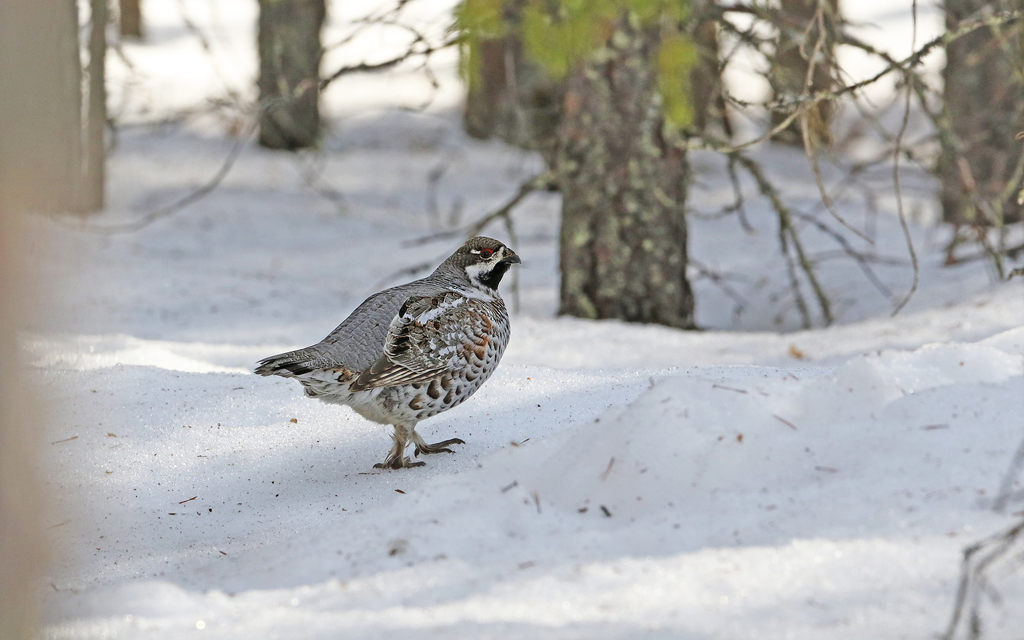
Hazel Grouse
Photo © Christoph Moning
Photo © Christoph Moning — CC BY 4.0 — Source: iNaturalist photo #196485408Identification
The hazel grouse is one of the smallest members of the grouse family, measuring just 35–39 cm in length. Despite its modest size, this plump bird is beautifully patterned with grey upperparts, brown wings, and chestnut-flecked white underparts. In flight, it reveals a distinctive black-tipped grey tail that can help confirm identification.
Sexual dimorphism is evident: males sport a short, erectile crest and a striking white-bordered black throat patch, while females have a shorter crest and lack the bold throat markings. The bird's presence is often betrayed by sound rather than sight—males produce a high-pitched "ti-ti-ti-ti-ti" call, while females make a liquid "tettettettettet" sound. The distinctive burring noise of their wings in flight is another useful audio cue for alert observers.
Range & Habitat
The hazel grouse is a sedentary species breeding across the Palearctic region, ranging from Hokkaido in the far east to central and eastern Europe in the west. Eleven recognized subspecies are distributed throughout this vast range, from Scandinavia and central Poland east to Siberia, with populations also found in the Alps, Balkans, and across Russia.
This species shows a strong preference for dense, damp, mixed coniferous woodland, particularly areas with spruce. Such habitat provides the dense cover essential for this shy, elusive bird to forage and breed safely away from predators.
Behaviour & Diet
Hazel grouse are ground feeders that consume primarily plant material throughout most of the year. During the breeding season, they supplement their diet with insects. These sedentary birds remain within their woodland territories year-round, never undertaking long-distance migrations.
Breeding occurs on the ground, where females lay a typical clutch of 3–6 eggs. Following gamebird conventions, the female alone incubates the eggs and raises the chicks without assistance from the male, bearing full responsibility for parental care until the young fledge.
Best Time & Places to See It
Finding hazel grouse requires patience and the right habitat. Focus your search on dense, damp coniferous woodlands with abundant spruce throughout the Palearctic region. The bird's sedentary nature means populations are year-round residents in suitable areas, making any season potentially productive—though the breeding season may offer better chances of hearing territorial males calling.
Early mornings are typically best for detecting these birds, when calling activity is highest and the forest is quietest. Listen carefully for the characteristic calls and wing-burring sounds that often provide the only indication of a hazel grouse's presence, as their shyness and preference for dense cover make direct sightings challenging even for experienced birdwatchers.
Photography Tips
Photographing hazel grouse demands stealth and patience. Approach potential habitat slowly and deliberately, pausing frequently to listen for calls. Their wariness means they often flush before you achieve a clear view, so position yourself carefully and be prepared for quick reactions.
Use sound as your primary tool—learn to recognize and locate birds by their distinctive calls rather than relying on visual searching. Focus on early morning sessions in prime habitat, and be ready with a telephoto lens, as close approaches are rarely possible. The bird's cryptic plumage, while beautiful in detail, blends remarkably well with woodland surroundings, so viewing these grouse often rewards those who listen first and watch second.
Aggtelek National Park
Åsnens National Park
Baikal National Park
Biebrza National Park
Bieszczady National Park
Bükk National Park
Chartreuse Regional Nature Park
Färnebofjärden National Park
Gladyshevskiy Wildlife Refuge
Nothing matches these filters.
No community photos yet. Log in to add the first one.
No community observations of this species yet.