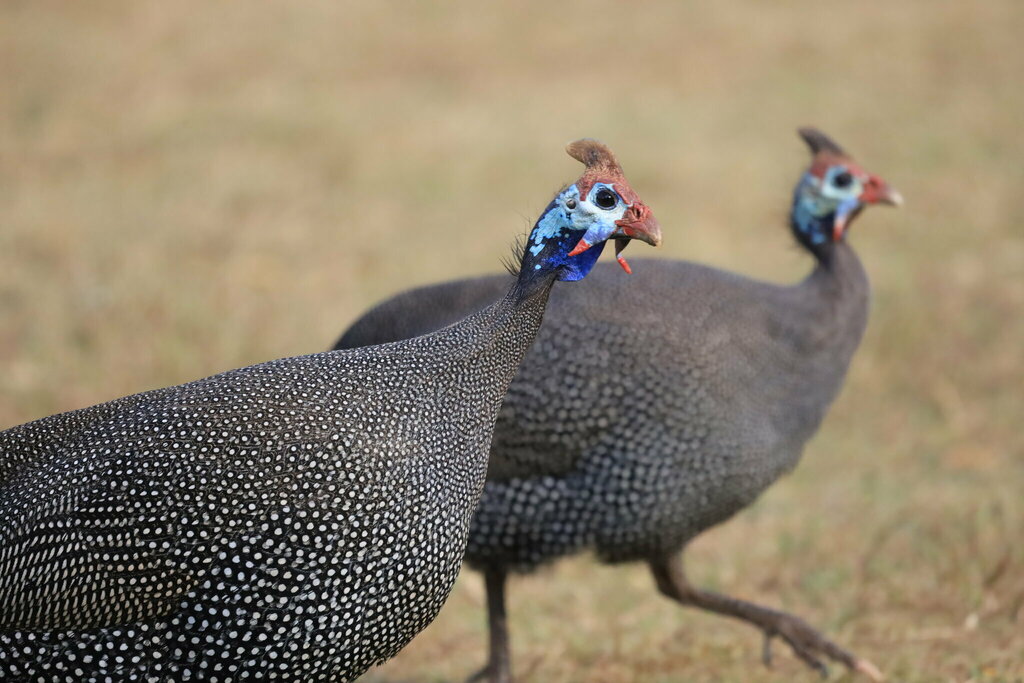
Helmeted Guineafowl
Photo © Paul Hoekman
Photo © Paul Hoekman — CC BY 4.0 — Source: iNaturalist photo #321540775Identification
The helmeted guineafowl is a distinctive large galliforme, measuring 53 to 58 cm in length and weighing around 1.3 kg. Its most recognizable feature is the small, bare head crowned with a dull yellow or reddish bony knob called a casque, complemented by bare facial skin displaying red, blue, or black hues. The body is stocky and rounded, covered in gray-black plumage speckled with white. Wings and tail are notably short and rounded, giving the bird a compact silhouette. The nine recognized subspecies show considerable variation in the size, shape, and coloration of the casque and facial wattles, making some populations distinctly different in appearance.
Range & Habitat
Native to Africa, predominantly south of the Sahara, the helmeted guineafowl has been widely introduced as a domesticated species across the globe, including the West Indies, North America, Colombia, Brazil, Australia, and Europe. Feral populations descended from domestic flocks now occur in many of these regions. In their natural state, they breed in warm, fairly dry, and open habitats characterized by scattered shrubs and trees, such as savannas and farmland.
Behaviour & Diet
These are highly gregarious birds, forming flocks of approximately 25 individuals during the nonbreeding season and roosting communally. Despite having short, rounded wings suited only for explosive, short-lived flight, helmeted guineafowl are remarkably terrestrial and can walk 10 km or more daily, relying on gliding for longer distances. They are prone to running rather than flying when alarmed, and make loud, harsh calls when disturbed. Their bodies are exceptionally well-adapted for running over rough terrain at speed.
Their diet is highly varied, shifting seasonally. Outside breeding season, they consume corn, tubers, seeds—particularly from agricultural weeds—and crop spillage. During breeding season, over 80 percent of their diet consists of invertebrates, especially arthropods such as beetles. Like domestic chickens, they scratch in loose soil for food using their strong claws, though they rarely uproot growing plants. They can live up to 12 years in the wild. Males are notably aggressive toward one another, engaging in fierce fighting that may cause injury, accompanied by wing-raising displays and gaping-beak threats.
Best Time & Places to See It
Summer represents the peak breeding season in African habitats. Travelers should focus on warm, dry, open landscapes with scattered vegetation—savannas and farmland offer the best opportunities. In their native range south of the Sahara, these birds are relatively common in suitable habitats. Outside Africa, feral populations in Europe, North America, and Australia can be encountered, though sightings may be less predictable. Early morning and late afternoon often provide the best viewing opportunities, as these are active feeding periods.
Photography Tips
The helmeted guineafowl's striking bare head and distinctive plumage make it photogenic, though challenging. Their tendency to run rather than fly means ground-level perspectives can be effective. Capture the characteristic posture and the ornamental casque detail by positioning yourself ahead of foraging birds. The birds are particularly photogenic during aggressive displays, when males raise their wings and bristle their feathers. The contrast between their dark, speckled bodies and colorful facial skin demands careful exposure metering. Early light enhances the subtle white speckles against gray-black plumage and brings out facial coloration. Patience and a longer lens (300mm or greater) are essential, as these gregarious but wary birds will take flight if approached too closely.
Wild South Africa: Safari + Coast
Nothing matches these filters.
Bwindi Impenetrable National Park
Lake Mburo National Park
Mabamba Swamp
Murchison Falls National Park
Queen Elizabeth National Park
Aberdare National Park
Abijata-Shalla Lakes National Park
Addo Elephant National Park
Agulhas National Park
Nothing matches these filters.
No community photos yet. Log in to add the first one.
No community observations of this species yet.