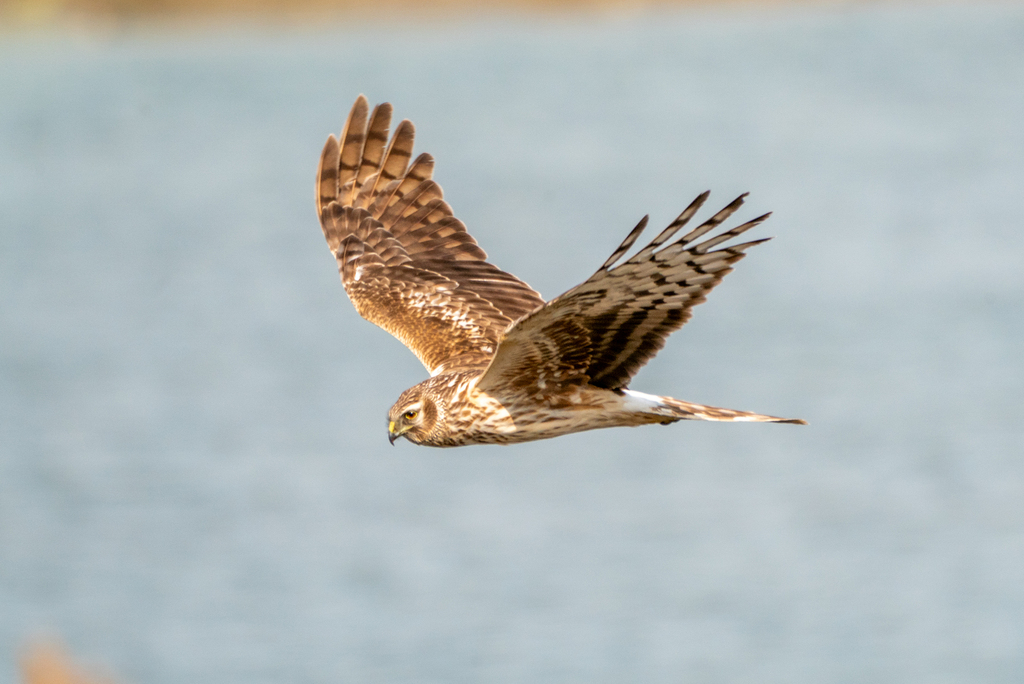
Hen Harrier
Photo © WATANABE Hitoshi 渡辺仁
Photo © WATANABE Hitoshi 渡辺仁 — CC BY 4.0 — Source: iNaturalist photo #359499135Identification
The hen harrier is a medium-sized raptor measuring 41–52 cm in length with a wingspan of 97–122 cm. It is highly sexually dimorphic, making identification straightforward once you know what to look for. Males are noticeably smaller and display predominantly grey and white plumage with striking black wingtips, while females are larger and predominantly brown above with buff underparts marked by brown barring. Both sexes share a distinctive white rump patch, though it is more noticeable on females and juveniles—a feature that earned females and young birds the colloquial name "ringtails."
The species is relatively long-winged and long-tailed, adaptations that serve its hunting style. Juveniles resemble females but with less distinct barring and dark brown secondaries. When heard, males produce distinctive calls including a sharp chek-chek-chek and a more bouncing chuk-uk-uk-uk during display flights, while females give a whistled piih-eh when receiving food and an alarm call of rapid chit-it-it-it-it-et-it.
Range & Habitat
The hen harrier breeds across open areas throughout Eurasia, favoring marshes, grasslands, moorland, bogs, farmland, swamps and other assorted open habitats. The species is migratory, with birds moving further south outside the breeding season, though residents in milder regions such as France and Great Britain may remain year-round. Higher altitude populations largely desert their breeding grounds in winter.
Behaviour & Diet
Hen harriers are remarkable among raptors for practicing polygyny, with individual males known to mate with up to five females in a single season. Research on the Orkney Islands demonstrated that food availability directly influences polygyny rates, with males receiving supplementary feeding attracting more breeding females than those without extra food. Males maintain territories averaging 2.6 km² and play an important role in breeding, hunting to provision incubating females and helping feed chicks after hatching, though they typically spend no more than around five minutes watching the nest at a time. Nests are constructed on the ground from sticks and lined with grass and leaves, containing four to eight whitish eggs that incubate for 31–32 days. Chicks fledge at around 36 days, though breeding maturity is not reached until 2–3 years of age.
Hen harriers hunt in typical harrier fashion, flying low with long wings held in a shallow V, hugging the contours of the land below. Up to 95% of their diet comprises small mammals, though they regularly hunt birds, particularly open-country passerines such as sparrows, larks and pipits, alongside small shorebirds and young waterfowl. In winter, these harriers roost communally with merlins and marsh harriers in open country.
Best Time & Places to See It
Hen harriers are best observed in their breeding season across open moorland, grassland and marshland habitats throughout their Eurasian range. In milder regions like Great Britain and France, year-round residents can be found, though higher altitude areas are largely abandoned in winter. Winter observers should seek them in open country where they congregate at communal roosts, often alongside merlins and marsh harriers.
Photography Tips
Photograph hen harriers in their characteristic low, quartering flight over open ground, where their distinctive wing posture and rump patches are most visible. The sexual dimorphism makes for compelling comparison shots—capture both the grey and white males and the brown "ringtail" females when possible. Early morning light across moorland or marshland will best showcase their plumage details and hunting behavior. During breeding season, patient observation at nest sites from a distance will reveal males passing food to females and the dramatic aerial displays accompanied by their characteristic vocalizations.
Private Full-Day Birdwatching Tour from Lisbon to the Tagus Estuary
Nothing matches these filters.
Alpilles Regional Nature Park
Alta Murgia National Park
Altai Tavan Bogd National Park
Appennino Lucano Val d’Agri Lagonegrese National Park
Åsnens National Park
Avesnois Regional Nature Park
Baikal National Park
Baima Snow Mountain National Nature Reserve
Bannau Brycheiniog National Park
Nothing matches these filters.
No community photos yet. Log in to add the first one.
No community observations of this species yet.