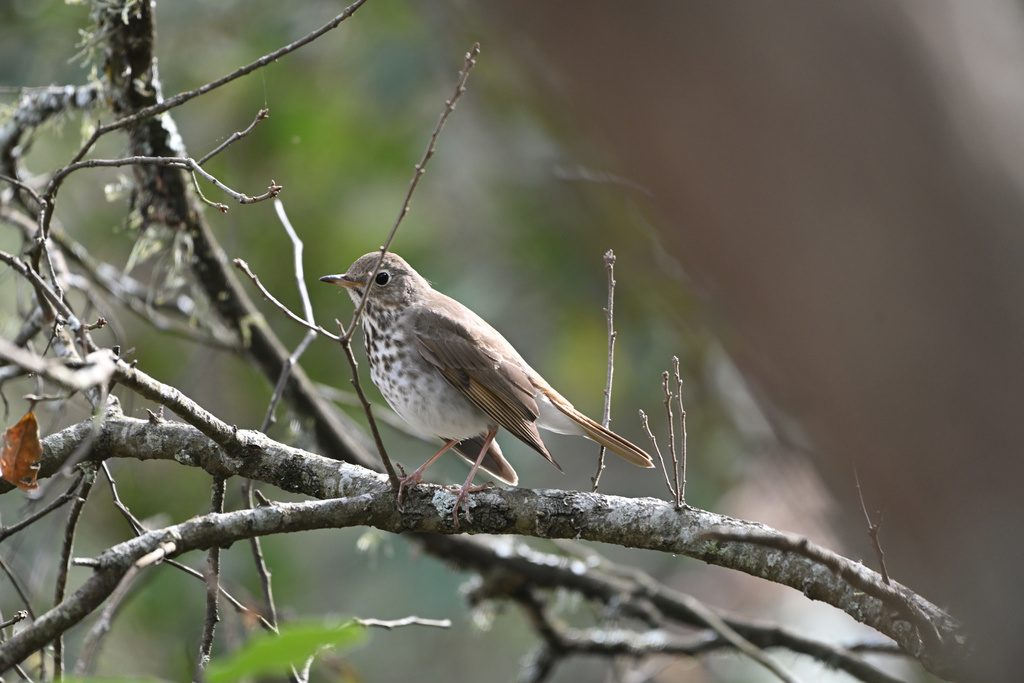
Identification
The hermit thrush is a compact, stocky thrush measuring 15–18 cm in length with a wingspan of 25–30 cm. It is distinguished by its reddish tail, olive-brown to grey-brown upperparts (depending on geography), and white underparts spotted with dark markings on the breast and flanks. A prominent white eye ring and pink legs are useful field marks. Eastern birds appear more olive-brown, while western populations are greyer-brown. Like other Catharus thrushes, it displays a characteristic white-dark-white underwing pattern. The hermit thrush has relatively longer wings than its congeners, giving it a more streamlined silhouette.
Range & Habitat
Hermit thrushes breed across Canada, southern Alaska, and the northeastern and western United States in coniferous and mixed woodlands. They are highly migratory, with most populations moving to wintering grounds in the southern United States and Central America. However, some birds remain year-round in northern coastal US states and southern Ontario, making the hermit thrush the only spotted thrush normally found in North America during winter. The species is a very rare vagrant to western Europe and northeast Asia. Outside breeding season, they inhabit parks and wooded suburban neighborhoods in addition to forest habitats.
Behaviour & Diet
Hermit thrushes are ground and low-level foragers, searching the forest floor, trees, and shrubs for food. Their diet consists primarily of insects and berries. The species is renowned for its extraordinary song—often described as "the finest sound in nature." The ethereal, flute-like vocalization begins with a single note followed by several descending musical phrases in a minor key, repeated at different pitches. Remarkably, analysis reveals that the song's notes are related by simple integer pitch ratios similar to human music, a feature unique among bird songs studied. Hermit thrushes typically sing from high, open perches.
Best Time & Places to See It
Breeding birds can be found in coniferous and mixed forests across their northern range during spring and summer. In winter, focus your search on the southern United States and Central America where the majority migrate, or in northern coastal areas where some populations remain year-round. The hermit thrush's distinctive song is easiest to locate during the breeding season, when males sing regularly from exposed perches. Winter birding in the southern US offers reliable encounters, as the hermit thrush is the only spotted thrush present during this season.
Photography Tips
The hermit thrush's subtle plumage requires careful exposure metering to capture detail in both the brown upperparts and spotted underparts. The reddish tail is a key identifying feature—position yourself to catch this characteristic coloration in flight or when the bird flicks its tail. The white eye ring provides good contrast and should be in sharp focus. Early morning light in forest settings renders the bird's warm tones beautifully. Patient positioning near singing males during breeding season can yield images of birds in characteristic high, exposed singing postures. For flight shots, capture the white-dark-white underwing pattern when the bird flushes from the forest floor.
Tombstone Territorial Park
Acadia National Park
Alaska Maritime National Wildlife Refuge
Algonquin Provincial Park
Alligator River National Wildlife Refuge
Arches National Park
Arctic National Wildlife Refuge
Banff National Park
Bear River Migratory Bird Refuge
Nothing matches these filters.
No community photos yet. Log in to add the first one.
No community observations of this species yet.