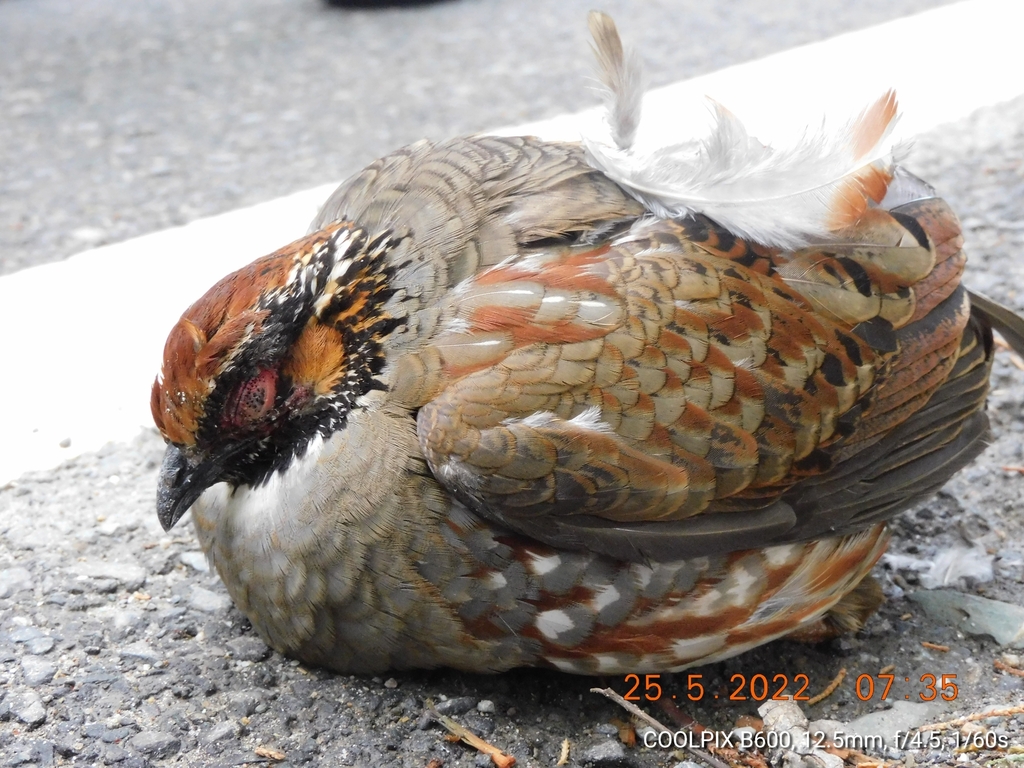
Hill Partridge
Photo © Jagdish Singh Negi
Photo © Jagdish Singh Negi — CC BY 4.0 — Source: iNaturalist #123908511Identification
The Hill Partridge is a small pheasant, measuring roughly 27–30 cm in length, with males and females displaying distinctly different plumage. Males are particularly striking, featuring an ornate pattern with an orange crown and face that contrasts sharply against a black head and streaked throat—hence the alternative name "necklaced hill partridge." Females lack these distinctive head markings entirely, instead showing a grey chest and upper belly, with white feathers streaked in ginger-brown extending across the flanks and belly. Weight varies considerably, from around 230 g in small females to 390 g in large males. Four subspecies have been identified based on subtle differences in male head markings, with five subspecies recognized in total across the species' range.
Range & Habitat
The Hill Partridge is found across a narrow band stretching from the western Himalayas to northern Vietnam, occurring in India, Nepal, Bhutan, Tibet, Myanmar, Thailand, and Vietnam. The species is not globally threatened and remains common throughout most of its range. It inhabits subtropical and tropical moist lowland forests as well as subtropical and tropical moist montane forests, showing a preference for forested terrain across varying elevations.
Behaviour & Diet
Hill Partridges are typically observed in pairs or small coveys numbering up to ten individuals, which often consist of family groups. They feed primarily on seeds and various invertebrates, which they collect by scratching through leaf litter in their forest habitat. While feeding, they constantly utter a hen-like contact call. Indian populations breed between April and June, with earlier breeding recorded at lower altitudes. Clutch sizes typically range from 3 to 5 eggs, though clutches of up to nine eggs have been documented in captivity. The eggs are white, and captive birds show an incubation period of 24 days. Nests are constructed from whatever manageable materials lie within a few feet of the nest site, with a lined shallow scrape at the centre, usually situated within low-growing vegetation or among roots.
Best Time & Places to See It
The breeding season from April to June offers good opportunities to locate Hill Partridges, particularly in India and other parts of the Himalayan foothills, as birds are more vocal and active during this period. The species' preference for moist montane and lowland forests means that forested hill stations and protected forest areas across its range—from the western Himalayas through Nepal, Bhutan, and into Southeast Asia—provide the best viewing locations. Early mornings when the birds are most active and calling offer the best chances of encounter.
Photography Tips
The Hill Partridge's small size and preference for dense forest undergrowth make it a challenging subject for photographers. The striking plumage patterns of males—particularly the contrasting orange and black head markings—are worth capturing, but patience and stillness are essential. Focus on areas of low vegetation and leaf litter where birds are most likely to be feeding and scratching. Their constant contact calls while feeding can help locate birds, allowing you to position yourself for photography. Early morning light filtering through the forest canopy will best showcase the males' ornate patterns and colourful markings.
Langtang National Park
Helambu, Nepal
+364 birds+14 mammals
Where the southern slopes of the Himalayan highlands descend toward the subtropical valleys of central Nepal, Langtang National Park sprawls across one of the subcontinent's most…
VIEW NATIONAL PARKKhangchendzonga National Park
Sakkyong, India
+290 birds+1 mammals
Where the eastern Himalayas surge toward their crowning peaks, Khangchendzonga National Park embraces a landscape of almost overwhelming vertical drama. Rising from subtropical river valleys into…
VIEW NATIONAL PARKNanda Devi National Park
Garpak, India
+218 birds+5 mammals
Where the Himalayas surge into their most dramatic alpine amphitheater, a wilderness of raw geological power unfolds across 624 square kilometers of pristine terrain. Nanda Devi,…
VIEW NATIONAL PARKGaoligong Mountain National Nature Reserve
Nujiang Lisu Autonomous Prefecture, China
+443 birds+13 mammals
VIEW NATURE RESERVENo community photos yet. Log in to add the first one.
No community observations of this species yet.