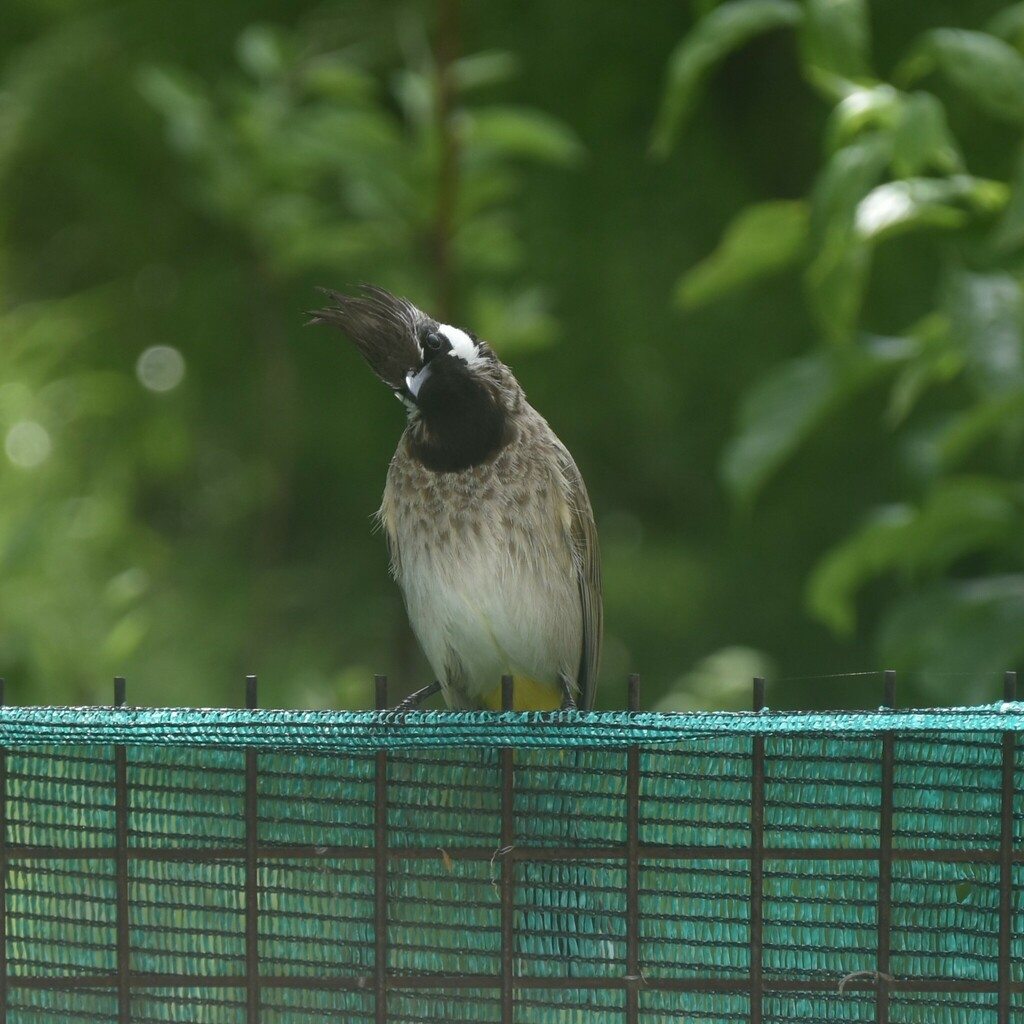
Himalayan Bulbul
Photo © Name
Photo © Name — CC BY 4.0 — Source: iNaturalist #163628819Identification
The Himalayan bulbul, also known as the white-cheeked bulbul, is a compact songbird measuring about 18 cm in length with a wingspan of 25.5–28 cm and an average weight of 30 g. Its most distinctive feature is its striking head pattern: black and white plumage on the head, throat, and prominent crest. The back, sides, and notably long tail are warm brown, while the underside is pale yellow. Males and females are similar in appearance, making field identification straightforward once you've spotted the characteristic crest and facial markings.
The species is perhaps best identified by its remarkable song—a beautiful four-part whistle that accelerates in tempo, resembling an oriole's call. This melodious vocalization is often your best clue to the bird's presence, particularly during breeding season when males are vocal and territorial.
Range & Habitat
The Himalayan bulbul is found across the northern regions of the Indian subcontinent and adjoining areas, with its range centered in and around the Himalayas. This distribution makes it an excellent target species for travellers exploring the foothills and middle elevations of this vast mountain range.
The species frequents forests and shrubland habitats, but is equally comfortable in human-modified landscapes. Look for it in gardens and parks throughout its range, making it accessible to birdwatchers visiting both remote and more developed areas. Its adaptability to varied habitats increases your chances of encounter during a Himalayan expedition.
Behaviour & Diet
Himalayan bulbuls are active foragers with an omnivorous diet. They feed on insects and other small invertebrates, supplemented with berries, fruits, seeds, buds, and nectar. This dietary flexibility means you're likely to see them gleaning insects from foliage or probing flowers for nectar, often in small groups or pairs.
During the breeding season, these birds become highly territorial and vocal. They construct neat cup-shaped nests in bushes or low branches using stems, roots, and twigs. Females typically lay three eggs, which hatch after 12 days of incubation. Young fledge after 9–11 days in the nest, and pairs may raise up to three broods per year, providing extended opportunities for observation and photography during the breeding months.
Best Time & Places to See It
The breeding season offers the best chance to locate and observe Himalayan bulbuls, as territorial males are vocal and conspicuous. Search for them in foothill forests, mixed scrub, and gardens throughout the Himalayan region of the Indian subcontinent. Dawn and late afternoon typically yield the most activity and song.
While the species is fairly common within its range, patience and good listening skills are essential. Focus on areas with fruiting trees and flowering shrubs, where feeding birds are predictable. Local guides familiar with Himalayan birdlife can significantly improve your chances of locating this rewarding species.
Photography Tips
The Himalayan bulbul's striking black-and-white head pattern and raised crest make it photogenic, especially in good light. Position yourself to capture the distinctive facial markings and crest detail—a 300–500mm lens is ideal for getting frame-filling portraits. Early morning light works best for revealing the contrast between the dark head and pale underparts.
Behaviour photography opportunities abound: capture the bird foraging in fruiting trees, singing from an exposed perch, or visiting flowers. The species' relatively small size and preference for dense vegetation can present focusing challenges, so use continuous autofocus and be prepared with a fast shutter speed. Patient stalking of singing males during breeding season often yields excellent results.
Langtang National Park
Helambu, Nepal
+364 birds+14 mammals
Where the southern slopes of the Himalayan highlands descend toward the subtropical valleys of central Nepal, Langtang National Park sprawls across one of the subcontinent's most…
VIEW NATIONAL PARKValmiki National Park
Ramnagar, India
+66 birds+6 mammals
Along Bihar's western frontier, where the Gandak River winds through subtropical forest and grassland, Valmiki National Park sprawls across terrain shaped by monsoon rains and seasonal…
VIEW NATIONAL PARKGangotri National Park
Bhatwari, India
+119 birds+1 mammals
Where the Bhagirathi River carves through the western Himalayas in northern Uttarakhand, Gangotri National Park rises across steep alpine terrain that defines the boundary between temperate…
VIEW NATIONAL PARKSagarmatha National Park
Khumjung, Nepal
+219 birds+7 mammals
Soaring peaks and deep glacial valleys define this alpine wilderness in northeastern Nepal, where the terrain rises from forested foothills into a realm of high-altitude tundra…
VIEW NATIONAL PARKKhangchendzonga National Park
Sakkyong, India
+290 birds+1 mammals
Where the eastern Himalayas surge toward their crowning peaks, Khangchendzonga National Park embraces a landscape of almost overwhelming vertical drama. Rising from subtropical river valleys into…
VIEW NATIONAL PARKNanda Devi National Park
Garpak, India
+218 birds+5 mammals
Where the Himalayas surge into their most dramatic alpine amphitheater, a wilderness of raw geological power unfolds across 624 square kilometers of pristine terrain. Nanda Devi,…
VIEW NATIONAL PARKValley of Flowers National Park
Ghangaria, India
+117 birds+1 mammals
Where alpine meadows explode with color each monsoon season, the Himalayan slopes of Uttarakhand rise to create one of Earth's most extraordinary floral displays. Perched between…
VIEW NATIONAL PARKNo community photos yet. Log in to add the first one.
No community observations of this species yet.