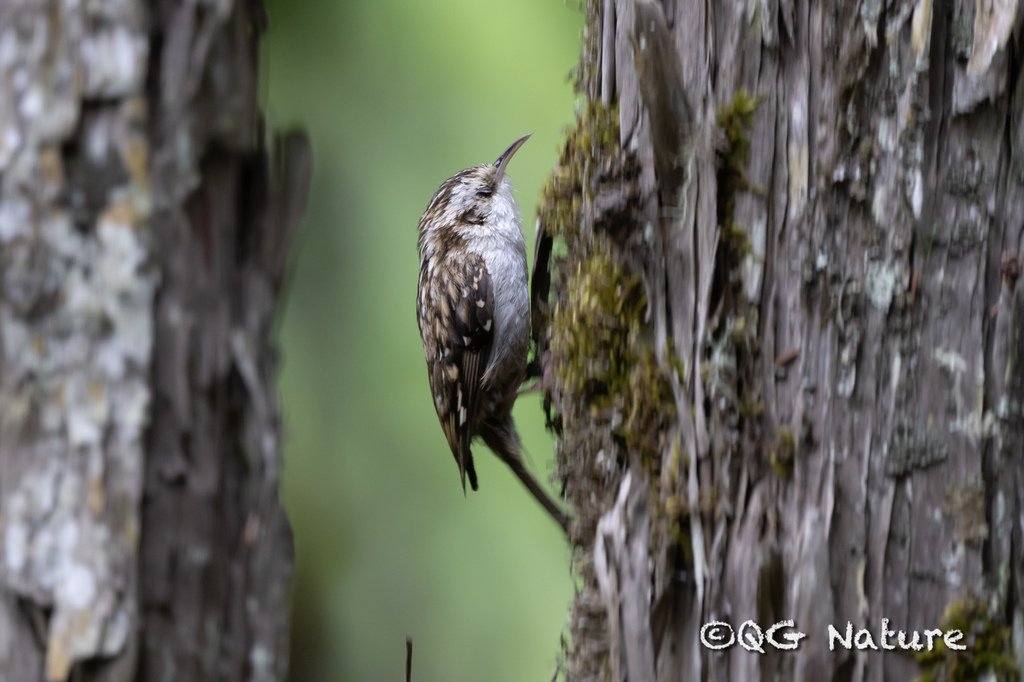
Hodgson’s Treecreeper
Photo © Wang.QG
Photo © Wang.QG — CC BY 4.0 — Source: iNaturalist photo #391099616Identification
Hodgson's Treecreeper is a small passerine, measuring 12.5 cm in length, with a fairly drab appearance that belies its subtle charm. It is brownish with lighter and darker streaks above, while below and on the supercilium it appears off-white. Compared to the Common Treecreeper, this species is notably browner overall, distinguished by a contrasting rufous rump. Like other treecreepers, it possesses a long curved bill and long stiff tail feathers—adaptations essential for its specialised climbing lifestyle.
The species has a distinctive song that begins with two characteristic shree calls, followed by one or a few warbling notes and usually two up- and downslurring notes, taking 2 to 2.5 seconds in total. The song drops in pitch at a constant rate, from around 7.5 kHz initially down to 6 kHz and slurring to 4 kHz by the end, providing a useful audio identification clue in the field.
Range & Habitat
Hodgson's Treecreeper is found across the southern rim of the Himalayas, with populations in Bhutan, China, India, Myanmar, Nepal, and Pakistan. Three subspecies are recognised: C. h. hodgsoni from northern Pakistan to northwest India; C. h. mandellii from Nepal, Bhutan, and northeast India; and C. h. khamensis (the Kham Treecreeper) from southwest China, Myanmar, and possibly northeast India.
The species inhabits temperate to cool tropical montane forests, showing a strong preference for coniferous woodlands. It is mostly resident, though in winter it may move downhill to oak and rhododendron woodlands. In Bhutan, for example, the mandellii subspecies is found year-round in moist Bhutan fir forests between approximately 3,000 and 4,000 metres above sea level.
Behaviour & Diet
True to its name, Hodgson's Treecreeper spends much of its time creeping methodically up vertical tree trunks in search of arthropod prey. Its stiff tail feathers serve as a crucial aid during this climbing behaviour, providing support and leverage as the bird forages. The species nests in tree crevices, a typical treecreeper strategy that offers good protection for eggs and young.
Breeding pairs produce clutches of 4–6 reddish-brown blotched pinkish-white eggs, representing a typical reproductive effort for the family. The species is relatively sedentary, with limited seasonal movements beyond altitudinal shifts in response to winter conditions.
Best Time & Places to See It
Hodgson's Treecreeper is not uncommon throughout its range and can be encountered year-round in suitable habitat. The species is equally common as its northern relatives, making it a consistent target for the dedicated observer. In Bhutan, montane fir forests between 3,000 and 4,000 metres offer reliable viewing opportunities, particularly during the breeding season when birds are more vocal and active.
Winter movements to lower elevations in oak and rhododendron zones may present additional opportunities, depending on location. The bird's status as a Species of Least Concern reflects its stability across its range, despite long-term habitat fragmentation concerns in some regions.
Photography Tips
Photographing Hodgson's Treecreeper requires patience and a telephoto lens, as these small, active birds are constantly in motion along tree trunks. Early morning light in montane forests provides the best conditions for capturing the subtle plumage details, particularly the contrasting rufous rump that helps distinguish it from related species. Position yourself with the light behind or to the side to illuminate the bird's streaking.
The bird's habit of creeping upward along trunks and branches offers predictable movement patterns that experienced photographers can exploit. Including the characteristic stiff tail feathers in the frame adds behavioural interest to images. In Bhutan's fir forests, the cool morning light at higher elevations produces particularly pleasing results for this montane specialist.
Langtang National Park
Helambu, Nepal
+364 birds+14 mammals
Where the southern slopes of the Himalayan highlands descend toward the subtropical valleys of central Nepal, Langtang National Park sprawls across one of the subcontinent's most…
VIEW NATIONAL PARKGangotri National Park
Bhatwari, India
+119 birds+1 mammals
Where the Bhagirathi River carves through the western Himalayas in northern Uttarakhand, Gangotri National Park rises across steep alpine terrain that defines the boundary between temperate…
VIEW NATIONAL PARKSagarmatha National Park
Khumjung, Nepal
+219 birds+7 mammals
Soaring peaks and deep glacial valleys define this alpine wilderness in northeastern Nepal, where the terrain rises from forested foothills into a realm of high-altitude tundra…
VIEW NATIONAL PARKKhangchendzonga National Park
Sakkyong, India
+290 birds+1 mammals
Where the eastern Himalayas surge toward their crowning peaks, Khangchendzonga National Park embraces a landscape of almost overwhelming vertical drama. Rising from subtropical river valleys into…
VIEW NATIONAL PARKGiant Panda National Park
Mianyang, China
+447 birds+47 mammals
Where the eastern slopes of China's Sichuan plateau descend into cloud-wrapped valleys, one of Asia's most biodiverse landscapes unfolds across more than 350,000 square kilometres. This…
VIEW NATIONAL PARKJiuzhai Valley
Jiuzhaigou County, China
+226 birds+7 mammals
Where crystalline alpine streams cascade through limestone gorges and karst terrain rises in dramatic vertical walls, Jiuzhai Valley unfolds across nearly 1,300 square kilometers of southwestern…
VIEW NATURAL MONUMENTHuanglong Scenic and Historic Interest Area
Ngawa Tibetan and Qiang Autonomous Prefecture, China
+194 birds+7 mammals
Across the high plateau of northwestern Sichuan, a geological wonder unfolds where limestone terraces and mineral-rich springs have sculpted one of China's most distinctive natural monuments.…
VIEW NATURAL MONUMENTNanda Devi National Park
Garpak, India
+218 birds+5 mammals
Where the Himalayas surge into their most dramatic alpine amphitheater, a wilderness of raw geological power unfolds across 624 square kilometers of pristine terrain. Nanda Devi,…
VIEW NATIONAL PARKSanjiangyuan National Park
Nagqu, China
+187 birds+25 mammals
Where the headwaters of three great Asian rivers emerge from a high alpine plateau, the landscape unfolds in tundra and dwarf shrubland—a world of austere beauty…
VIEW NATIONAL PARKWolong National Nature Reserve
Wenchuan County, China
+333 birds+17 mammals
Where the Qingyi River cuts through the eastern flanks of the Minshan Range, a temperate montane forest cloaks steep valleys in dense canopy that thins dramatically…
VIEW NATURE RESERVEBaima Snow Mountain National Nature Reserve
Diqing Tibetan Autonomous Prefecture, China
+204 birds+3 mammals
High-altitude ridges and steep-sided valleys define this reserve in northwestern Yunnan, where elevations surge from around 3,000 metres to peaks above 4,100 metres. The terrain supports…
VIEW NATURE RESERVENo community photos yet. Log in to add the first one.
No community observations of this species yet.