Horned Screamer
Photo © desertnaturalist
Photo © desertnaturalist — CC BY 4.0 — Source: iNaturalist #140688217Identification
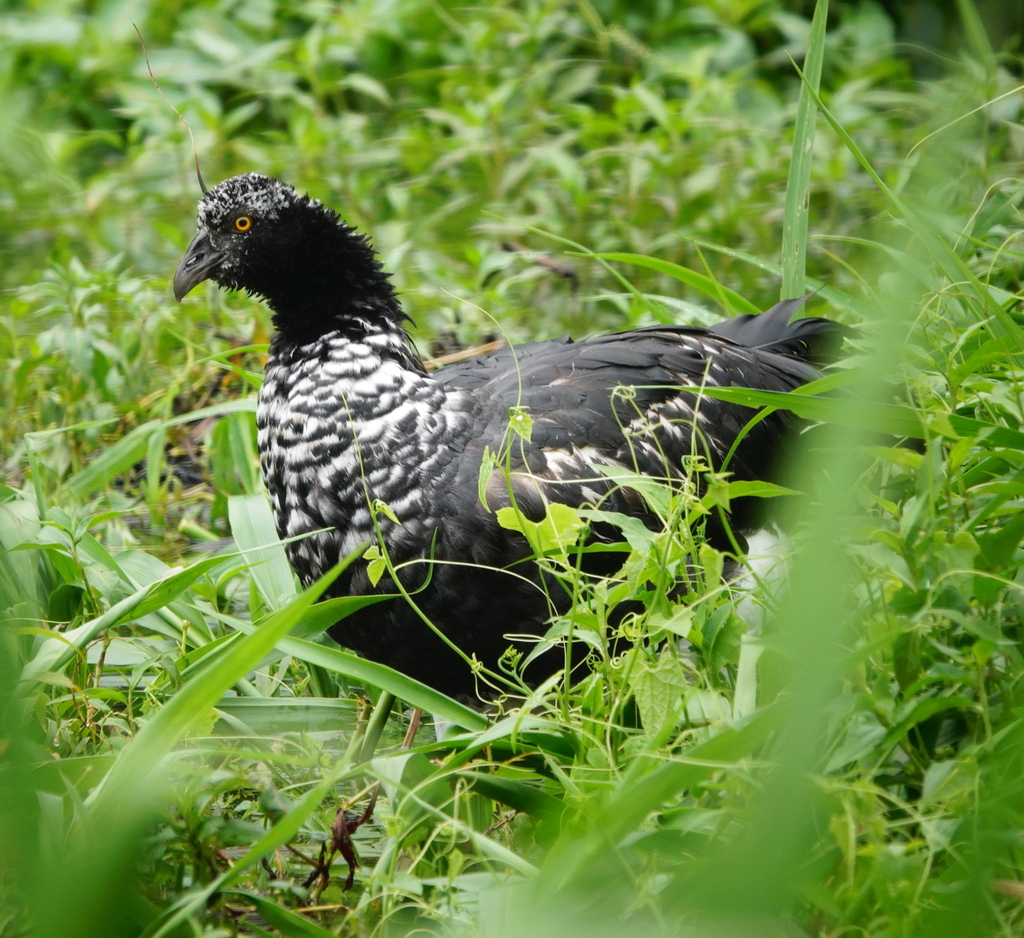
The Horned Screamer is a massive bird, measuring 84–95 cm in length and weighing around 3.5 kg, making it one of the largest members of its family. Despite its size, it has a surprisingly small, chicken-like bill that distinguishes it from its relatives in the duck and goose family. The plumage is striking: the upperparts, head, and breast are predominantly black, adorned with white speckles on the crown, throat, and wing coverts, while the belly and under-wing coverts are white. The most distinctive feature is the long, spiny structure projecting forward from the crown—a unique ornament among all birds. This cornified structure is not a feather but rather a specialized growth that is loosely attached to the skull and grows continuously, often breaking at the tip.
The bird's legs are notably long and lanky, with three large toes on each foot that are only partially webbed. Perhaps most impressively, it possesses two sharp spurs on its wings and feet—formidable weapons that hint at a more aggressive nature than its waterfowl cousins. These physical characteristics make the Horned Screamer instantly recognizable in its wetland habitat.
Range & Habitat
The Horned Screamer is found throughout the lowlands of tropical South America, with a range that includes Colombia, Venezuela, Brazil, Bolivia, Peru, Ecuador, French Guiana, Suriname, and Guyana. It has possibly been extirpated from Trinidad. Despite some local declines, the species remains widespread and fairly common overall, with its range in Brazil appearing to have expanded in recent years.
This species is strictly a wetland bird, preferring well-vegetated marshes where it can find abundant aquatic plants. Its dependence on these specific habitats makes it a reliable indicator of healthy freshwater wetland ecosystems across its South American range.
Behaviour & Diet
The Horned Screamer is a largely sedentary bird, spending most of its time in its favored marshes rather than undertaking long migrations. Like most screamers, it is semi-social and tends to group together with other individuals, though it is not particularly gregarious. The species is primarily herbivorous, feeding almost exclusively on water plants found in its marsh habitat.
True to its name, the Horned Screamer produces a very loud and repetitive echoing call that carries far across the wetlands. In Ecuador, locals call this distinctive sound "el clon-clon" because of its peculiar, echoing quality—a memorable soundtrack to any visit to its habitat.
Best Time & Places to See It
The Horned Screamer's sedentary nature means it can be found year-round in suitable wetland habitats throughout its range. The species is the official bird of the Department of Arauca and the Municipality of Arauca in Colombia, as well as a symbol of the National Reserve of Churute in Ecuador, making these locations prime destinations for travellers seeking this remarkable bird. Its widespread presence across the lowlands of northern South America offers multiple opportunities for observation throughout the region.
Photography Tips
Photographing the Horned Screamer presents excellent opportunities for distinctive wildlife images. The bird's large size, bold black-and-white plumage pattern, and unique crown spike make it highly photogenic against the vegetation of marshes and wetlands. Its semi-social behavior means patient photographers may encounter small groups, providing opportunities for varied compositions. The bird's loud calls will often alert you to its presence before visual contact is made, allowing you to move into position. Early morning visits to well-vegetated marshes will offer the best light and highest activity levels for capturing this remarkable South American species.
Emas National Park
Brazil
+333 birds+23 mammals
Across the high plateaux of central Brazil, where the cerrado grasslands roll toward distant horizons under an immense sky, Emas National Park anchors one of South…
VIEW NATIONAL PARKYasuní National Park
Aguarico, Ecuador
+601 birds+43 mammals
Where the western Amazon basin converges with Ecuador's Orellana Province, lowland rainforest reaches toward the horizon in an unbroken canopy of staggering botanical density. Yasuní National…
VIEW NATIONAL PARKAntisana National Park
Quijos, Ecuador
+432 birds+21 mammals
Where the eastern Andean slopes descend into the Amazon basin, Antisana National Park sprawls across roughly 2,500 square kilometers of some of South America's most dramatic…
VIEW NATIONAL PARKNatural Sierra de Chiribiquete National Park
Solano, Colombia
+359 birds+27 mammals
Massive table-top mountains rise abruptly from the lowland rainforest of southeastern Colombia, their sheer sandstone cliffs and isolated summits creating some of the most dramatic topography…
VIEW NATIONAL PARKNatural Sierra de la Macarena National Park
Vista Hermosa, Colombia
+566 birds+15 mammals
Across nearly 20,000 square kilometres of Colombia's Meta Department, the terrain rises from lowland savanna into Andean foothills through a mosaic of gallery forests, palm-fringed wetlands,…
VIEW NATIONAL PARKAmacayacu National Park
Leticia, Colombia
+567 birds+25 mammals
Where the Rio Amazonas curves through the tri-border region where Colombia, Peru, and Brazil converge, Amacayacu National Park sprawls across more than 5,250 square kilometres of…
VIEW NATIONAL PARKIlha Grande National Park
Brazil
+233 birds
Across the subtropical plateaus and Atlantic forest remnants of southern Brazil, a vast protected landscape spanning nearly 4,600 square kilometers safeguards one of the continent's most…
VIEW NATIONAL PARKChapada dos Guimarães National Park
Brazil
+450 birds+1 mammals
Where weathered sandstone plateaus rise above the cerrado grasslands of central Brazil, Chapada dos Guimarães National Park protects 624 square kilometres of ecological transition zone that…
VIEW NATIONAL PARKChapada dos Veadeiros National Park
Brazil
+324 birds+6 mammals
Where granite plateaus rise above the cerrado savanna in central Brazil, Chapada dos Veadeiros National Park unfolds across 6,665 square kilometres of some of the world's…
VIEW NATIONAL PARKPantanal Matogrossense National Park
Brazil
+322 birds+17 mammals
Where the flooded forests of central Brazil meet vast seasonally inundated grasslands, Pantanal Matogrossense National Park sprawls across nearly 2,900 square kilometers of one of the…
VIEW NATIONAL PARKChapada Diamantina National Park
Brazil
+346 birds+5 mammals
Where granite peaks and sandstone cliffs rise abruptly from the Brazilian interior, Chapada Diamantina National Park sprawls across 4,215 square kilometers of some of Brazil's most…
VIEW NATIONAL PARKAmazônia National Park
Brazil
+439 birds+6 mammals
Where the Rio Amazonas and its tributaries weave through the heart of Pará state, a vast tapestry of rainforest stretches across 23,611 square kilometers of unbroken…
VIEW NATIONAL PARKJaú National Park
Brazil
+354 birds+3 mammals
Vast floodplain forests and blackwater rivers define this remote corner of western Amazonas, where the Rio Negro and its tributaries have carved an intricate mosaic of…
VIEW NATIONAL PARKPacaás Novos National Park
Brazil
+279 birds+1 mammals
Across the border between Rondônia and Amazonas, vast tracts of humid tropical forest rise and fall in gentle undulations, carved by clear-flowing rivers that feed into…
VIEW NATIONAL PARKAnavilhanas National Park
Brazil
+468 birds+8 mammals
Across the Rio Negro in central Amazonas, an archipelago of over a thousand islands rises from the world's largest rainforest river system, creating a labyrinth of…
VIEW NATIONAL PARKManu National Park
Manu, Peru
+892 birds+26 mammals
Across the eastern slopes of the Peruvian Andes, tropical rainforest descends into the Amazon basin with a complexity that few terrestrial ecosystems match. Manu National Park…
VIEW NATIONAL PARKSierra del Divisor National Park
Alto Tapiche, Peru
+298 birds+2 mammals
Where the western Amazon meets the Andes foothills, nearly 41,000 square kilometres of pristine rainforest rise across Peru's Alto Tapiche region in a landscape of extraordinary…
VIEW NATIONAL PARKBahuaja Sonene National Park
San Pedro de Putina Punco, Peru
+602 birds+8 mammals
Where the Madre de Dios and Heath rivers converge in southeastern Peru rises one of South America's most biodiverse wilderness regions: a vast protected realm of…
VIEW NATIONAL PARKCordillera Azul National Park
Pampa Hermosa, Peru
+322 birds+1 mammals
Where the eastern Andes descend into the western Amazon basin, Cordillera Azul National Park sprawls across nearly 38,000 square kilometres of some of Peru's most pristine…
VIEW NATIONAL PARKNo community photos yet. Log in to add the first one.
No community observations of this species yet.