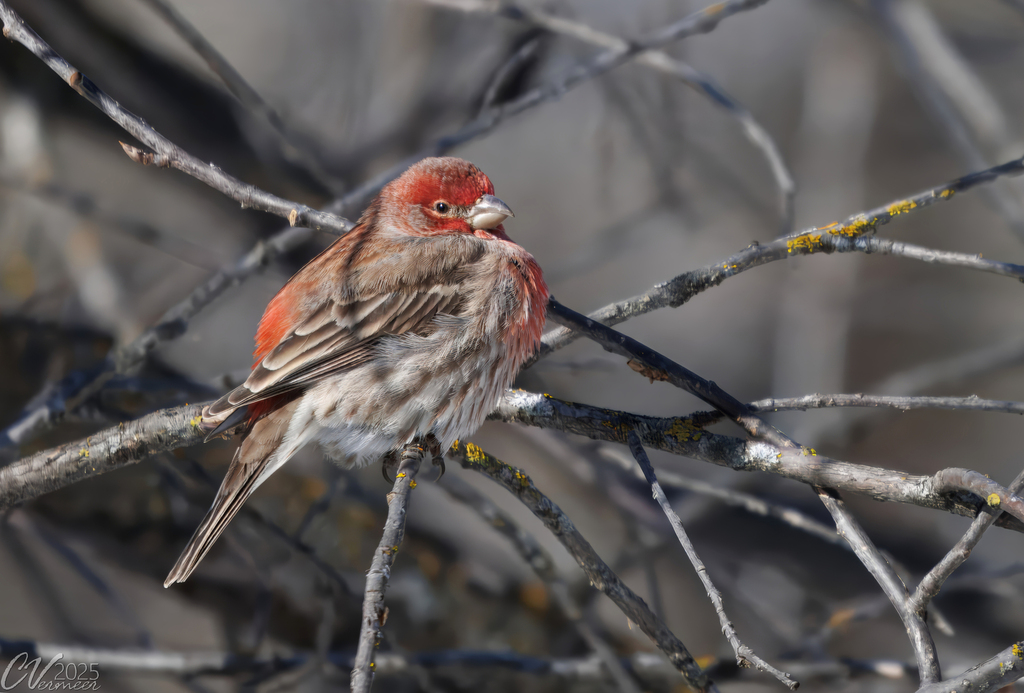
House Finch
Photo © Carol Ann Vermeer
Photo © Carol Ann Vermeer — CC BY 4.0 — Source: iNaturalist photo #488101039Identification
The house finch is a moderate-sized finch measuring 5 to 6 inches long with a wingspan of 8 to 10 inches. Adults display a long, square-tipped brown tail and dull-brown plumage across the back with deeper gray shading on the wing feathers. The breast and belly are typically streaked, particularly on the flanks.
Males are distinguished by reddish coloration on the head, neck, and shoulders, which may extend to the belly and back. The intensity of male coloration varies seasonally and by diet, ranging from pale straw-yellow through bright orange to deep red. Females have brown upperparts with streaked underparts. The house finch's song consists of high-pitched musical jumbles ending with a distinct wheer note; flight calls are soft cheet or wheat sounds.
Range & Habitat
Originally native to Mexico and the southwestern United States, house finches have dramatically expanded their range since the 1940s when birds were illegally released in New York City. Today they are found year-round across almost all of the United States and most of Mexico, with breeding grounds extending well into Canada as far north as northern Alberta. They also inhabit all major Hawaiian islands except Niʻihau and Kahoʻolawe. House finches are primarily permanent residents, though some birds migrate southward, with adult females typically traveling longer distances than males.
The species favors urban and suburban areas throughout North America, as well as semi-open habitats in the west from southern Canada to Oaxaca, Mexico. Analyses spanning over a century show that egg-laying occurs significantly earlier during warmer springs. With an estimated 40 million birds across North America, the house finch is the second-most populous finch species on the continent.
Behaviour & Diet
House finches forage on the ground or in vegetation, primarily consuming grains, seeds, and berries. They are voracious consumers of weed seeds such as nettle and dandelion, and also take incidental small insects like aphids. These birds are frequent visitors to bird feeders year-round, particularly favoring sunflower and nyjer seed, and readily congregate at hanging nyjer sock feeders. While they may damage orchard fruit and consume commercially grown grain, they are generally considered an annoyance rather than a significant pest.
Breeding occurs from February through August, with females typically raising two or more broods annually of 2 to 6 eggs per brood. Nests are constructed in cavities including building openings, hanging plants, and decorative structures, usually 6 to 9 feet above ground. During courtship, males touch bills with females and present food; males continue feeding females throughout breeding and incubation, and are the primary feeders of fledglings. Females are typically attracted to males with the deepest red head coloration.
Best Time & Places to See It
House finches are year-round residents throughout most of their range, making them accessible to observe in any season. Urban and suburban gardens, particularly those with bird feeders stocked with nyjer or sunflower seed, offer reliable viewing opportunities. In the western United States, semi-open habitats and scrublands provide good sightings. Spring is an excellent season for observing breeding behavior and courtship displays. Look for small flocks gathering at feeders or foraging on the ground in open areas.
Photography Tips
The male's vibrant red plumage provides striking photographic subjects, particularly in good natural light where the coloration is most vivid. Capture courtship behavior at close range during the breeding season from February through August. Bird feeders offer excellent opportunities for intimate portraits and behavioral shots, especially when using nyjer sock feeders that attract birds to predictable positions. The contrast between colorful males and streaked females makes for dynamic compositions. Early morning light best highlights the red pigmentation in males and reveals the delicate streaking patterns in females and immatures.
Acadia National Park
Algonquin Provincial Park
Arches National Park
Badlands National Park
Banff National Park
Bear River Migratory Bird Refuge
Bic National Park
Big Bend National Park
Biscayne National Park
Nothing matches these filters.
No community photos yet. Log in to add the first one.
No community observations of this species yet.