House Sparrow
Passer domesticus
Photo © Esteban Poveda
Photo © Esteban Poveda — CC BY 4.0 — Source: iNaturalist photo #136543105ABOUT
Subspecies of House Sparrow
European house sparrowIndian House SparrowMediterranean House SparrowEast Mediterranean House SparrowNorth-west African House SparrowTurkestan House SparrowKashmir House SparrowEgyptian House SparrowPasser domesticus rufidorsalisPasser domesticus hufufaePersian house sparrowPasser domesticus hyrcanus
Identification
The house sparrow is a small, compact bird typically measuring 16 cm (6.3 in) long and weighing 24–39.5 g (0.85–1.39 oz). It has a full chest, large rounded head, and a stout, conical bill—an adaptation for cracking seeds. The tail is short and the wingspan ranges from 19–25 centimetres.
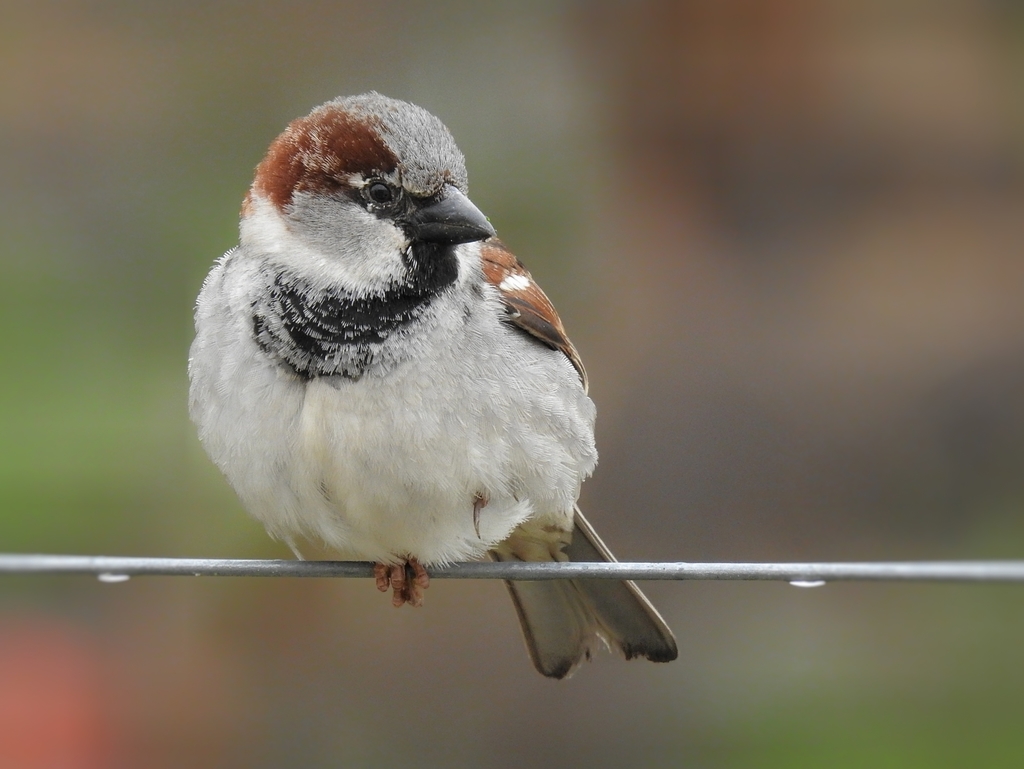
Sexual dimorphism is striking. Males display bold black, white, and brown markings with a dark grey crown, chestnut-brown flanks on the head, and black around the bill and throat forming a distinctive "bib" or "badge" that varies in size and may signal social status. Females are predominantly buffish-brown above and below, lacking the male's dramatic head markings. Juveniles resemble females but are deeper brown below, with lighter bills (yellow to straw-coloured) that darken with age. Young birds cannot always be reliably sexed by plumage alone, and immature males acquire adult markings gradually by their first breeding season.
Range & Habitat
Native to most of Europe, the Mediterranean Basin, and large parts of Asia, the house sparrow has become the world's most widely distributed wild bird through both intentional and accidental introduction to Australasia, Africa, and the Americas. It is strongly associated with human habitation and thrives in urban and rural settings across widely varied habitats and climates.
The species typically avoids extensive woodlands, grasslands, polar regions, and hot, dry deserts remote from human development, preferring areas where people have settled. This dependence on human proximity is fundamental to its ecological niche and global success.
Behaviour & Diet
House sparrows are opportunistic, omnivorous feeders. While they naturally consume seeds from grains, flowering plants, and weeds, they readily catch invertebrates including insects, larvae, and caterpillars. They frequently visit home and public bird feeding stations, making them familiar to many travellers.
Most vocalisations are variations on short, frequent chirping calls transcribed as "chirrup," "tschilp," or "philip." Males use these calls to proclaim nest ownership and invite pairing, repeating them with emphasis during breeding season in what resembles an "ecstatic call" or song. Young birds also produce warbling vocalisations, particularly in captivity.
Best Time & Places to See It
House sparrows are ubiquitous and abundant wherever humans have settled—around towns, villages, farms, markets, and gardens across most of the world. They can be observed year-round in virtually any inhabited area, from city centres to rural homesteads. Their association with human food sources and nesting sites makes them remarkably predictable and accessible to travellers in nearly every region except polar areas and remote deserts.
Photography Tips
The strong sexual dimorphism of house sparrows offers excellent opportunities for comparative photography. Males' bold black bibs, chestnut crowns, and white cheek markings provide striking contrast and are particularly visible during breeding season when males' bills turn black and plumage wear exposes bright markings. Females' subtle brown and buff tones require careful exposure metering to capture detail. Photograph birds at feeding stations or near nesting sites where they are most active and least wary. Spring and breeding season offer the most vibrant male plumage, while winter birds appear duller with whitish feather tips that soften their markings.
HIDES
Sort by
80 €/ person
Book nowNothing matches these filters.
HOTSPOTS
Country
Type
Sort by
5,0 (1)
National Park
Bwindi Impenetrable National Park
Kanyashogi·Uganda
+603 birds+26 mammals
5,0 (1)
National Park
Kanha Tiger Reserve
Kanha Kisli F.V.·India
+321 birds+23 mammals
5,0 (1)
National Park
Lake Mburo National Park
Uganda
+505 birds+24 mammals
5,0 (1)
Nature Reserve
Mabamba Swamp
Memere·Uganda
+464 birds+2 mammals
5,0 (1)
National Park
Murchison Falls National Park
Uganda
+608 birds+33 mammals
5,0 (1)
National Park
Queen Elizabeth National Park
Uganda
+672 birds+30 mammals
National Park
Abel Tasman National Park
New Zealand
+96 birds+9 mammals
National Park
Aberdare National Park
Mweiga ward·Kenya
+394 birds+30 mammals
National Park
Acadia National Park
Bar Harbor·United States
+291 birds+27 mammals
Nothing matches these filters.
COMMUNITY
Share your photo of this species
Sort by
No community photos yet. Log in to add the first one.
0
Observed by
0
Hotspots reported
0
Countries
No community observations of this species yet.