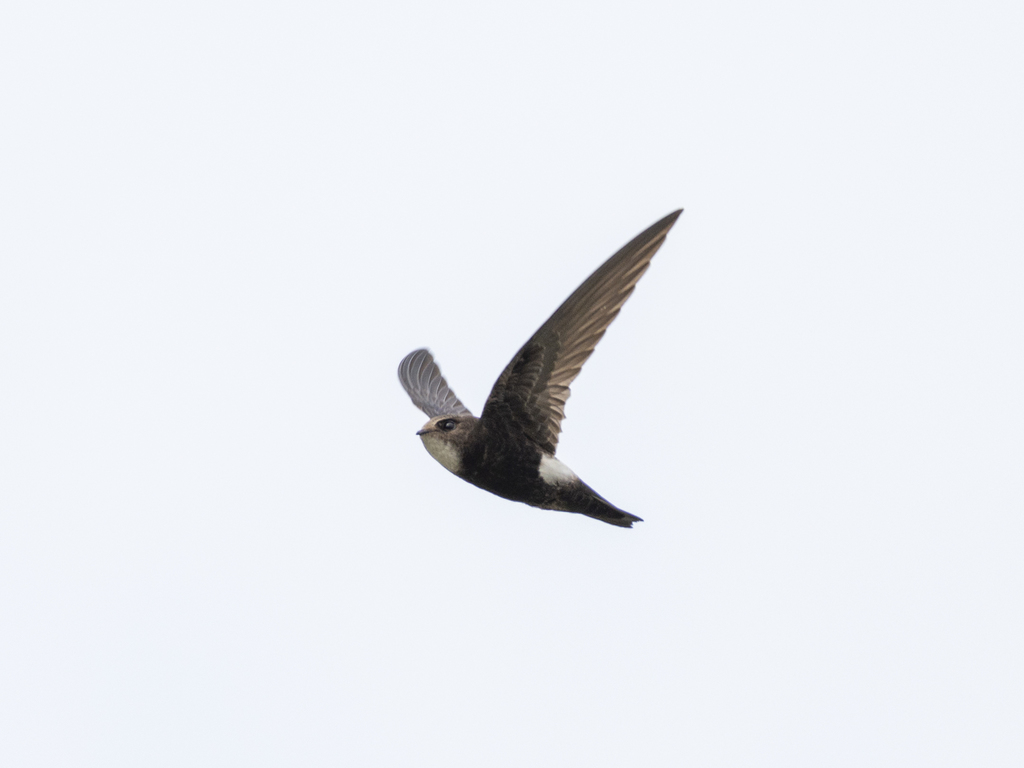
House Swift
Photo © Lawrence Hylton
Photo © Lawrence Hylton — CC BY 4.0 — Source: iNaturalist photo #178646289Identification
The house swift is a small to medium-sized swift with a body length of 14 to 16 cm and wingspan of 12.5–14.5 cm, weighing approximately 20–35 g. It bears a striking resemblance to the little swift, from which it was only recently distinguished as a separate species. The most distinctive features are its predominantly black plumage—darker than that of the little swift—combined with a white rump band and white throat-patch. The bird's tail is dark and slightly forked, adding to its streamlined profile.
Range & Habitat
The house swift is found across much of Asia, with four recognized subspecies occupying different regions. Apus nipalensis nipalensis ranges from Nepal through Southeastern China, Japan, and parts of Southeast Asia, while Apus nipalensis subfurcatus inhabits the Malay Peninsula and nearby islands. Two further subspecies are restricted to Indonesia—Apus nipalensis furcatus on Java and Bali—and Taiwan (Apus nipalensis kuntzi). The species thrives in both urban and rural settings, from mountainous regions in Nepal to cities and towns across China, Vietnam, and Hong Kong.
House swifts are highly aerial birds, spending the majority of their time in flight. They have been recorded in northern Australia and India during winter months, indicating seasonal movements, though migration patterns remain poorly understood. A single unconfirmed record from North America in 2012 remains the only documented occurrence outside Asia.
Behaviour & Diet
House swifts breed in two main habitat types: cliffsides—particularly on offshore islands near Vietnam—and urban areas, where they prefer to nest under roof overhangs or in tunnels. They construct their nests using saliva to bind together leaves, branches, and feathers. The breeding season yields two broods annually, with the first egg-laying period lasting three weeks and fledglings taking flight by early June. The second clutch hatches a few weeks later, with the final young leaving the nest by mid-September. Clutch sizes range from one to five eggs, and incubation lasts 20 to 30 days.
Like other swallows and swifts, house swifts are aerial insectivores, capturing prey in flight. Fecal analysis has revealed that their diet consists almost entirely of arthropods, particularly ants, spiders, mosquitos, and flies. These birds produce a distinctive vocal repertoire, including a characteristic ti-ti-ti-tititrrrrrr call among many other sounds.
Best Time & Places to See It
House swifts are resident or partially migratory throughout their Asian range, making them observable year-round in suitable habitat. The breeding season, running from early spring through mid-September, is the most productive period for observation. Urban populations in Chinese, Vietnamese, and Hong Kong cities offer accessible viewing opportunities, while those seeking a more wilderness experience might target coastal cliff colonies near Vietnam or mountainous regions in Nepal.
Photography Tips
Photographing house swifts presents a genuine challenge due to their aerial lifestyle and rapid, erratic flight patterns. Fast shutter speeds (1/2000 s or faster) and high-speed continuous shooting modes are essential. Early morning and late afternoon, when swifts are most active near roosting and nesting sites, offer the best opportunities. Urban locations with visible nesting sites under building overhangs provide predictable vantage points. A telephoto lens (400mm or longer) will help you frame these small, distant birds effectively. Patience and preparation are crucial—scout locations beforehand and anticipate flight paths near known colonies.
Langtang National Park
Helambu, Nepal
+364 birds+14 mammals
Where the southern slopes of the Himalayan highlands descend toward the subtropical valleys of central Nepal, Langtang National Park sprawls across one of the subcontinent's most…
VIEW NATIONAL PARKOrang National Park
Rangagarapathar, India
+298 birds+1 mammals
Where the Brahmaputra's floodplains meet the foothills of Assam, Orang National Park unfolds across a mosaic of riverine grasslands, forests and wetlands that pulse with the…
VIEW NATIONAL PARKSagarmatha National Park
Khumjung, Nepal
+219 birds+7 mammals
Soaring peaks and deep glacial valleys define this alpine wilderness in northeastern Nepal, where the terrain rises from forested foothills into a realm of high-altitude tundra…
VIEW NATIONAL PARKKhangchendzonga National Park
Sakkyong, India
+290 birds+1 mammals
Where the eastern Himalayas surge toward their crowning peaks, Khangchendzonga National Park embraces a landscape of almost overwhelming vertical drama. Rising from subtropical river valleys into…
VIEW NATIONAL PARKPhou Khao Khouay National Protected Area
Thaphabath District, Thailand
+113 birds
Where the Annamite Mountains descend into central Thailand's monsoon forests, Phou Khao Khouay National Protected Area sprawls across rugged limestone terrain interlaced with river valleys and…
VIEW NATIONAL PARKMu Ko Ang Thong National Park
Thailand
+47 birds+1 mammals
Forty-two limestone islands rise from the Gulf of Thailand, their weathered karst peaks piercing emerald waters in a landscape of stunning geological drama. Mu Ko Ang…
VIEW NATIONAL PARKHat Noppharat Thara-Mu Ko Phi Phi National Park
Ao Nang, Thailand
+253 birds+9 mammals
Where limestone karsts rise dramatically from turquoise waters, Hat Noppharat Thara-Mu Ko Phi Phi National Park unfolds across a mosaic of beach, mangrove forest, and island…
VIEW NATIONAL PARKKhao Yai National Park
Prachantakham District, Thailand
+377 birds+46 mammals
Evergreen dipterocarp forest blankets the rolling terrain of this national park in eastern Thailand, where limestone hills rise abruptly from the forest floor and seasonal streams…
VIEW NATIONAL PARKMu Ko Similan National Park
Lam Kaen, Thailand
+82 birds+1 mammals
Granite islands rise from the Andaman Sea in a scattered archipelago where limestone cliffs meet turquoise shallows, their steep faces weathered into caves and overhangs that…
VIEW NATIONAL PARKKhao Laem Ya-Mu Ko Samet National Park
Mueang Rayong District, Thailand
+159 birds+3 mammals
Where limestone hills meet the Gulf of Thailand, Khao Laem Ya–Mu Ko Samet National Park stitches together a mosaic of terrestrial and marine worlds that few…
VIEW NATIONAL PARKKhao Laem National Park
Sangkhla Buri District, Thailand
+197 birds
Where the Vajiralongkorn Reservoir sprawls across the forested valleys of Kanchanaburi's northern borderlands, Khao Laem National Park protects a landscape where limestone ridges rise dramatically from…
VIEW NATIONAL PARKWulingyuan
Jundiping, China
+97 birds+3 mammals
Sandstone peaks erupting from forested valleys define this sprawling 993-square-kilometre national park in Hunan Province, where vertical cliffs rise dramatically above lush subtropical woodland. The landscape—a…
VIEW NATURAL MONUMENTGiant Panda National Park
Mianyang, China
+447 birds+47 mammals
Where the eastern slopes of China's Sichuan plateau descend into cloud-wrapped valleys, one of Asia's most biodiverse landscapes unfolds across more than 350,000 square kilometres. This…
VIEW NATIONAL PARKMount Nanling Forest Park
Ruyang Forest Farm, China
+179 birds+3 mammals
Granite ridges and weathered peaks rise through a canopy of subtropical montane forest where Ruyang Forest Farm anchors one of southern China's most biodiverse landscapes. Across…
VIEW FOREST & JUNGLEJiuzhai Valley
Jiuzhaigou County, China
+226 birds+7 mammals
Where crystalline alpine streams cascade through limestone gorges and karst terrain rises in dramatic vertical walls, Jiuzhai Valley unfolds across nearly 1,300 square kilometers of southwestern…
VIEW NATURAL MONUMENTHuanglong Scenic and Historic Interest Area
Ngawa Tibetan and Qiang Autonomous Prefecture, China
+194 birds+7 mammals
Across the high plateau of northwestern Sichuan, a geological wonder unfolds where limestone terraces and mineral-rich springs have sculpted one of China's most distinctive natural monuments.…
VIEW NATURAL MONUMENTKaziranga National Park
Kohora, India
+422 birds+26 mammals
Dawn breaks over the floodplains of the Brahmaputra, where tall grasslands stretch endlessly beneath monsoon-heavy skies. This sprawling wilderness of northeastern Assam is a mosaic of…
VIEW NATIONAL PARKBako National Park
Kuching, Malaysia
+210 birds+17 mammals
Weathered sandstone cliffs rise dramatically from the South China Sea, their ochre faces sculpted by millennia of wind and tide into a landscape of extraordinary geological…
VIEW NATIONAL PARKKuching Wetlands National Park
Kuching, Malaysia
+103 birds+4 mammals
Where brackish waters meet mangrove stilts and freshwater swamps blend into coastal mudflats, one of Southeast Asia's most dynamic wetland ecosystems unfolds across Sarawak's northwestern coast.…
VIEW NATIONAL PARKTaman Negara National Park
Kampong Samas, Malaysia
+393 birds+48 mammals
Where ancient rainforest meets limestone peaks, one of Southeast Asia's oldest protected wilderness preserves sprawls across 4,343 square kilometers of primordial landscape. Dipterocarp giants tower overhead,…
VIEW NATIONAL PARKPenang National Park
Balik Pulau, Malaysia
+107 birds+2 mammals
Granite peaks rise abruptly from the Andaman Sea where tropical rainforest clings to steep slopes in one of Malaysia's oldest protected landscapes. Mangrove forests fringe the…
VIEW NATIONAL PARKTaman Negara Bukit Lambir National Park
Miri, Malaysia
+153 birds+7 mammals
Rainforest cascades down sandstone ridges where crystal streams carve through ancient geology, creating a landscape of profound biological richness in Sarawak's interior. This 68-square-kilometre sanctuary protects…
VIEW NATIONAL PARKGunung Mulu National Park
Long Seridan, Malaysia
+280 birds+39 mammals
Where granite monoliths pierce the rainforest canopy of Sarawak, an ancient limestone karst landscape reveals one of Southeast Asia's most biodiverse strongholds. Soaring peaks cloaked in…
VIEW NATIONAL PARKTaman Nasional Baluran
Situbondo, Indonesia
+189 birds+9 mammals
Across the northeastern tip of East Java, where monsoon winds sweep down from the Bali Strait, a landscape of contrasts unfolds within 374 square kilometres of…
VIEW NATIONAL PARKManusela National Park
Maluku Tengah, Indonesia
+112 birds+3 mammals
Across the Maluku Tengah district of Indonesia's eastern archipelago, a sprawling expanse of 4,175 square kilometers of largely intact tropical forest rises from coastal lowlands toward…
VIEW NATIONAL PARKBogani Nani Wartabone National Park
Bolaang Mongondow, Indonesia
+154 birds+4 mammals
Across North Sulawesi's rugged interior, where tectonic uplift has carved steep ridges and deep valleys through ancient volcanic terrain, Bogani Nani Wartabone National Park sprawls across…
VIEW NATIONAL PARKGunung Ciremai National Park
Majalengka, Indonesia
+116 birds+1 mammals
Volcanic slopes rise sharply from West Java's interior, where Gunung Ciremai's 3,078-metre summit dominates a landscape carved by geological upheaval and shaped by equatorial monsoon rainfall.…
VIEW NATIONAL PARKGunung Merbabu National Park
Magelang, Indonesia
+61 birds+2 mammals
Where volcanic slopes rise sharply from the plateau of Central Java, Gunung Merbabu National Park encompasses nearly 200 square kilometers of montane forest that transitions through…
VIEW NATIONAL PARKMount Merapi National Park
Hargobinangun, Indonesia
+150 birds+3 mammals
Where the volcanic slopes of central Java rise into mist and montane forest, Mount Merapi National Park guards one of Indonesia's most dynamic landscapes. Spanning roughly…
VIEW NATIONAL PARKLore Lindu National Park
Indonesia
+177 birds+4 mammals
Across the mountainous spine of Central Sulawesi spreads a wilderness of montane forest, rolling ridges, and deep valleys that rises from the island's volcanic bedrock to…
VIEW NATIONAL PARKMutis Timau National Park
Timor Tengah Selatan, Indonesia
+77 birds
Where the volcanic highlands of Timor Tengah Selatan rise above the surrounding lowlands, Mutis Timau National Park unfolds across approximately 224 square kilometres of mountain forest…
VIEW NATIONAL PARKKerinci Seblat National Park
Kerinci, Indonesia
+228 birds+16 mammals
Across nearly 67,000 square kilometres of Sumatra's spine, a mountainous realm of equatorial rainforest rises from steaming lowlands to volcanic peaks shrouded in cloud. Kerinci Seblat…
VIEW NATIONAL PARKWay Kambas National Park
Lampung Timur, Indonesia
+237 birds+20 mammals
Across the low swamplands of eastern Lampung, where freshwater wetlands merge into tidal mangrove forests along the Sunda Strait, sprawls one of Sumatra's most vital sanctuaries.…
VIEW NATIONAL PARKKomodo National Park
Komodo, Indonesia
+155 birds+14 mammals
Where volcanic peaks rise dramatically from turquoise waters, a primordial landscape unfolds across three main islands and countless smaller ones scattered throughout the Lesser Sunda archipelago.…
VIEW NATIONAL PARKHainan Tropical Rainforest National Park
Haikou, China
+69 birds+1 mammals
Tropical forests blanket the volcanic slopes of central Hainan, where moisture-laden winds from the South China Sea collide with mountainous terrain to create some of China's…
VIEW NATIONAL PARKWuyishan National Park
Yanshan County, China
+141 birds+2 mammals
Where subtropical monsoon rains sustain a perpetually humid landscape, Wuyishan National Park rises from Fujian's eastern plateau as a realm of forested ridges, cascading streams, and…
VIEW NATIONAL PARKWolong National Nature Reserve
Wenchuan County, China
+333 birds+17 mammals
Where the Qingyi River cuts through the eastern flanks of the Minshan Range, a temperate montane forest cloaks steep valleys in dense canopy that thins dramatically…
VIEW NATURE RESERVEPoyang Lake National Nature Reserve
Shangrao, China
+270 birds+7 mammals
Where the Yangtze River's massive floodplain spreads across central China, Poyang Lake National Nature Reserve encompasses one of the continent's most dynamic and water-rich wetland systems.…
VIEW NATURE RESERVEXishuangbanna National Nature Reserve
Xishuangbanna Dai Autonomous Prefecture, China
+173 birds+2 mammals
Where subtropical monsoon forests meet the margins of the Yunnan plateau, Xishuangbanna National Nature Reserve sprawls across a landscape of dramatic relief—deep river valleys carved by…
VIEW NATURE RESERVEGaoligong Mountain National Nature Reserve
Nujiang Lisu Autonomous Prefecture, China
+443 birds+13 mammals
VIEW NATURE RESERVEBaima Snow Mountain National Nature Reserve
Diqing Tibetan Autonomous Prefecture, China
+204 birds+3 mammals
High-altitude ridges and steep-sided valleys define this reserve in northwestern Yunnan, where elevations surge from around 3,000 metres to peaks above 4,100 metres. The terrain supports…
VIEW NATURE RESERVENo community photos yet. Log in to add the first one.
No community observations of this species yet.