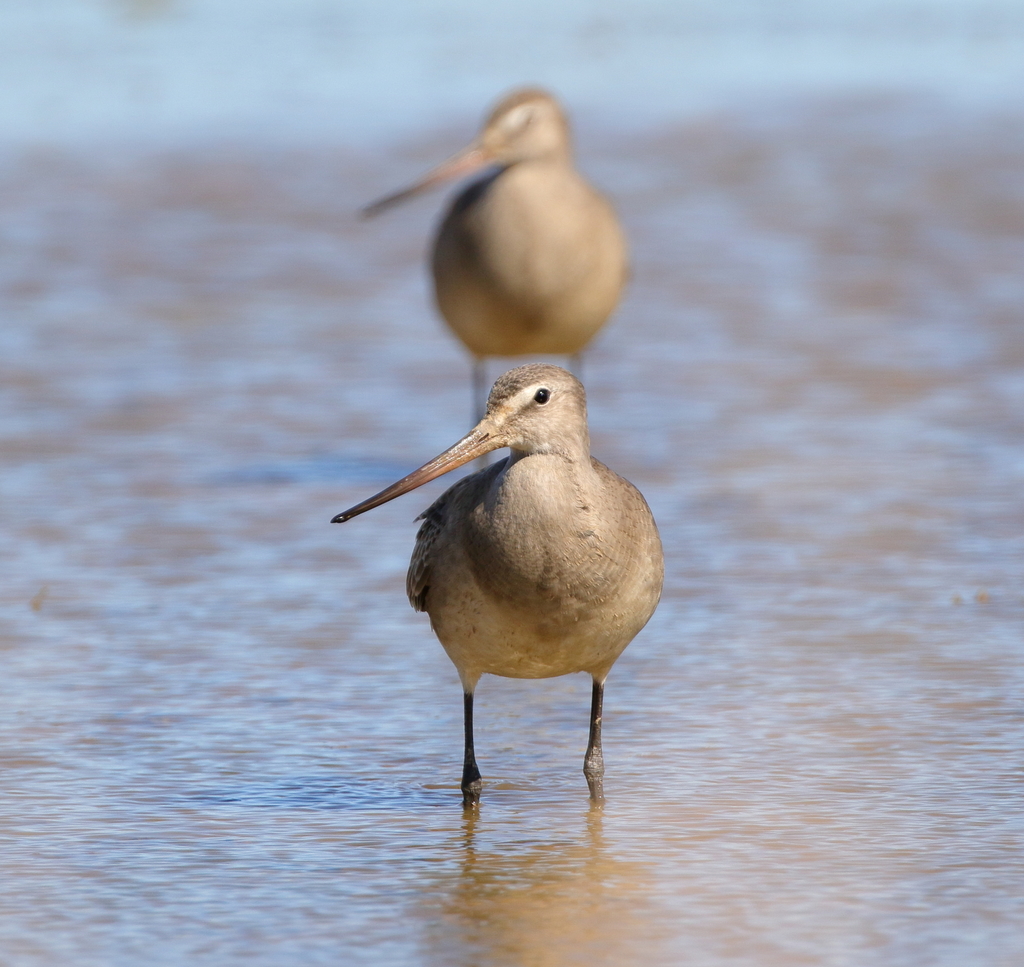
Hudsonian Godwit
Photo © David Bird
Photo © David Bird — CC0 1.0 — Source: iNaturalist #96200504Identification
The Hudsonian godwit is a large, sexually dimorphic shorebird with a distinctive upright posture, long slender legs, and a notably long bill with a slight upward curve. Adults display chestnut underparts with mottled brown upper parts, a white rump, and a black tail. The bill is pink with a dark tip, while legs and feet are bluish-grey. In flight, birds reveal striking black wing linings. Females are noticeably heavier than males, weighing 250–360 g compared to males at 200–270 g. The species undergoes a complex moult strategy with five distinct plumages throughout its lifecycle, though only the adult summer plumage is reliably sexed in the field.
Range & Habitat
This extreme long-distance migrant breeds across scattered subarctic localities from the Bering Sea to Hudson Bay, with three primary breeding clusters: western Alaska (including the Yukon–Kuskokwim Delta and Cook Inlet Basin), the northern Northwest Territories (Mackenzie River Delta and Anderson River), and the western shore of Hudson Bay near Churchill, Manitoba. Breeding habitat occurs at the interface between spruce, dwarf birch, and willow forests and wetlands, particularly sedge meadows and sweet gale bogs. Hudsonian godwits undertake a remarkable looped migration, staging at major sites including James Bay, the Quill Lakes in Saskatchewan, and Aropuk Lake in Alaska before flying nonstop over the Atlantic Ocean to winter in southern South America.
Behaviour & Diet
The species is renowned for its extraordinary migration strategy, featuring a rapid, direct southbound journey over the Atlantic and a slower, more diffuse northbound migration with numerous stopovers. Massive staging occurs between July and September, with birds gathering to build energy reserves before their transoceanic flights, which typically commence in the mid-afternoon from James Bay. Northbound migration through North America peaks in April and May, following the Great Plains and utilizing wetland complexes such as Cheyenne Bottoms, the Rainwater Basin, and Lake Thompson. The species' remote breeding and wintering grounds and swift direct migration made it poorly known until staging sites were discovered around James Bay and breeding sites near Churchill in the mid-20th century.
Best Time & Places to See It
Spring migration through interior North America offers the best opportunities to observe Hudsonian godwits, with peak activity in mid-April and May at major stopover sites along the Great Plains, particularly Cheyenne Bottoms in Kansas, the Rainwater Basin in Nebraska, and Lake Thompson in South Dakota. Autumn staging sites at James Bay, the Quill Lakes in Saskatchewan, and Aropuk Lake in Alaska attract large concentrations between early July and early September. Small numbers appear irregularly during southbound migration in the Maritimes and New England, with hundreds sometimes grounded on Cape Cod during inclement weather in August. The species' fragmented and localized distribution makes it an important focus of conservation and migration biology research.
Photography Tips
Photographing Hudsonian godwits is best attempted during spring and autumn migration at major staging and stopover sites, where birds concentrate in accessible wetland habitats. The species' characteristic upright posture, curved bill, and distinctive plumage—particularly the chestnut underparts in breeding season and striking black wing linings in flight—provide excellent photographic subjects. Early morning light is ideal for capturing the subtle coloration of mottled brown upper parts and the contrast of the white rump and black tail. Patience at known stopover wetlands during peak migration periods in April, May, and August will yield the best opportunities for close-range images of this remarkable long-distance migrant.
Tombstone Territorial Park
Acadia National Park
Alaska Maritime National Wildlife Refuge
Algonquin Provincial Park
Anavilhanas National Park
Arctic National Wildlife Refuge
Banff National Park
Bear River Migratory Bird Refuge
Becharof National Wildlife Refuge
Nothing matches these filters.
No community photos yet. Log in to add the first one.
No community observations of this species yet.