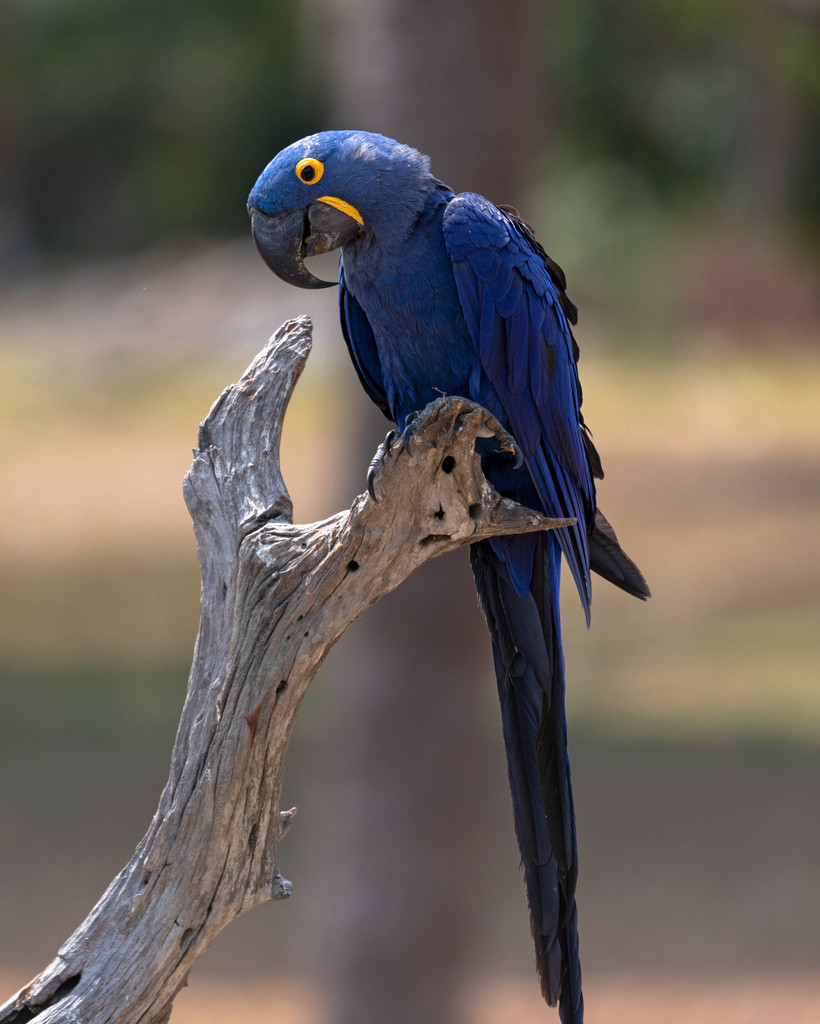
Hyacinth Macaw
Photo © Paulo Mascaretti
Photo © Paulo Mascaretti — CC0 1.0 — Source: iNaturalist photo #234999519Identification
The hyacinth macaw is the world's longest parrot species, measuring approximately one meter from the tip of its tail to the top of its head, and weighing between 1.2–1.7 kg. Its plumage is predominantly blue, lighter on the upper parts, with black coloring on large sections of the underwing and undertail. The most distinctive feature is the striking yellow ring encircling the eye and the vibrant yellow patch just beneath the beak. Each wing spans 38.8–42.5 cm, and the tail is notably long and pointed. While generally unmistakable due to its size, it could potentially be confused with the smaller Lear's macaw.
Range & Habitat
The hyacinth macaw is native to central and eastern South America. The species inhabits areas where its primary food sources are available, particularly regions with stands of palm trees such as acuri and bocaiuva. The Pantanal region is a significant stronghold for the species. Habitat loss poses a serious threat to wild populations, and combined with trapping for the pet trade, has resulted in the species being classified as Vulnerable on the IUCN Red List and protected under CITES Appendix I.
Behaviour & Diet
Hyacinth macaws are highly specialized feeders, with their diet composed predominantly of nuts from specific palm species, particularly acuri and bocaiuva palms. In the Pantanal, they feed almost exclusively on nuts from Acrocomia aculeata and Attalea phalerata palms. Their extraordinarily powerful beaks can crack extremely hard nuts including coconuts, Brazil nut pods, and macadamia nuts, which require 300 psi of pressure to open—a capability shared by few other birds. They possess dry, smooth tongues with an internal bone structure that functions as an effective tool for accessing fruits. The birds will travel vast distances to locate the ripest foods. Notably, hyacinth macaws engage in limited tool use, employing chewed leaves or wood pieces to keep nuts in position while feeding, behavior observed both in wild and captive populations.
Best Time & Places to See It
The Pantanal region is the most rewarding destination for observing hyacinth macaws in their natural habitat. Nesting occurs between July and December, during which time birds concentrate around nesting sites. The 90% of nests in the Pantanal are constructed in manduvi trees, making these areas particularly productive for observation. Birds fly in pairs and can often be spotted traveling between feeding areas where palm nuts are available.
Photography Tips
The hyacinth macaw's striking blue plumage and large size make it a rewarding photographic subject. The intense yellow facial patches and eye-rings provide excellent color contrast and should be a focus for close-up shots. Early morning light will enhance the vibrant blue coloring of the plumage. Since birds travel extensively to feed and fly in pairs, patience and positioning near palm groves during the nesting season (July–December) will increase opportunities for compelling images. The bird's impressive size means a standard telephoto lens will capture impressive frame-filling compositions even at moderate distances.
Chapada dos Guimarães National Park
Chapada dos Veadeiros National Park
Encontro das Águas State Park
Guirá State Park
Pantanal Matogrossense National Park
Rio Negro Pantanal State Park
Serra do Pardo National Park
Terra Ronca State Park
Nothing matches these filters.
No community photos yet. Log in to add the first one.
No community observations of this species yet.