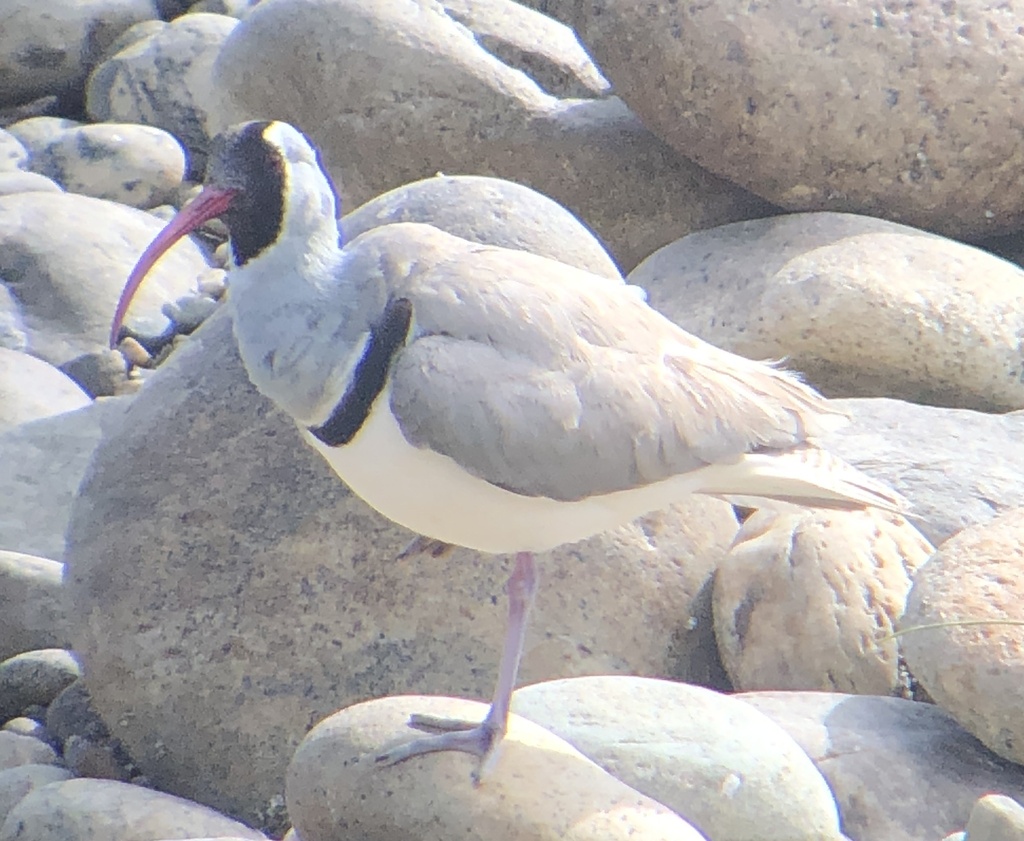
Ibisbill
Photo © Markus Lampinen
Photo © Markus Lampinen — CC BY 4.0 — Source: iNaturalist #247796541The ibisbill (Ibidorhyncha struthersii) is a bird related to the waders, but sufficiently distinctive to merit its own family Ibidorhynchidae. It is grey with a white belly, red legs and long down-curved bill, and a black face and black breast band. It occurs on the shingle riverbanks of the high plateaux of central Asia and the Himalayas. == Taxonomy == The ibisbill belongs to the order Charadriiformes which also includes the sandpipers, plovers, terns, auks, gulls, skuas and others. In its evolutionary relationships, it appears to be most closely related to a group including the oystercatchers (Haematopodidae), and the avocets and stilts (Recurvirostridae), but sufficiently distinctive to merit its own family, Ibidorhynchidae. It is monotypic, with no subspecies. The species was described in 1831 by Vigors based on painting by John Gould, although Brian Hodgson had sent a manuscript to the Asiatic Society of Bengal two years earlier describing it as the "Red-billed Erolia" but this was published only in 1835 with an apology from the editor. Hodgson later suggested a new genus name of Clorhynchus for the bird stating that Gould's description of Ibidorhyncha was inaccurate while Vieillot's Erolia had been rejected. The species is named in honour of…
Langtang National Park
Helambu, Nepal
+364 birds+14 mammals
Where the southern slopes of the Himalayan highlands descend toward the subtropical valleys of central Nepal, Langtang National Park sprawls across one of the subcontinent's most…
VIEW NATIONAL PARKSagarmatha National Park
Khumjung, Nepal
+219 birds+7 mammals
Soaring peaks and deep glacial valleys define this alpine wilderness in northeastern Nepal, where the terrain rises from forested foothills into a realm of high-altitude tundra…
VIEW NATIONAL PARKKhangchendzonga National Park
Sakkyong, India
+290 birds+1 mammals
Where the eastern Himalayas surge toward their crowning peaks, Khangchendzonga National Park embraces a landscape of almost overwhelming vertical drama. Rising from subtropical river valleys into…
VIEW NATIONAL PARKGiant Panda National Park
Mianyang, China
+447 birds+47 mammals
Where the eastern slopes of China's Sichuan plateau descend into cloud-wrapped valleys, one of Asia's most biodiverse landscapes unfolds across more than 350,000 square kilometres. This…
VIEW NATIONAL PARKHemis National Park
Raigahar Dhar, India
+131 birds+13 mammals
Where granite gorges cleave through the Himalayas at dizzying altitudes, a vast wilderness of alpine desert unfolds across the rain shadow of Ladakh. Hemis sprawls across…
VIEW NATIONAL PARKSanjiangyuan National Park
Nagqu, China
+187 birds+25 mammals
Where the headwaters of three great Asian rivers emerge from a high alpine plateau, the landscape unfolds in tundra and dwarf shrubland—a world of austere beauty…
VIEW NATIONAL PARKWolong National Nature Reserve
Wenchuan County, China
+333 birds+17 mammals
Where the Qingyi River cuts through the eastern flanks of the Minshan Range, a temperate montane forest cloaks steep valleys in dense canopy that thins dramatically…
VIEW NATURE RESERVEQinghai Lake National Nature Reserve
Hainan Tibetan Autonomous Prefecture, China
+243 birds+11 mammals
At 3,200 metres above sea level on the Tibetan plateau, where winter temperatures plunge far below freezing and snow blankets the landscape for half the year,…
VIEW NATURE RESERVENo community photos yet. Log in to add the first one.
No community observations of this species yet.