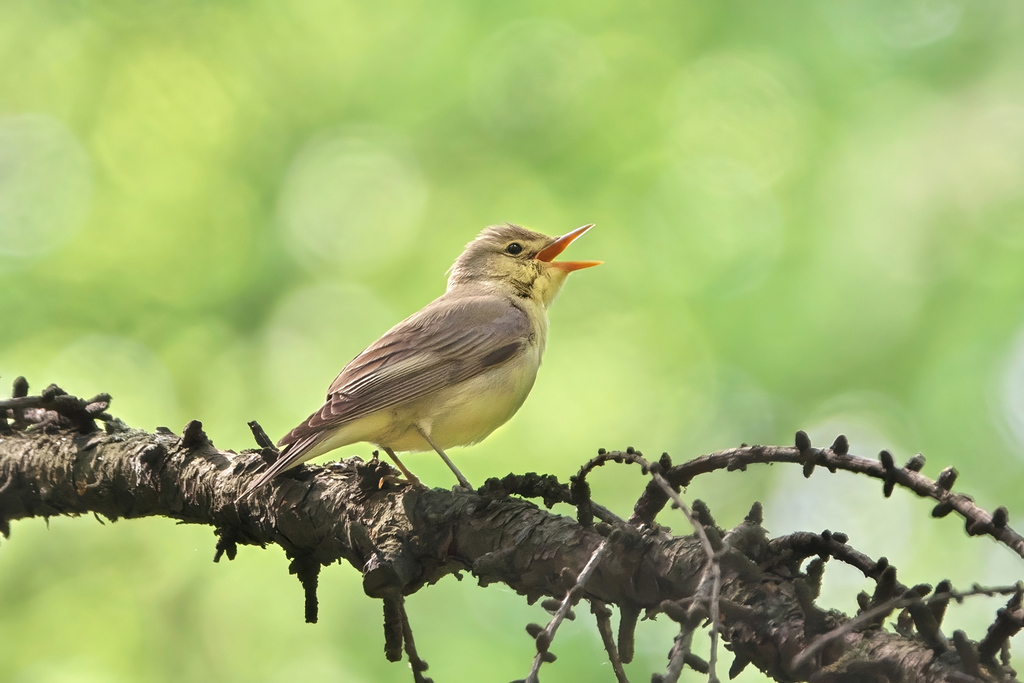
Icterine Warbler
Photo © Andrey Gulivanov
Photo © Andrey Gulivanov — CC BY 4.0 — Source: iNaturalist photo #135677348Identification
The Icterine Warbler is a fairly large warbler with a notably large head, broad-based bill, and long wings. Its tail is quite short and square-ended. The upperparts are greyish-green while the underparts are uniformly light yellow, giving it a distinctive pale appearance. Look for pale lores, a rather vague yellowish supercilium, and a pale eye ring. A useful field mark is the panel on the folded wings formed by pale edges to the secondary and tertiary feathers. The legs are grey, sometimes with a bluish tinge. In general comportment, it moves more clumsily than the smaller, superficially similar Phylloscopus warblers.
Range & Habitat
The Icterine Warbler has the most northerly and widespread distribution of the four Hippolais species, breeding across mainland Europe from northern France and Norway through most of northern and eastern Europe, south to the northern Balkans and Crimea, then eastwards in a narrowing band to the River Ob. It is replaced by the Melodious Warbler in southwestern Europe. The species is a migratory bird, with the entire population wintering in sub-Saharan Africa, mainly south of the equator. It is normally a passage migrant in Great Britain and Ireland, though it has bred in Scotland. Recent records include sightings in Alaska.
Behaviour & Diet
The Icterine Warbler is mainly insectivorous but will feed on fruit in late summer. It forages among foliage, taking insects from leaves or while fluttering, and will also flycatch. Rather solitary and territorial on both breeding and wintering grounds, it nests in trees or bushes, laying four to six eggs. Its song is a fast, nasal babble incorporating mimicry of other species, while its call is a sharp teck or tec, tec, tec.
Best Time & Places to See It
The Icterine Warbler favours woodland edge or glades with well-spaced trees and tall undergrowth, preferring broad-leafed trees but also occurring in mixed conifer-broadleaf habitats. It frequents copses, orchards, parks, gardens, shelterbelts, and tall hedges interspersed with trees. The species begins its southward migration from late July, peaking in early August, and returns to the breeding range in late May, making late spring and early autumn the best times to encounter migrants in western Europe.
Photography Tips
Photograph this warbler in open woodland where it frequents the crowns of well-spaced trees, allowing clear sightlines. Its pale underparts and greyish-green upperparts provide good contrast in backlighting. Focus on capturing the distinctive pale panel on the folded wings and the subtle facial markings. Early morning light will best reveal the uniform yellow underparts and the fine details of the supercilium and eye ring. Given its clumsy foraging style and solitary nature, patience and a longer lens will reward you with active feeding sequences among foliage.
Lake Mburo National Park
Murchison Falls National Park
Queen Elizabeth National Park
Abruzzo, Lazio and Molise National Park
Aggtelek National Park
Åsnens National Park
Avesnois Regional Nature Park
Białowieża National Park
Biebrza National Park
Nothing matches these filters.
No community photos yet. Log in to add the first one.
No community observations of this species yet.