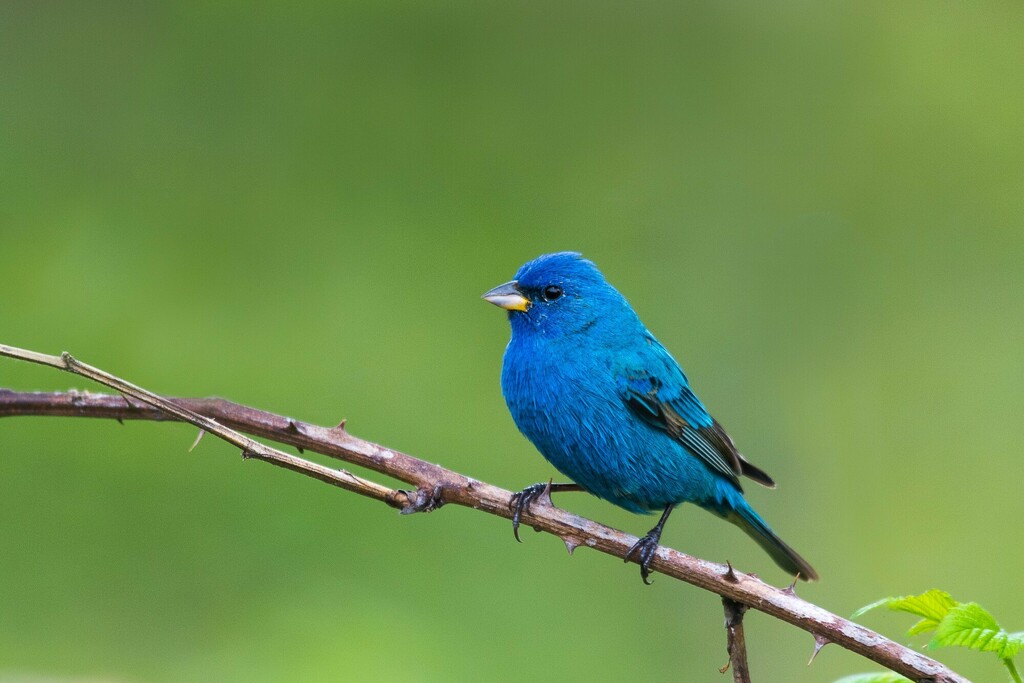
Indigo Bunting
Photo © Adam Jackson
Photo © Adam Jackson — CC0 1.0 — Source: iNaturalist photo #339455700Identification
The indigo bunting is a small songbird, measuring 11.5–13 cm in length with a wingspan of 18–23 cm. It displays striking sexual dimorphism. Breeding males are vibrant cerulean blue on the body with an indigo head, black wings and tail edged in blue, and a short, conical bill. In fall and winter, males appear mostly brown as blue feathers are overlaid with brown edges. Females are brown year-round on the upperparts with lighter brown underparts, faint wing bars, and faint streaking beneath. Immature males may show hints of blue on the tail and shoulders. The bill is light brown tinged with blue in females and brownish-black above with light blue below in males.
Range & Habitat
The indigo bunting is highly migratory, ranging from southern Canada to northern Florida during the breeding season, and from southern Florida to northern South America during winter. It navigates these vast distances by night, using the stars. The species prefers farmland, brush areas, open woodland, brushy forest edges, and second growth woodland. Interestingly, populations have increased with forest clearings and agricultural development, suggesting the species benefits from human land modification.
Behaviour & Diet
The indigo bunting is a seed-eating specialist with seasonal dietary flexibility. During summer months, it feeds primarily on insects, while winter diet consists largely of seeds. Nest-building and incubation are undertaken exclusively by the female. The species is closely related to the lazuli bunting and interbreeds with it where their ranges overlap in the Great Plains, though genetic studies show these species diverged 4.1–7.3 million years ago.
Best Time & Places to See It
The indigo bunting can be observed throughout its breeding range from southern Canada to northern Florida and eastern Texas during spring and summer months. Winter sightings occur in southern Florida, central Mexico, the West Indies, Central America, and northern South America. Look for them in open woodlands, farmland edges, and brushy areas where they forage for insects and seeds.
Photography Tips
Capturing the male's brilliant breeding plumage requires timing your visit to spring and early summer when males display their vibrant cerulean and indigo coloring. The contrast between breeding males, brown winter males, and brown females offers diverse photographic opportunities. Use patience and early morning light to photograph males singing from exposed perches, where they advertise their territories and attract mates. Their small size (approximately 14.5 g) means a telephoto lens is essential for detailed shots.
Acadia National Park
Algonquin Provincial Park
Alligator River National Wildlife Refuge
Arches National Park
Arenal Volcano National Park
Arrecifes de Cozumel National Park
Badlands National Park
Barra del Colorado National Wildlife Refuge
Baru Volcano National Park
Nothing matches these filters.
No community photos yet. Log in to add the first one.
No community observations of this species yet.