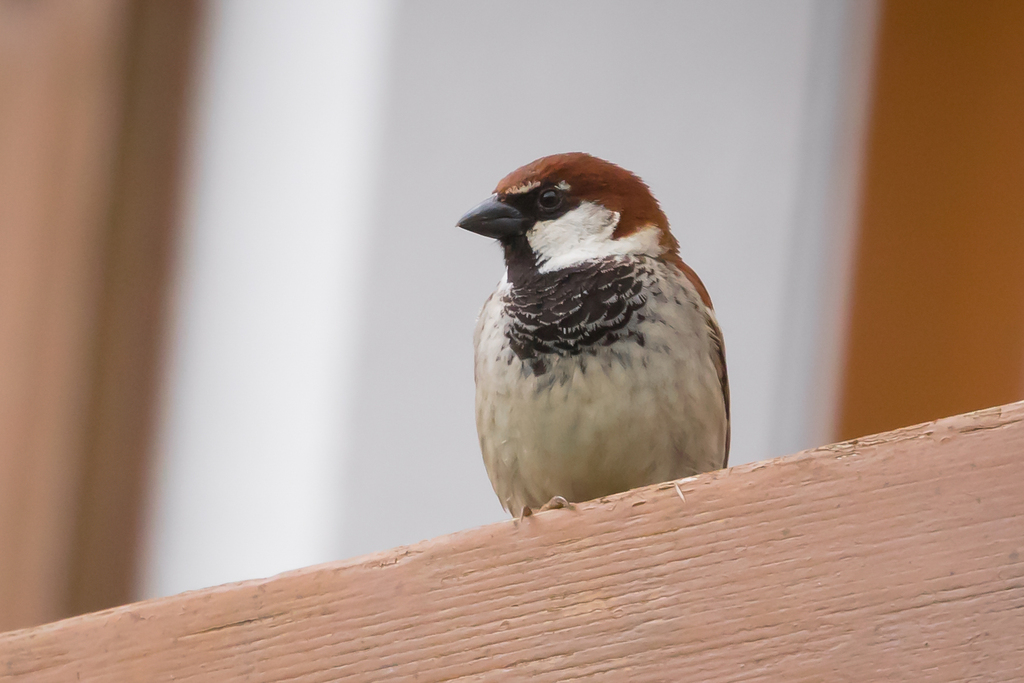
Italian Sparrow
Photo © Johannes S.
Photo © Johannes S. — CC BY 4.0 — Source: iNaturalist photo #628575188Identification
The Italian sparrow is a small, chunky bird measuring 14–16 centimetres in length, roughly the same size as the house sparrow. Males display distinctive plumage with a chestnut crown, nape, and sides of the head contrasting with white cheeks—a pattern inherited from the Spanish sparrow. The male's upperparts are bright chestnut, and its underparts pale grey, notably lacking the black streaking found on Spanish sparrows. A characteristic black patch on the throat and chest, known as a bib or badge, is particularly prominent after wear and preening brighten the plumage. Females are nearly identical to female house sparrows, though they lack the black streaks on the underparts that distinguish female Spanish sparrows. The Italian sparrow's vocalisations resemble those of both parent species but carry better in natural environments than house sparrow calls.
Range & Habitat
The Italian sparrow is found throughout northern and central Italy, Corsica, and small parts of France, Switzerland, Austria, and Slovenia. A narrow hybrid zone about 20–30 km wide exists in the southern Alps where Italian sparrows contact house sparrows. In southern Italy, a gradual transition occurs with Spanish sparrows, with birds increasingly resembling Spanish sparrows from around Naples towards western Sicily. Intermediate forms also occur on Malta, Crete, and adjacent Mediterranean islands, though these are sometimes classified as Italian sparrows. Interestingly, Sardinia is occupied by Spanish sparrows rather than Italian sparrows, creating a complex mosaic of distributions across the Mediterranean.
Behaviour & Diet
The Italian sparrow exhibits behavioural and ecological characteristics influenced by its hybrid heritage. Males proclaim nest ownership with a "chreep" call similar to that of Spanish sparrows, and employ faster versions of this call during courtship displays. Male song patterns grade gradually into those of the Spanish sparrow across southern Italy, though in areas of overlap with house sparrows, the two species sound remarkably alike. The species shows partial reproductive isolation from its parental species, particularly where it occurs alongside Spanish sparrows without cross-breeding, suggesting that plumage-based mate selection has developed.
Best Time & Places to See It
Northern and central Italy offer the most reliable opportunities to observe Italian sparrows in their core range. The gradual transition zone in southern Italy provides chances to observe intermediates between Italian and Spanish sparrows. Malta, Crete, and other Mediterranean islands harbour populations of intermediate forms worth seeking. The narrow contact zone in the Alps rewards birders interested in observing the subtle plumage differences between Italian and house sparrows, though this zone spans only 20–30 km and represents a frontier of biological interest rather than a birding hotspot.
Photography Tips
Photograph males in good light to capture the distinctive chestnut crown, white cheeks, and black bib—features that distinguish them from both parent species. The plumage pattern becomes more vivid with wear and preening, so look for well-maintained birds to show the brightest colours. Males in courtship display offer dynamic photo opportunities. In southern Italy and Mediterranean islands, seek out birds displaying intermediate characteristics between the Italian and Spanish sparrow forms. Females present a greater identification challenge; careful attention to the lack of black underpart streaking will help separate them from Spanish sparrow females.
S’Albufera Natural Park
Platja de Muro, Spain
+253 birds+6 mammals
Where Mediterranean lagoons meet the Balearic coast, S'Albufera stretches across nearly 1,600 hectares of wetland and dune systems that rank among Europe's most ecologically vital shallow-water…
VIEW NATURAL PARKMercantour National Park
Isola, France
+146 birds+32 mammals
Where alpine meadows surrender to vertiginous limestone cliffs, the Mercantour's beating heart pulses with Mediterranean and Alpine rhythms. This 4,221-square-kilometre sanctuary straddles France's southeastern border, its…
VIEW NATIONAL PARKÉcrins National Park
La Chapelle-en-Valgaudémar, France
+143 birds+36 mammals
Where granite peaks and Alpine meadows converge across nearly 2,100 square kilometres, Écrins National Park forms one of the wildest mountainous strongholds of the French Alps.…
VIEW NATIONAL PARKCamargue Regional Nature Park
Saintes-Maries-de-la-Mer, France
+378 birds+48 mammals
Where the Rhône Delta sprawls into the Mediterranean, a landscape of stark and haunting beauty emerges—vast salt marshes punctuated by shallow lagoons, reed beds, and scrubland…
VIEW NATURAL PARKPollino National Park
Viggianello, Italy
+125 birds+9 mammals
Where limestone ridges rise abruptly from the Basilicatan foothills, Pollino National Park enfolds a landscape of profound ecological character—one defined by steep valleys, alpine meadows clinging…
VIEW NATIONAL PARKSila National Park
San Giovanni in Fiore, Italy
+125 birds+11 mammals
Where the Calabrian Apennines rise inland from the Ionian coast, Sila National Park preserves a landscape of high plateaus and beech-dominated forests that feel more Central…
VIEW NATIONAL PARKCirceo National Park
Italy
+232 birds+6 mammals
Where limestone headlands plunge toward the Tyrrhenian Sea, Circeo National Park preserves a rare mosaic of Mediterranean coastal habitats that few Italian reserves can match. The…
VIEW NATIONAL PARKStelvio National Park
Valfurva, Italy
+116 birds+17 mammals
Where granite peaks rise above three thousand metres and alpine meadows give way to rocky scree, Stelvio National Park guards one of Europe's most dramatically vertical…
VIEW NATIONAL PARKGran Paradiso National Park
Cogne, Italy
+120 birds+16 mammals
Where the western Alps rise steeply above the Aosta Valley, granite ridges and alpine meadows converge in a landscape shaped as much by glacial history as…
VIEW NATIONAL PARKTuscan Archipelago National Park
Rio, Italy
+174 birds+8 mammals
Where the Tyrrhenian Sea fragments into granite and schist islands, the Arcipelago Toscano National Park protects one of the Mediterranean's most biodiverse maritime realms. Scattered across…
VIEW NATIONAL PARKForeste Casentinesi, Monte Falterona and Campigna National Park
Santa Sofia, Italy
+92 birds+13 mammals
Where the northern Apennines rise above the Tuscan-Emilian divide, beech and fir forests cloak the slopes of Monte Falterona in a mantle of temperate woodland that…
VIEW NATIONAL PARKMaiella National Park
Pacentro, Italy
+131 birds+11 mammals
Limestone scarps rise abruptly from the valleys around Pacentro, their pale faces scored by millennia of water and wind into a landscape of canyons, karst features,…
VIEW NATIONAL PARKGran Sasso and Monti della Laga National Park
Pietracamela, Italy
+155 birds+12 mammals
Where the Apennines rise in their most dramatic form, the Gran Sasso e Monti della Laga National Park unfolds across nearly 70,000 hectares of limestone peaks,…
VIEW NATIONAL PARKMonti Sibillini National Park
Castelsantangelo sul Nera, Italy
+113 birds+11 mammals
Where the Apennines rear their limestone spine across central Italy, the Sibillini Mountains National Park reveals a landscape of dramatic vertical relief, high plateaus, and deeply…
VIEW NATIONAL PARKGargano National Park
Cagnano Varano, Italy
+219 birds+7 mammals
Where the Gargano Peninsula's limestone plateaus descend toward the Adriatic, Cagnano Varano sits at the threshold of one of southern Italy's most ecologically vital landscapes. The…
VIEW NATIONAL PARKAppennino Tosco-Emiliano National Park
Ventasso, Italy
+86 birds+8 mammals
Where the northern Apennines rise in folded ridges across the Emilia-Romagna borderland, the Dell'Appennino Tosco-Emiliano National Park protects one of Italy's most geologically complex mountain landscapes.…
VIEW NATIONAL PARKCilento, Vallo di Diano and Alburni National Park
Campora, Italy
+145 birds+12 mammals
Where the southern Apennines descend toward the Tyrrhenian coast, the landscape transforms into a mosaic of limestone plateaus, deep ravines, and Mediterranean scrubland that defines Cilento,…
VIEW NATIONAL PARKDolomiti Bellunesi National Park
Sospirolo, Italy
+76 birds+11 mammals
Where the Dolomites descend into the Veneto foothills near Sospirolo, a landscape of limestone massifs, forested valleys, and rushing waterways creates one of northern Italy's most…
VIEW NATIONAL PARKAspromonte National Park
Careri, Italy
+89 birds+5 mammals
Where the Aspromonte massif rises sharply from Calabria's Tyrrhenian coast, ancient beech and mixed temperate forests cloak the upper slopes, giving way at lower elevations to…
VIEW NATIONAL PARKAsinara National Park
Porto Torres, Italy
+103 birds+5 mammals
Rocky limestone cliffs plunge toward the Tyrrhenian Sea where Dell'Asinara National Park guards a slender island sanctuary off Sardinia's northwestern coast. The park's terrain is a…
VIEW NATIONAL PARKSamaria National Park
Chania Regional Unit, Greece
+103 birds+1 mammals
Vertical walls of pale limestone rise nearly a kilometre from the Cretan seabed, their flanks carved by the Samaria Gorge into one of Europe's most dramatic…
VIEW NATIONAL PARKAbruzzo, Lazio and Molise National Park
Pescasseroli, Italy
+139 birds+18 mammals
Where the central Apennines rise in dramatic limestone and clay ridges, the Gran Sasso e Monti della Laga National Park unfolds across one of Italy's most…
VIEW NATIONAL PARKAlta Murgia National Park
Bari, Italy
+168 birds+6 mammals
Across the limestone plateaux of Apulia's interior, where the Adriatic's influence fades into continental warmth, lies a landscape sculpted by millennia of human pastoralism and Mediterranean…
VIEW NATIONAL PARKAppennino Lucano Val d’Agri Lagonegrese National Park
Spinoso, Italy
+121 birds+3 mammals
The Apennine mountains rise in weathered limestone ridges across central Italy, and where they push into Basilicata's interior, the landscape opens into a complex mosaic of…
VIEW NATIONAL PARKBelluno Dolomites National Park
Sospirolo, Italy
+72 birds+10 mammals
Where the Dolomites' pale limestone ramparts rise above the Veneto plain, the Belluno Dolomites National Park encompasses a landscape of profound ecological diversity. The park's subarctic-style…
VIEW NATIONAL PARKCinque Terre National Park
Riomaggiore, Italy
+135 birds+1 mammals
Steep terraced cliffs plunge toward the Ligurian Sea where five villages cling to a Csb-climate coastline shaped by centuries of viticulture and stone masonry. Riomaggiore, the…
VIEW NATIONAL PARKVal Grande National Park
Verbano-Cusio-Ossola, Italy
+81 birds+6 mammals
Granite peaks and plunging ravines define this Alpine wilderness where the Toce River carves through one of Italy's most remote mountain landscapes. Straddling the Verbano-Cusio-Ossola district…
VIEW NATIONAL PARKVesuvius National Park
Ottaviano, Italy
+82 birds+4 mammals
The slopes of Vesuvius rise from the Campanian plain in a dramatic cone of volcanic rock and ash, their flanks wrapped in the characteristic vegetation of…
VIEW NATIONAL PARKNo community photos yet. Log in to add the first one.
No community observations of this species yet.