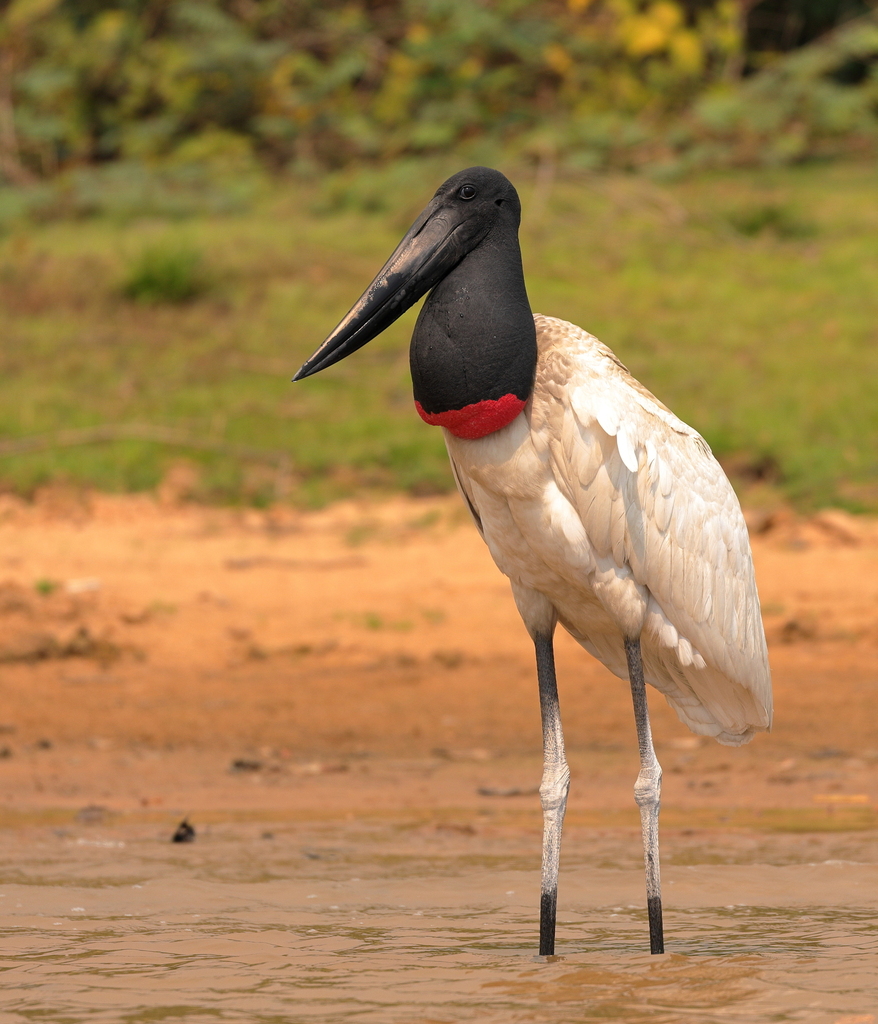
Jabiru
Photo © Darren Obbard
Photo © Darren Obbard — CC BY 4.0 — Source: iNaturalist photo #428517531Identification
The jabiru is the tallest flying bird found in South and Central America, standing nearly the same height as the flightless greater rhea. Adults measure 120–140 cm in length with a wingspan of 2.3–2.8 m, weighing 4.3–9 kg. Large males may stand as tall as 1.53 m. The plumage is mostly white, but the head and upper neck are featherless and black, with a distinctive featherless red stretchable patch at the base of the neck. The long, black, broad bill measures 25–35 cm and is slightly upturned with a sharp point. Sexual dimorphism is notably high—possibly the highest of any stork—with males approximately 25% larger than females.
While the jabiru may appear ungainly on the ground, it is a powerful and graceful flier. The name "jabiru" comes from the Tupi–Guaraní language and means "swollen neck," a reference to that distinctive red patch. It is the only member of the genus Jabiru and is sometimes called tuiuiu in Brazil, or tuim-de-papo-vermelho ("red-necked tuim") in Mato Grosso.
Range & Habitat
The jabiru is found throughout the Americas from Mexico to Argentina, except west of the Andes. It sometimes wanders into the United States, usually in Texas, but has also been reported in Mississippi, Oklahoma, and Louisiana. The species is most common in the Pantanal region of Brazil and the Eastern Chaco region of Paraguay.
Jabirus live in large groups near rivers and ponds, where they forage in shallow water and find abundant prey in wetland environments.
Behaviour & Diet
The jabiru is an opportunistic feeder that consumes prodigious quantities of frogs, fish, snakes, snails, insects, and other invertebrates. It will also eat fresh carrion and dead fish, helping to maintain water quality in isolated bodies of water. They feed by holding their open bill at a 45-degree angle to the water; when prey is contacted, they close the bill and swallow. Fish around 8–20 cm are typically taken, though larger fish weighing up to 500 g and eels up to 80 cm can be captured. Jabirus detect prey more through tactile sensation than vision and usually forage by wading in flocks.
Unlike many other storks, jabirus are solitary nesters and are often seen in pairs during the nonbreeding season, suggesting a lifelong pair bond. Nests are massive stick platforms built by both parents around August–September in the Southern Hemisphere on tall trees. These nests are enlarged each season, growing to several meters in diameter and reaching depths of up to 1.8 m. Clutches contain two to five white eggs, with fledging occurring around 110 days; young often remain in parental care for another three months, making consecutive breeding seasons difficult.
Best Time & Places to See It
The jabiru is most reliably observed in the Pantanal region of Brazil and the Eastern Chaco region of Paraguay. These wetland areas provide ideal habitat with abundant shallow water and food sources. While the species is widespread across its range, it is not abundant in any single area, making dedicated trips to known strongholds the best strategy for sightings. The nesting period around August–September in the Southern Hemisphere may offer opportunities to observe breeding behavior and pairs together.
Photography Tips
Photographing jabirus requires patience and positioning near water margins where they forage. Their predominantly white plumage contrasts dramatically with the black head and red neck patch, creating striking compositions. Capture birds wading in shallow water with their distinctive bills angled down for feeding, or photograph pairs together during the nonbreeding season. The birds' large size and impressive wingspan make them impressive in flight, so watch for takeoffs and landings near nesting sites. Early morning and late afternoon light will enhance the white plumage and highlight the red neck patch. When present in flocks—particularly during the rare mouse population explosions mentioned historically—multiple birds feeding in the same field create excellent opportunities for dramatic group compositions.
Emas National Park
Brazil
+333 birds+23 mammals
Across the high plateaux of central Brazil, where the cerrado grasslands roll toward distant horizons under an immense sky, Emas National Park anchors one of South…
VIEW NATIONAL PARKTortuguero National Park
Roxana, Costa Rica
+420 birds+23 mammals
Canals and lagoons thread through a labyrinth of lowland rainforest where the Caribbean coast of Costa Rica meets the wetland frontier. This is terrain shaped by…
VIEW NATIONAL PARKSanta Rosa National Park
Santa Elena, Costa Rica
+359 birds+30 mammals
Where Pacific-facing slopes descend from volcanic uplands toward the Guanacaste lowlands, Santa Rosa National Park unfolds across a mosaic of tropical dry forest, gallery woodland, and…
VIEW NATIONAL PARKNatural Sierra de la Macarena National Park
Vista Hermosa, Colombia
+566 birds+15 mammals
Across nearly 20,000 square kilometres of Colombia's Meta Department, the terrain rises from lowland savanna into Andean foothills through a mosaic of gallery forests, palm-fringed wetlands,…
VIEW NATIONAL PARKItatiaia National Park
Brazil
+519 birds+12 mammals
Where granite peaks pierce the Atlantic rainforest canopy in southeastern Brazil, Itatiaia National Park rises as one of the country's oldest and most ecologically vital protected…
VIEW NATIONAL PARKViruá National Park
Brazil
+389 birds+6 mammals
Across the northern frontier of Roraima, where the forest canopy rises from ancient Amazonian lowlands, Viruá National Park protects nearly 3,700 square kilometres of terra firme…
VIEW NATIONAL PARKIlha Grande National Park
Brazil
+233 birds
Across the subtropical plateaus and Atlantic forest remnants of southern Brazil, a vast protected landscape spanning nearly 4,600 square kilometers safeguards one of the continent's most…
VIEW NATIONAL PARKChapada dos Guimarães National Park
Brazil
+450 birds+1 mammals
Where weathered sandstone plateaus rise above the cerrado grasslands of central Brazil, Chapada dos Guimarães National Park protects 624 square kilometres of ecological transition zone that…
VIEW NATIONAL PARKPantanal Matogrossense National Park
Brazil
+322 birds+17 mammals
Where the flooded forests of central Brazil meet vast seasonally inundated grasslands, Pantanal Matogrossense National Park sprawls across nearly 2,900 square kilometers of one of the…
VIEW NATIONAL PARKMapinguari National Park
Brazil
+354 birds
Vast tracts of western Amazonian rainforest blanket the remote terrain of this 56,827 square kilometre national park in Amazonas state, where seasonal rivers wind through dense…
VIEW NATIONAL PARKManu National Park
Manu, Peru
+892 birds+26 mammals
Across the eastern slopes of the Peruvian Andes, tropical rainforest descends into the Amazon basin with a complexity that few terrestrial ecosystems match. Manu National Park…
VIEW NATIONAL PARKBahuaja Sonene National Park
San Pedro de Putina Punco, Peru
+602 birds+8 mammals
Where the Madre de Dios and Heath rivers converge in southeastern Peru rises one of South America's most biodiverse wilderness regions: a vast protected realm of…
VIEW NATIONAL PARKSoberanía National Park
Cristóbal, Panama
+495 birds+34 mammals
Rainforest and riverine woodland blanket the rolling terrain of this 714-square-kilometre national park in Colón Province, where the Caribbean watershed feeds a maze of streams and…
VIEW NATIONAL PARKRío Pilcomayo National Park
Argentina
+271 birds+13 mammals
Where the Río Pilcomayo cuts through northeastern Argentina's subtropical lowlands, a sprawling mosaic of wetlands, grasslands, and seasonally flooded forests creates one of South America's most…
VIEW NATIONAL PARKParque Provincial Pampa del Indio
Laguna Limpia, Argentina
+231 birds+4 mammals
Across the flat horizons of Chaco Province, where the Paraná River system spills into vast wetlands and grasslands, Parque Provincial Pampa del Indio protects one of…
VIEW NATURE RESERVEChaco National Park
Municipio de Presidencia de la Plaza, Argentina
+258 birds+7 mammals
Across the humid subtropical lowlands of northeastern Argentina, where the Paraná River basin feeds vast seasonal wetlands and gallery forests, Chaco National Park protects one of…
VIEW NATIONAL PARKSian Ka’an
Chunyaxché, Mexico
+350 birds+16 mammals
Where the Yucatán Peninsula dissolves into wetland and mangrove, a vast mosaic of forest, lagoon, and coastal margin creates one of Mexico's most biodiverse strongholds. Across…
VIEW BIOSPHERE RESERVEMontes Azules
Candelaria, Mexico
+395 birds+47 mammals
Where jungle-clad limestone plateaus plunge into canyon systems carved by the Usumacinta River, Mexico's most pristine rainforest reserve unfolds across the Lacandón region of Chiapas. Montes…
VIEW BIOSPHERE RESERVETikal National Park
Tikal, Guatemala
+399 birds+16 mammals
Dense rainforest canopy rises above the limestone plateau of Petén, where archaeological wonder and ecological richness merge seamlessly across one of Central America's most biodiverse landscapes.…
VIEW NATIONAL PARKLaguna del Tigre National Park
Petén, Guatemala
+399 birds+29 mammals
Where the Petén lowlands dissolve into wetland and forest, Laguna del Tigre National Park protects one of Guatemala's most ecologically vital landscapes. This sprawling reserve encompasses…
VIEW NATIONAL PARKPalo Verde National Park
Bagaces, Costa Rica
+318 birds+24 mammals
Dry forest spreads across Palo Verde's low-lying terrain in northwestern Guanacaste, where seasonal rivers and lagoons etch through deciduous woodland that sheds its canopy each winter.…
VIEW NATIONAL PARKTapantí Macizo de la Muerte National Park
Orosi, Costa Rica
+503 birds+18 mammals
Where montane cloud forest rises steeply from the Orosi Valley, Tapantí Macizo de la Muerte National Park enfolds a landscape of perpetual moisture and emerald complexity.…
VIEW NATIONAL PARKCaño Negro National Wildlife Refuge
Caño Negro District, Costa Rica
+486 birds+16 mammals
Where the San Juan River's seasonal floodplain opens into expansive wetlands, Caño Negro Wildlife Sanctuary sprawls across one of Central America's most productive freshwater ecosystems. This…
VIEW WILDLIFE SANCTUARYBarra del Colorado National Wildlife Refuge
Tortuguero, Costa Rica
+462 birds+36 mammals
Where the Caribbean's restless waters meet the Limón Province coastline, Barra del Colorado National Wildlife Sanctuary unfolds across a landscape of extraordinary ecological complexity. This equatorial…
VIEW WILDLIFE SANCTUARYNo community photos yet. Log in to add the first one.
No community observations of this species yet.