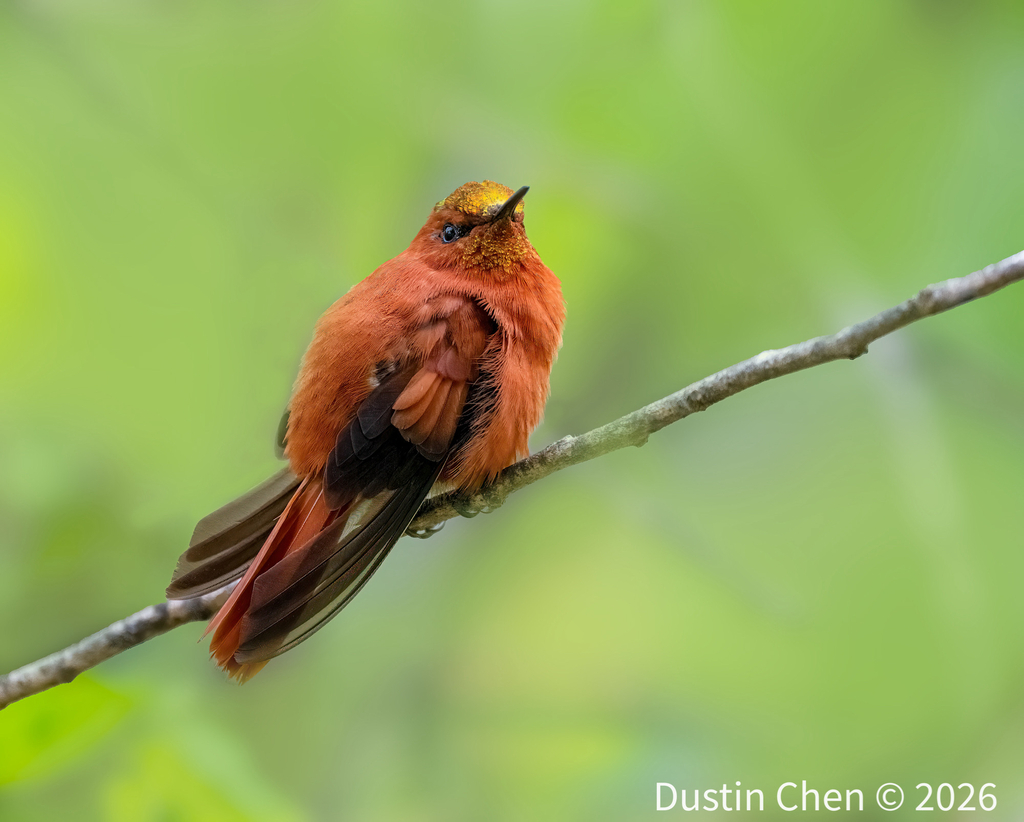
Juan Fernandez Firecrown
Photo © Dustin Chen
Photo © Dustin Chen — CC0 1.0 — Source: iNaturalist photo #697550525Identification
The Juan Fernández firecrown is among the most strikingly sexually dimorphic hummingbirds, with males and females so different in appearance that they were once thought to be separate species. Males measure 11.5 to 12 cm in length and weigh approximately 10.9 grams, while females are slightly smaller at about 10.5 cm and 6.8 grams. Both sexes possess a straight black bill.
Males are unmistakable, displaying an almost entirely cinnamon-orange plumage with an iridescent fiery reddish-yellow crown and forehead, complemented by dark coppery-gray wings. Females present a markedly different appearance, with bluish-green upperparts and an iridescent bluish-purple crown. Their underparts are pure white adorned with black and green disks, and their wings are slaty green. The tail feathers are distinctive, with central feathers and inner webs in blue-green and outer webs in white.
Range & Habitat
This critically endangered species is found exclusively on Isla Róbinson Crusoe, one of Chile's Juan Fernández Islands. It inhabits forests, thickets, and gardens, showing a marked preference for shady areas. In summer, males frequently visit San Juan Bautista, the island's only town, where they feed on flowers of endemic Dendroseris trees. All known breeding records occur at elevations between 120 and 660 meters.
Behaviour & Diet
The Juan Fernández firecrown moves around the island in search of flowering plants but is otherwise sedentary. It forages primarily for nectar at native flowers, particularly Rhaphithamnus venustus and Sonchus brassicifolius. During autumn and winter months when native plants are scarce, it supplements its diet with introduced Eucalyptus and Abutilon. The species feeds by clinging to flowers, favoring shaded blossoms positioned well above ground level.
Both males and females defend foraging territories, with males occupying the most productive feeding sites. Beyond nectar, they consume small insects captured in flight or gleaned from leaves. The breeding season runs from September to mid-November, with females constructing tiny cup nests woven from fern fibers, mosses, and spiderweb, typically positioned about 4 meters above ground on twig tips. Over 75% of nests are built in Myrceugenia fernandeziana trees. Clutches contain two eggs. Males produce a distinctive song described as "a medley of high-pitched squeaky notes, dry gravelly trills and descending chatters."
Best Time & Places to See It
The best opportunity to observe this species is during the breeding season from September to mid-November, when activity is highest. Summer months are particularly rewarding for viewing males in San Juan Bautista, where they congregate around flowering endemic trees. Visitors should explore forested and shaded garden areas across Isla Róbinson Crusoe, where the birds move predictably between flowering plants and territory sites.
Photography Tips
Photographing the Juan Fernández firecrown requires patience and familiarity with its preferred habitats and feeding patterns. Position yourself near known flowering sites, particularly Dendroseris trees in summer months and shaded blossoms throughout the year. The extreme sexual dimorphism makes this species particularly rewarding to photograph—seek opportunities to capture both the brilliant cinnamon-orange males with their fiery crowns and the subtler green and white females. Early morning visits to shaded areas where the birds forage will maximize your chances of encountering these rare hummingbirds in good light.
Chile: Fuegian Snipe & Juan Fernandez
No community photos yet. Log in to add the first one.
No community observations of this species yet.