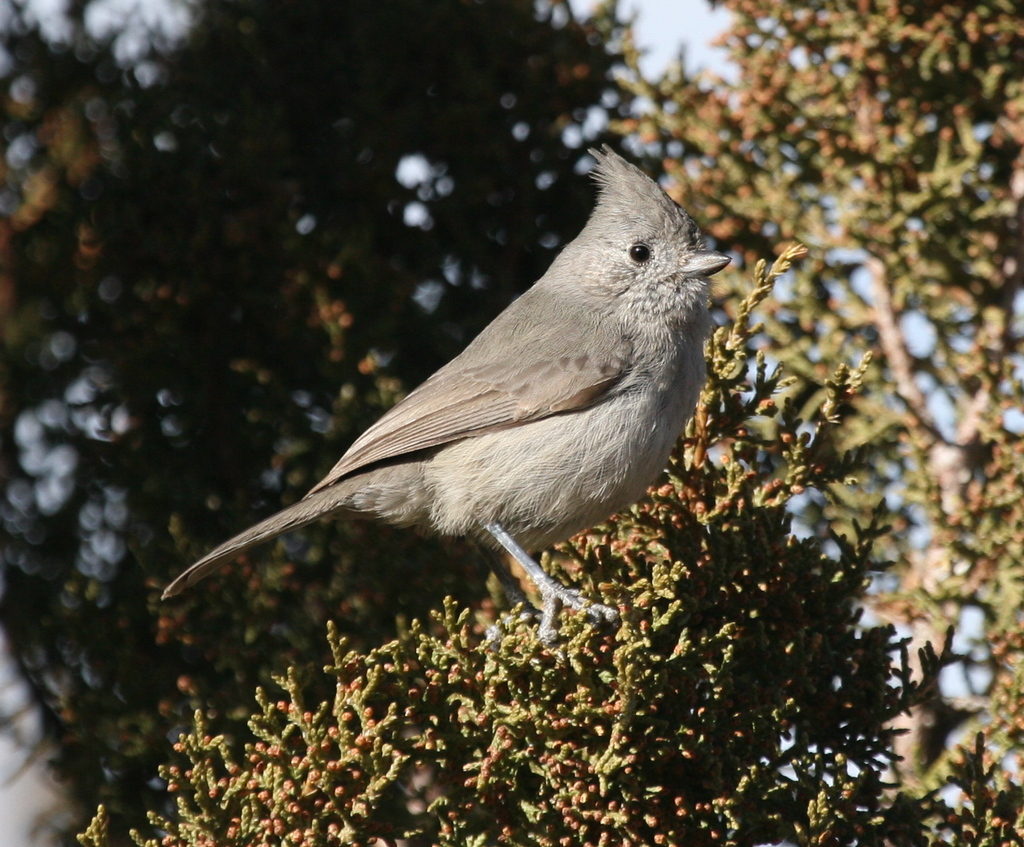
Juniper Titmouse
Photo © Cole Wolf
Photo © Cole Wolf — CC BY 4.0 — Source: iNaturalist photo #304634194Identification
The juniper titmouse is a small, gray passerine with a distinctive small tuft or crest atop its head. Males and females are visually similar in plumage, making this species relatively straightforward to identify once you've spotted it. Its compact size and neat gray coloring are characteristic of the tit family. The juniper titmouse can be distinguished from the very similar oak titmouse by its grayer back—the oak titmouse has a noticeably browner back. Their ranges overlap only in a small area of California, which can help with identification depending on your location. The tufted titmouse, which does not overlap in range with the juniper titmouse, is larger and more distinctive, featuring a whiter belly, rusty flanks, and black markings on the forehead.
Range & Habitat
The juniper titmouse is a year-round resident primarily of the Great Basin region, ranging from southeastern Oregon and central Colorado south to the eastern Mojave Desert in California and central Arizona, extending as far as west Texas and extreme northeastern Sonora, Mexico, including the Madrean sky islands. This species shows a strong preference for open woodlands of warm, dry pinyon-juniper and juniper forests, as well as desert riparian woods—habitats that reflect its name and ecological specialization.
Behaviour & Diet
Juniper titmice are social but not gregarious birds, forming pairs or small groups rather than large flocks. After breeding season, they may join mixed-species foraging flocks. These active foragers hunt insects and spiders, sometimes catching prey in mid-air, and supplement their diet with berries, acorns, and seeds. Notably, they hammer seeds against branches to crack them open, and their strong legs and feet allow them to hang upside down while foraging across foliage, twigs, branches, and trunks. They readily visit feeders stocked with suet, peanut butter, and seeds.
The juniper titmouse produces a distinctive rolling series of notes given on the same pitch, and its call is a raspy "tschick-adee" sound. For roosting, these birds sleep in cavities, dense foliage, or birdhouses; when roosting in foliage, they select a twig surrounded by dense needles or dead pine needle accumulations that simulate a cavity.
Best Time & Places to See It
The breeding season, running from March into July with peak activity in April and May, offers excellent opportunities to observe juniper titmice as they are most vocal and active during this period. Look for them year-round in pinyon-juniper woodlands and desert riparian areas throughout the Great Basin and southwestern United States. Their preference for open woodlands makes them relatively accessible to patient observers who scan the mid-story foliage and branches carefully.
Photography Tips
The juniper titmouse's small crest and active foraging behavior offer good photographic opportunities. Position yourself near open woodlands with clear sightlines through the pinyon-juniper canopy. Early morning during breeding season, when birds are most vocal and active, provides the best light and activity levels. These birds will visit feeders, which can provide more controlled photography opportunities. Their habit of hanging upside down while foraging creates dynamic poses worth anticipating with your camera.
Canyonlands National Park
Wayne County, United States
+186 birds+15 mammals
Where the Colorado River has carved an intricate labyrinth through the high desert plateau of southeastern Utah, Canyonlands National Park sprawls across nearly 3,030 square kilometres…
VIEW NATIONAL PARKSaguaro National Park
Rincon Valley, United States
+354 birds+40 mammals
Where the Sonoran Desert meets sky-island mountains, two geographically separated districts of Saguaro National Park sprawl across nearly two thousand square kilometers of Arizona's most iconic…
VIEW NATIONAL PARKCarlsbad Caverns National Park
Eddy County, United States
+309 birds+18 mammals
Beneath the Chihuahuan Desert floor of southern New Mexico lies one of North America's most spectacular subterranean landscapes. Carlsbad Caverns National Park encompasses over 518 square…
VIEW NATIONAL PARKArches National Park
Grand County, United States
+185 birds+20 mammals
Where rust-red sandstone fins rise abruptly from high desert scrubland, Arches National Park spans 548 square kilometers of one of North America's most sculptural landscapes. The…
VIEW NATIONAL PARKZion National Park
Washington County, United States
+244 birds+30 mammals
Towering sandstone cliffs in shades of crimson, rust, and cream rise abruptly from the Virgin River's winding canyon floor, their sculpted faces bearing witness to millions…
VIEW NATIONAL PARKMesa Verde National Park
Montezuma County, United States
+166 birds+10 mammals
Across the high desert plateau of southwestern Colorado, where sandstone mesas rise abruptly from piñon-juniper scrubland, Mesa Verde National Park preserves one of North America's most…
VIEW NATIONAL PARKGreat Sand Dunes National Park
Saguache County, United States
+193 birds+14 mammals
Where the Colorado high plains collide with one of North America's most extraordinary geological anomalies, nearly 600 square kilometres of windswept sand rise abruptly from the…
VIEW NATIONAL PARKCapitol Reef National Park
Garfield County, United States
+196 birds+22 mammals
Wrinkled ridges of crimson and gold sandstone rise from the floor of south-central Utah, their weathered faces carved by the Fremont River into one of the…
VIEW NATIONAL PARKGrand Teton National Park
Teton County, United States
+247 birds+38 mammals
Where the Teton Range tears skyward in a dramatic escarpment above the Snake River valley, nearly 2,550 square kilometers of montane wilderness unfolds across Teton County,…
VIEW NATIONAL PARKBlack Canyon of the Gunnison National Park
Montrose County, United States
+169 birds+13 mammals
Where the Gunnison River has carved one of North America's steepest and most dramatic canyons, ancient metamorphic rock walls plunge nearly 2,000 feet in places, creating…
VIEW NATIONAL PARKDeath Valley National Park
Inyo County, United States
+339 birds+25 mammals
Across nearly 3.5 million acres of southeastern California's Inyo County, vast salt flats meet sculpted badlands and alluvial fans in a landscape so extreme it defines…
VIEW NATIONAL PARKBryce Canyon National Park
Tropic, United States
+202 birds+20 mammals
Hoodoos rise like a forest of stone pillars from an amphitheater carved into Utah's high plateau, where the Paunsaugunt elevates the landscape to over 9,000 feet…
VIEW NATIONAL PARKGuadalupe Mountains National Park
Culberson County, United States
+262 birds+14 mammals
Where fossil-laden limestone ridges thrust skyward above the Chihuahuan Desert floor, Guadalupe Mountains National Park reveals a landscape sculpted by ancient seas and relentless aridity. These…
VIEW NATIONAL PARKPetrified Forest National Park
Apache County, United States
+206 birds+23 mammals
Across the high desert plateau of northeastern Arizona, where the climate swings between scorching summer days and frost-laden winters, badlands of raw earth and timber-turned-to-stone dominate…
VIEW NATIONAL PARKWhite Sands National Park
Otero County, United States
+178 birds+6 mammals
Across the Tularosa Basin in south-central New Mexico sprawls an otherworldly landscape of gypsum dunes—the largest gypsum field on Earth and a stark desert playground shaped…
VIEW NATIONAL PARKBosque del Apache National Wildlife Refuge
Socorro County, United States
+345 birds+17 mammals
Where the Rio Grande emerges from its desert canyon in central New Mexico, a narrow ribbon of riparian woodland defies the arid landscape that surrounds it.…
VIEW WILDLIFE SANCTUARYTule Lake National Wildlife Refuge
Siskiyou County, United States
+255 birds+9 mammals
Across the high volcanic plateau of northeastern California, where summer heat scorches the alkali flats and winter winds sweep unobstructed through open water and marsh, Tule…
VIEW WILDLIFE SANCTUARYBear River Migratory Bird Refuge
Box Elder County, United States
+254 birds+9 mammals
Where the Bear River winds through the semi-arid basin country of northwestern Utah, a sprawling wildlife sanctuary transforms the high desert into a haven for migratory…
VIEW WILDLIFE SANCTUARYNo community photos yet. Log in to add the first one.
No community observations of this species yet.