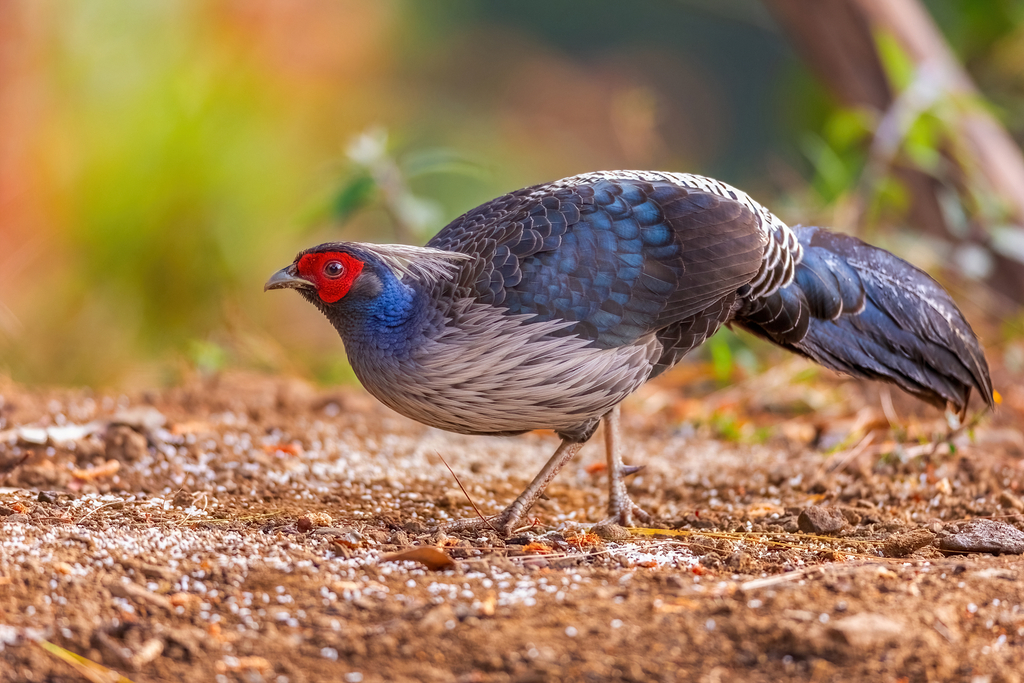
Kalij Pheasant
Photo © egorbirder
Photo © egorbirder — CC BY 4.0 — Source: iNaturalist photo #476950607Identification
The kalij pheasant is a striking and highly variable species, with males displaying dramatic plumage that differs considerably among the nine recognized subspecies. Males measure 63 to 74 cm in length, while females are noticeably smaller at 50 to 60 cm. The most distinctive shared features are the bare red face and greyish legs—the latter being a key distinguishing characteristic that separates it from the closely related red-legged silver pheasant. Western subspecies, including the white-crested kalij pheasant of the Himalayas, feature predominantly glossy blue-black plumage with white on the rump or underparts, while eastern subspecies display white or pale grey upperparts and tails with dense black vermiculation. Females are uniformly brownish across all subspecies, with some showing distinctive whitish and black underpart markings while others present a scaly appearance from pale-edged feathers.
Range & Habitat
This Himalayan foothills specialist occurs across a wide geographic range spanning from Nepal and Pakistan eastward to western Thailand. The kalij pheasant favours forests and thickets, making it an inhabitant of well-wooded terrain. While generally widespread throughout much of its range, conservation status varies significantly among subspecies: three eastern subspecies are considered threatened, and the black kalij pheasant of central Myanmar is virtually unknown in the wild. The species is also established as a feral population in Hawaii, having been introduced as a gamebird in 1962. In recognition of its cultural and ecological significance, the Government of Jammu and Kashmir designated the kalij pheasant as the official bird of the Union Territory in October 2021.
Behaviour & Diet
The kalij pheasant is a ground-dwelling galliform adapted to forested habitats. Though specific behavioural details are limited in available sources, its preference for forests and thickets indicates it is likely a terrestrial forager spending much time on the ground. The species is closely related to the silver pheasant, and the two populations are known to hybridize where their ranges overlap, suggesting behavioural similarities and some reproductive compatibility between these congeners.
Best Time & Places to See It
Travellers seeking the kalij pheasant should focus on the Himalayan foothills and forested regions of Nepal, Bhutan, northeastern India, Myanmar, and northwestern Thailand, depending on which subspecies they wish to encounter. The white-crested and nominate subspecies are found in the western Himalayas and Nepal respectively, while eastern subspecies inhabit Myanmar and Thailand. Given the species' preference for forest and thicket habitats, early morning visits to suitable woodland areas offer the best chance of observation, as pheasants are typically most active during dawn hours.
Photography Tips
Male kalij pheasants offer exceptional photographic opportunities due to their vibrant, glossy plumage and striking facial characteristics. The contrast between glossy blue-black and white plumage in western subspecies, or the intricate vermiculated patterns in eastern forms, provides striking compositional possibilities. The bare red face is a key identifying feature worth capturing in detail. Females, though less visually dramatic, present their own appeal with subtle brownish tones and variable plumage patterns. Photographers should be prepared for forest conditions with dappled light, and patience is essential when working in the dense thickets these birds favour.
Langtang National Park
Helambu, Nepal
+364 birds+14 mammals
Where the southern slopes of the Himalayan highlands descend toward the subtropical valleys of central Nepal, Langtang National Park sprawls across one of the subcontinent's most…
VIEW NATIONAL PARKValmiki National Park
Ramnagar, India
+66 birds+6 mammals
Along Bihar's western frontier, where the Gandak River winds through subtropical forest and grassland, Valmiki National Park sprawls across terrain shaped by monsoon rains and seasonal…
VIEW NATIONAL PARKSagarmatha National Park
Khumjung, Nepal
+219 birds+7 mammals
Soaring peaks and deep glacial valleys define this alpine wilderness in northeastern Nepal, where the terrain rises from forested foothills into a realm of high-altitude tundra…
VIEW NATIONAL PARKNanda Devi National Park
Garpak, India
+218 birds+5 mammals
Where the Himalayas surge into their most dramatic alpine amphitheater, a wilderness of raw geological power unfolds across 624 square kilometers of pristine terrain. Nanda Devi,…
VIEW NATIONAL PARKNo community photos yet. Log in to add the first one.
No community observations of this species yet.