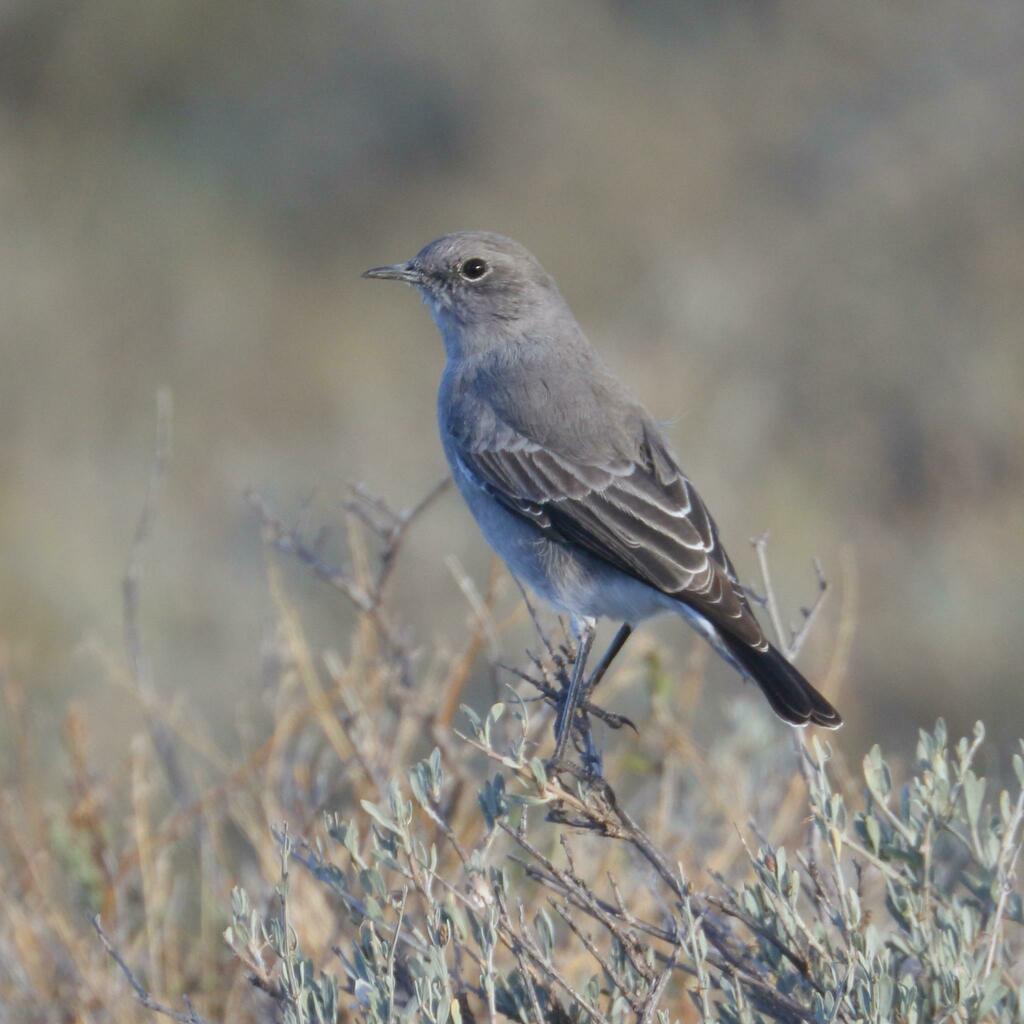
Karoo Chat
Photo © Alan Manson
Photo © Alan Manson — CC BY 4.0 — Source: iNaturalist #154811052Identification
The Karoo chat is a small passerine, measuring 16–18 cm in length and weighing around 32 gm. It is instantly recognizable by its striking plumage: grey upperparts contrasted with white underparts, a distinctive rufous patch behind the eye, and a black tail with conspicuous white outer feathers. The bird has a short, straight black bill, black legs and feet, and a dark eye. Males and females are similar in appearance, though juveniles are more heavily marked, displaying buff spotting and scaly underparts.
The Karoo chat can be distinguished from several similar species found in the same regions. It is paler than the grey form of the female mountain wheatear and differs in possessing a grey rather than white rump and completely white outer tail feathers. Its larger size and all-white outer tail feathers also prevent confusion with both the tractrac and sickle-winged chats.
Range & Habitat
This species is a common resident breeder restricted to southwestern Africa, with its range encompassing southwesternmost Angola, western Namibia, and western South Africa. Four subspecies are recognized across this distribution, each occupying slightly different regions from the Angolan border through coastal and interior Namibia to South Africa's interior plateaus.
The Karoo chat inhabits arid and semi-arid environments, primarily Karoo and desert scrub habitats in the south. Its range extends northward into the escarpment zone, demonstrating an affinity for harsh, sparsely vegetated terrain where few other birds thrive. The species shows remarkable adaptation to these extreme landscapes.
Behaviour & Diet
The Karoo chat is typically encountered singly or in pairs rather than in larger groups. It is a ground forager, actively hunting insects in short flights from the ground. Its diet consists of a variety of invertebrates including butterflies, bees, wasps, locusts, and ants, which it captures with quick aerial sorties. The bird produces distinctive vocalizations, including chak-chak and trrat-trrat calls.
This species is monogamous, maintaining pair bonds throughout life. Breeding birds construct cup-shaped nests woven from straw and leaves, typically positioned on the ground beneath bushes or shrubs for concealment. Clutches comprise two to four eggs, which are distinctively green in coloration.
Best Time & Places to See It
As a common resident breeder across its range, the Karoo chat can be encountered year-round within suitable habitat throughout southwestern Angola, western Namibia, and western South Africa. The species' preference for Karoo and desert scrub environments means that travelers should focus their search in arid lowlands and escarpment zones where sparse vegetation characterizes the landscape.
Photography Tips
Photographers should watch for these birds foraging on the ground or making short hunting flights, as this is when they are most active and visible. The bird's striking facial markings—particularly the rufous eye-patch—and contrasting grey and white plumage provide excellent photographic subjects when lighting conditions allow. The small size and preference for open, sparsely vegetated habitat mean patient stalking and careful approach are necessary to obtain close images.
Mokala National Park
Siyancuma Local Municipality, South Africa
+246 birds+35 mammals
Across the semi-arid savanna of the Northern Cape, where red earth meets sparse acacia woodland and open grassland punctuated by rocky outcrops, lies a landscape shaped…
VIEW NATIONAL PARKCederberg Wilderness Area
Cederberg Local Municipality, South Africa
+136 birds+12 mammals
Where ancient sandstone ridges rise dramatically from the semi-arid lowlands of Western Cape, the Cederberg Wilderness Area spreads across nearly 1,700 square kilometres of some of…
VIEW NATIONAL PARKTankwa-Karoo National Park
Hantam Local Municipality, South Africa
+201 birds+20 mammals
Across the semi-arid heartland of the Northern Cape, where winter rains carve ephemeral watercourses through endless ochre plains, Tankwa-Karoo National Park sprawls across more than 3,100…
VIEW NATIONAL PARKMountain Zebra National Park
Inxuba Yethemba Local Municipality, South Africa
+265 birds+35 mammals
Across the windswept plateaus and deeply incised valleys of the Eastern Cape's interior, Mountain Zebra National Park unfolds as a landscape of geological drama and ecological…
VIEW NATIONAL PARKAugrabies Falls National Park
Kai !Garib Local Municipality, South Africa
+176 birds+20 mammals
Where the Orange River cuts a dramatic scar through the Northern Cape's arid interior, Augrabies Falls National Park sprawls across nearly 1,200 square kilometers of raw,…
VIEW NATIONAL PARKAddo Elephant National Park
Sundays River Valley Local Municipality, South Africa
+388 birds+55 mammals
Where the Eastern Cape's semi-arid scrublands meet transitional woodland, Addo sprawls across 13,478 square kilometres of one of southern Africa's most biodiverse landscapes. The terrain rises…
VIEW NATIONAL PARKCamdeboo National Park
Camdeboo Local Municipality, South Africa
+272 birds+24 mammals
Granite ridges and weathered sandstone cliffs rise across a semi-arid landscape where the Karoo transitions into the eastern escarpment of South Africa, creating Camdeboo National Park's…
VIEW NATIONAL PARKSperrgebiet National Park
Barcelona, Namibia
+181 birds+18 mammals
Where the Namib's ancient gravel plains meet the Atlantic coast, one of Africa's most remote and geologically austere landscapes unfolds across more than 56,000 square kilometres.…
VIEW NATIONAL PARKDorob National Park
Henties Bay, Namibia
+230 birds+13 mammals
Where the Skeleton Coast meets the Namib Desert's inland reaches, Dorob National Park sprawls across 34,021 square kilometres of one of southern Africa's most austere and…
VIEW NATIONAL PARKSkeleton Coast Park
Barcelona, Namibia
+143 birds+7 mammals
Where the Atlantic's cold Benguela Current collides with one of Africa's most hostile coastlines, the Skeleton Coast Park sprawls across more than 104,000 square kilometres of…
VIEW OBSERVATION POINTNamib-Naukluft National Park
Namibia
+217 birds+33 mammals
Across nearly 94,000 square kilometers of southwestern Namibia, a landscape of extremes unfolds where towering sand dunes meet rugged mountain ranges, and ancient riverbeds carve through…
VIEW NATIONAL PARKNamibRand Nature Reserve
Hammerstein, Namibia
+107 birds+12 mammals
Where rust-coloured dunes surrender to sculpted granite outcrops and vast plains stretch toward an endless horizon, one of southern Africa's most pristine wilderness areas unfolds. The…
VIEW NATURE RESERVENo community photos yet. Log in to add the first one.
No community observations of this species yet.