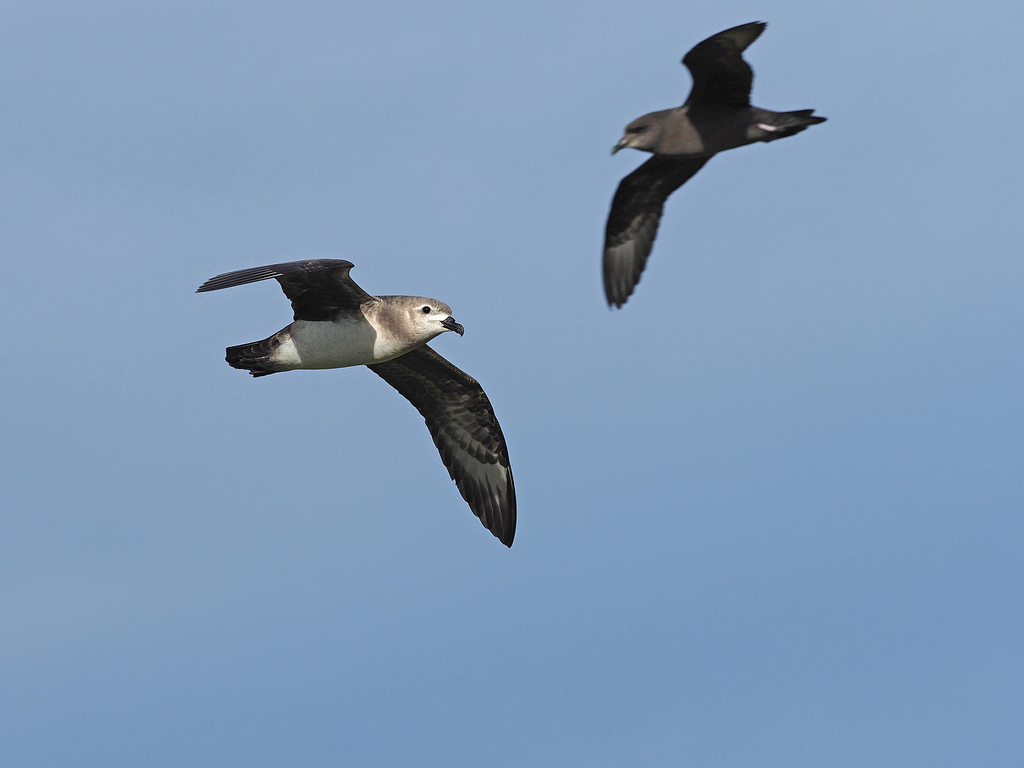
Kermadec Petrel
Photo © James Eaton
Photo © James Eaton — CC0 1.0 — Source: iNaturalist photo #395655140Identification
The Kermadec petrel is a medium-sized gadfly petrel measuring 38 cm in length with a wingspan of 100 cm. This species is notably polymorphic, occurring in light, dark, and intermediate colour morphs, which can make field identification challenging. Observers should be prepared to encounter birds across this colour range, particularly when scanning seabirds at sea or near breeding colonies.
Range & Habitat
The Kermadec petrel breeds across the Pacific Ocean from Lord Howe Island to the Juan Fernández Islands. The species is rarely recorded west of Lord Howe Island, where a tiny population of fewer than 100 individuals persists on Balls Pyramid. The Kermadec Islands, a New Zealand possession, represent the only breeding location in New Zealand waters, with colonies established on Nugent, Napier, Meyer, Dayrell, North Chanter, Macauley, Haszard, and Cheeseman Islands. Historically, the species bred in substantial numbers on the main Kermadec islands and on Raoul Island—where an estimated 500,000 individuals nested in 1908—but predation by introduced cats and rats has eliminated breeding there. The larger subspecies, P. n. juana, also breeds on Round Island off Mauritius. The species occasionally appears as a vagrant in Hawaii, Australia, and New Zealand, with records suggesting poleward movements may occur during periods of warmer-than-average sea surface temperatures.
Behaviour & Diet
Kermadec petrels are monogamous seabirds that raise a single chick annually. Chicks become independent after 100–130 days of parental care. The species exhibits an unusual breeding pattern, with different colonies nesting during different periods: some breed from October to February, while others nest from February to March. They feed on squid, fish, and other marine creatures encountered at sea.
Best Time & Places to See It
The primary destination for observing this species is the Kermadec Islands, particularly during the breeding season. At Balls Pyramid, birds typically nest in late summer. The wider Kermadec archipelago offers opportunities from October through March, depending on the specific colony. For northern hemisphere birdwatchers, occasional vagrancy records from Hawaii and Australia suggest these locations may yield sightings during dispersal periods, though such encounters remain rare. Sea-watching from ships traversing the Pacific between New Zealand and the Juan Fernández Islands may also produce sightings.
Photography Tips
Photographing Kermadec petrels requires patience and understanding of their oceanic habits. At breeding colonies, early morning and evening light often produces the best results for capturing perched birds or those returning to nest sites. The species' polymorphic plumage offers interesting compositional opportunities—attempt to photograph individuals representing different colour morphs to document the range of variation. At sea, approach slowly and position yourself to catch birds in flight against favorable lighting. A substantial telephoto lens (at least 400–600 mm) is essential for distant seabirds, while a wider lens may suit colony photography where birds nest in accessible cliff locations.
Chile: Fuegian Snipe & Juan Fernandez
Sydney Harbour National Park
Sydney, Australia
+203 birds+26 mammals
Where Sydney Harbour's sheltered waters meet the sandstone headlands of New South Wales, a mosaic of coastal heathland, eucalyptus woodland and rocky shores creates one of…
VIEW NATIONAL PARKFarallon National Wildlife Refuge
San Francisco, United States
+384 birds+16 mammals
Windswept granite peaks rising abruptly from the Pacific, the Farallon Islands form a wildlife sanctuary of extraordinary seabird abundance and ecological significance just twenty-seven miles west…
VIEW WILDLIFE SANCTUARYKīlauea Point National Wildlife Refuge
Kilauea, United States
+79 birds+1 mammals
At the northernmost tip of Kauai, where the Pacific trades collide with volcanic rock, Kīlauea Point National Wildlife Sanctuary crowns a dramatic headland overlooking one of…
VIEW WILDLIFE SANCTUARYMidway Atoll National Wildlife Refuge
United States
+91 birds+1 mammals
Straddling the international date line roughly midway between North America and Asia, this atoll sanctuary rises from the North Pacific as a cluster of coral and…
VIEW WILDLIFE SANCTUARYNo community photos yet. Log in to add the first one.
No community observations of this species yet.