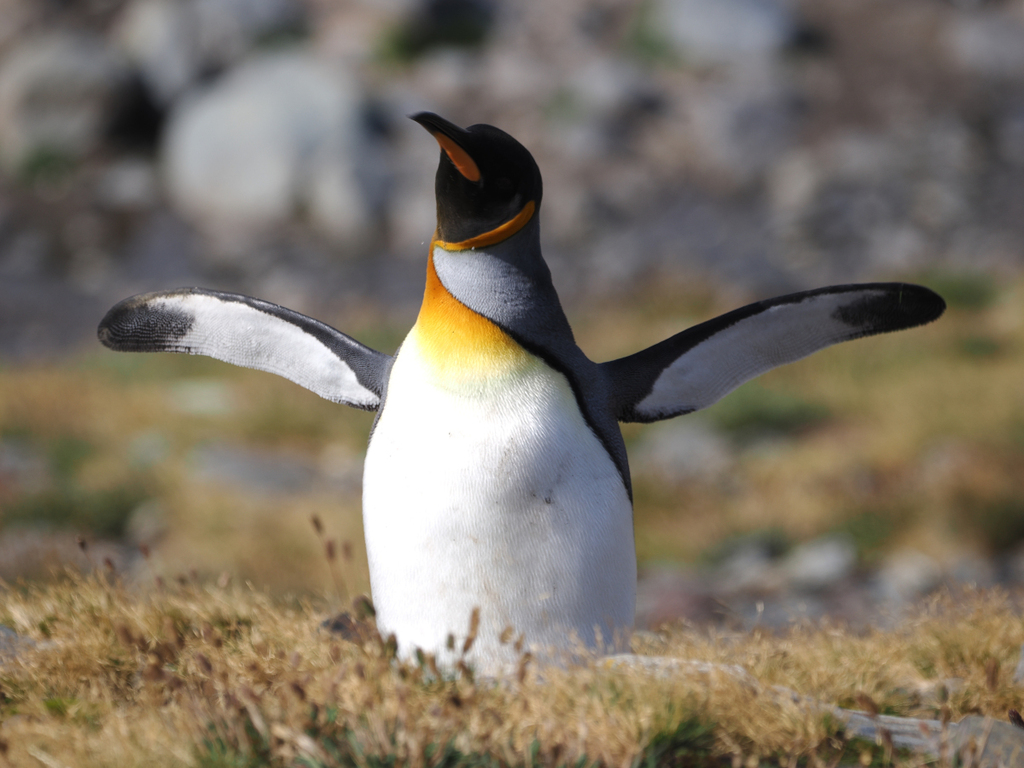
King Penguin
Photo © steve b
Photo © steve b — CC0 1.0 — Source: iNaturalist photo #260189026Identification
The king penguin is the second largest penguin species, standing 70 to 100 cm tall and weighing 9.3 to 18 kg. Males are slightly larger than females, though the sexes look similar otherwise and are best distinguished by their calls. At first glance, king penguins resemble their larger relatives, the emperor penguins, but several field marks separate them: the king penguin has a bright orange cheek patch (versus yellow and white in emperors), more orange on the upper chest, orange rather than pink markings on the lower mandible, a longer and straighter bill, larger flippers, and a noticeably sleeker body. The juvenile king penguin wears heavy dark brown down and looks quite different from the adult, but once moulted, resembles the adult with somewhat muted colouration.
Among other penguin species, king penguins are unmistakable due to their much larger size and taller frame, combined with their distinctive colourful markings and grizzled sooty-greyish back. Emperor penguin chicks, by contrast, are mostly grey with black and white masks.
Range & Habitat
King penguins breed on subantarctic islands between 45 and 55°S, including South Georgia, the Falkland Islands, southern Argentina, and other temperate islands of the region. The largest breeding populations are found on the Crozet Islands (around 455,000 pairs), the Prince Edward Islands (228,000 pairs), the Kerguelen Islands (240,000–280,000 pairs), and Macquarie Island in the Southern Ocean (around 70,000 pairs). The total global population is estimated at 2.23 million pairs and is currently increasing. The non-breeding range remains poorly understood, though vagrant birds have been recorded on the Antarctic Peninsula and in South Africa, Australia, and New Zealand.
Behaviour & Diet
King penguins are deep-diving specialists, repeatedly diving to depths exceeding 100 metres and recorded at depths greater than 300 metres. Their diet consists mainly of lanternfish, squid, and krill. Despite their impressive foraging abilities, king penguins face natural predators including giant petrels, skuas, the snowy sheathbill, leopard seals, and orcas.
Best Time & Places to See It
The Crozet Islands, Prince Edward Islands, and Kerguelen Islands in the Southern Ocean support the largest king penguin populations and offer the best opportunities for viewing. South Georgia archipelago and the Falkland Islands are also excellent destinations, though populations there were heavily depleted in the early 1900s by whalers who burned penguins for fuel. Macquarie Island provides another significant viewing location with around 70,000 breeding pairs.
Photography Tips
The king penguin's striking colourful markings—the bright orange cheek patches and chest plumage—photograph beautifully and are best captured in good light. Their larger size compared to other penguin species and their sleek profile make them relatively easy subjects. Colonies on subantarctic islands can be visited during breeding season, though access and conditions vary by location. The contrast between adults and juveniles in their brown down plumage offers interesting compositional opportunities if you visit during breeding periods when both are present.
Sea Lion Island
Sealion Island Settlement, Falkland Islands
+74 birds+3 mammals
Windswept tussock grasslands roll across volcanic terrain where Southern Ocean swells crash against rocky shores, creating one of the Falkland Islands' most dramatic wildlife theatres. This…
VIEW ISLAND & ARCHIPELAGOKidney Island
Stanley, Falkland Islands
+47 birds
Wind-scoured tussock grassland sweeps across this remote South Atlantic outcrop, where peaty soils and exposed rock formations create a landscape as austere as it is vital.…
VIEW ISLAND & ARCHIPELAGOMurrell Farm
falskland islands, Falkland Islands
+54 birds
Rolling grasslands sweep across windswept plateaux where the South Atlantic exerts its relentless influence on the vegetation, sculpting tussock grassland into a tapestry of browns and…
VIEW NATURE RESERVECape Dolphin
falskland islands, Falkland Islands
+54 birds+1 mammals
Where windswept grasslands meet dramatic coastal cliffs, the Falkland Islands' northern reaches reveal one of the Southern Hemisphere's most compelling seabird sanctuaries. The terrain here is…
VIEW NATURE RESERVEVolunteer Point
Stanley, Falkland Islands
+70 birds+3 mammals
Windswept grasslands meet volcanic black sand beaches where three penguin species converge in the South Atlantic's most theatrical wildlife theatre. This remote peninsula on East Falkland…
VIEW NATURE RESERVEWest Point Island
West Point, Falkland Islands
+67 birds+3 mammals
Windswept cliffs plunge dramatically into the South Atlantic, their rust-coloured rock faces sculpted by millennia of gales and spray. This northwestern outpost of the Falkland Islands…
VIEW ISLAND & ARCHIPELAGOCabo de Hornos National Park
Cape Horn, Chile
+88 birds+9 mammals
Where the Andes plunge into the Southern Ocean and the Drake Passage churns between two continents, Cabo de Hornos National Park sprawls across one of Earth's…
VIEW NATIONAL PARKMonte León National Park
Argentina
+100 birds+4 mammals
Where the Patagonian steppe meets the Atlantic, Monte León National Park protects a landscape of windswept coastal cliffs, rocky outcrops, and semi-arid grassland spanning over 1,200…
VIEW NATIONAL PARKLemaire Channel
Orne Harbour, Antarctica
+25 birds+13 mammals
Where granite peaks plunge into steel-grey waters, the Lemaire Channel carves one of Antarctica's most dramatic passages. This narrow strait, squeezed between the Antarctic Peninsula and…
VIEW PROTECTED LANDSCAPESalisbury Plain
South Georgia, South Georgia and the South Sandwich Islands
+33 birds+4 mammals
Where tussock grasses bow to relentless Antarctic winds and glacial meltwater carves braided channels through obsidian volcanic soil, one of Earth's most remote wildlife sanctuaries reveals…
VIEW PROTECTED LANDSCAPESt. Andrews Bay
South Georgia, South Georgia and the South Sandwich Islands
+34 birds+6 mammals
Where windswept tundra dissolves into obsidian beaches, one of the planet's most extraordinary wildlife theaters unfolds across St. Andrews Bay. This remote corner of South Georgia…
VIEW PROTECTED LANDSCAPEFortuna Bay
Stromness, South Georgia and the South Sandwich Islands
+37 birds+5 mammals
Where tussock grasslands sweep down to black-sand beaches and elephant seals haul out in thunderous colonies, the raw sub-Antarctic landscape reveals itself in its most dramatic…
VIEW PROTECTED LANDSCAPEPrion Island
Prince Olav Harbour, South Georgia and the South Sandwich Islands
+36 birds+2 mammals
Windswept tussock grasslands rise sharply from boulder-strewn beaches where the Southern Ocean hurls its grey swells against black volcanic rock. This remote speck in South Georgia's…
VIEW ISLAND & ARCHIPELAGOCooper Bay
Cooper Bay, South Georgia and the South Sandwich Islands
+28 birds+5 mammals
Where black-sand beaches meet towering cliffs striped with cascading meltwater, one of the Southern Ocean's most dramatic amphitheaters reveals itself. Cooper Bay cuts a deep indent…
VIEW PROTECTED LANDSCAPEElsehul Bay
Bird Island Station, South Georgia and the South Sandwich Islands
+33 birds+4 mammals
Granite peaks rise sheer from the Southern Ocean, their weathered faces streaked with cascading meltwater and cloaked in tussock grass that bends beneath relentless winds. This…
VIEW PROTECTED LANDSCAPENo community photos yet. Log in to add the first one.
No community observations of this species yet.