Identification
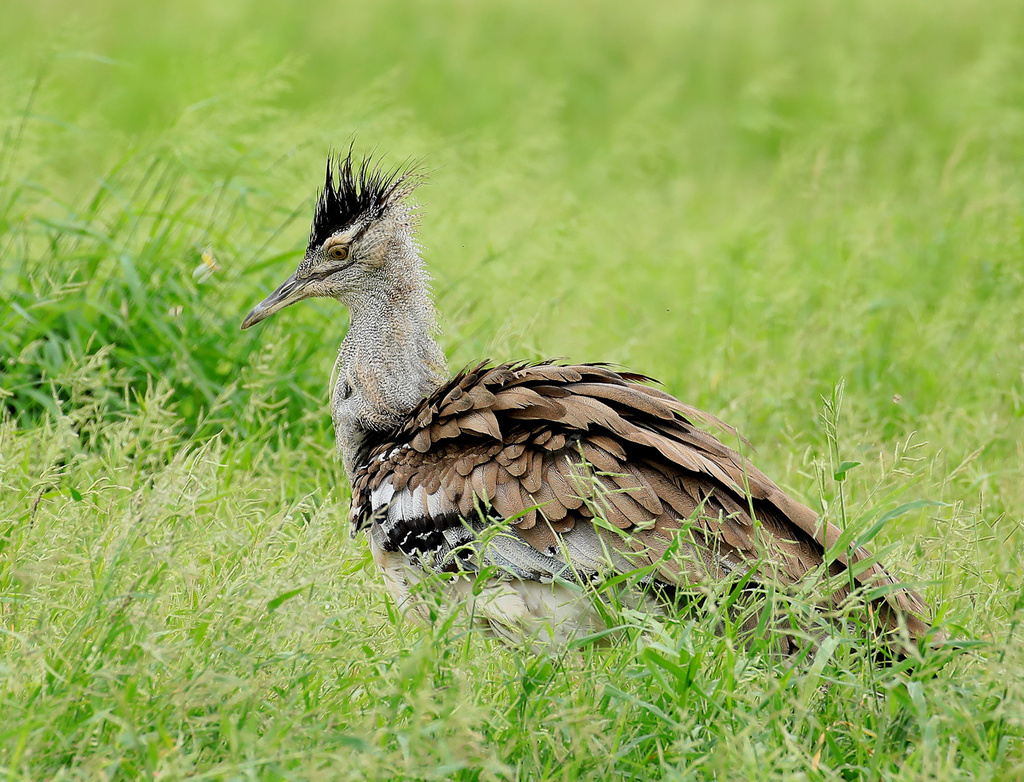
The kori bustard is Africa's largest flying bird, distinguished by its impressive size and cryptic plumage of grey, brown, black and white. Males are massive, measuring 105–135 cm in length with wingspans of 230–275 cm, and typically weigh 7–18 kg, though exceptional individuals may reach 20 kg or more—making them among the heaviest living flying animals on Earth. Females are noticeably smaller, weighing only one-third to half the mass of males, with shorter necks and slimmer legs.
Look for a large, long-legged ground bird with a distinctive blackish crest on its head and a prominent white eye stripe. The neck appears thick due to loose feathers, and a bold black collar marks the base of the hind-neck. The throat and chin are whitish with fine black barring, the belly is white, and the tail shows broad bands of brownish-grey and white. The bill is light greenish-horn and relatively long, while the eye is pale yellow and the legs yellowish. Females resemble males but are much slimmer with less pronounced crests.
Range & Habitat
Two subspecies are recognized across sub-Saharan Africa. The nominate race, A. k. kori, inhabits southern Africa including Botswana, Zimbabwe, Namibia, southern Angola, South Africa and Mozambique, where it is relatively pale in coloration. The "Somali kori" subspecies, A. k. struthiunculus, is found in East and Northeast Africa—Ethiopia, Uganda, South Sudan, Kenya and Tanzania—and displays bolder head patterning with more black and white on the wings. The two races are separated by the miombo woodlands of central Africa.
As a ground-dwelling species, kori bustards favour open and semi-open habitats where they can move freely and spot approaching threats across wide distances.
Behaviour & Diet
The kori bustard is an opportunistic omnivore, feeding on a varied diet according to availability. Like other bustards, it is primarily a ground-dweller, preferring to walk and run rather than fly. The species displays marked sexual dimorphism in breeding behaviour: males are polygamous, attempting to breed with as many females as possible and taking no part in raising young. Females construct simple nests consisting of shallow hollows in the earth, often concealed by nearby vegetation or other obstructive objects such as trees.
Best Time & Places to See It
Southern African reserves in Botswana, Namibia and South Africa offer reliable opportunities to see the nominate pale race, while East African parks in Kenya and Tanzania, particularly Serengeti National Park, are prime locations for encountering the darker "Somali kori" subspecies. The species' preference for open habitats makes it visible in suitable terrain, though its cryptic coloration provides effective camouflage.
Photography Tips
Photograph kori bustards in open habitats where the bird's massive frame and distinctive markings are fully visible against the landscape. The dramatic sexual dimorphism makes it rewarding to capture both males and females if possible—note the male's heavier build and more pronounced crest. Early morning and late afternoon light will enhance the subtle patterning of grey, brown and buff plumage. Patience is essential, as ground-dwelling bustards may remain motionless for extended periods. When disturbed, they may run before taking flight, offering dynamic shooting opportunities. The pale yellow eye and contrasting black collar are key features to bring into sharp focus.