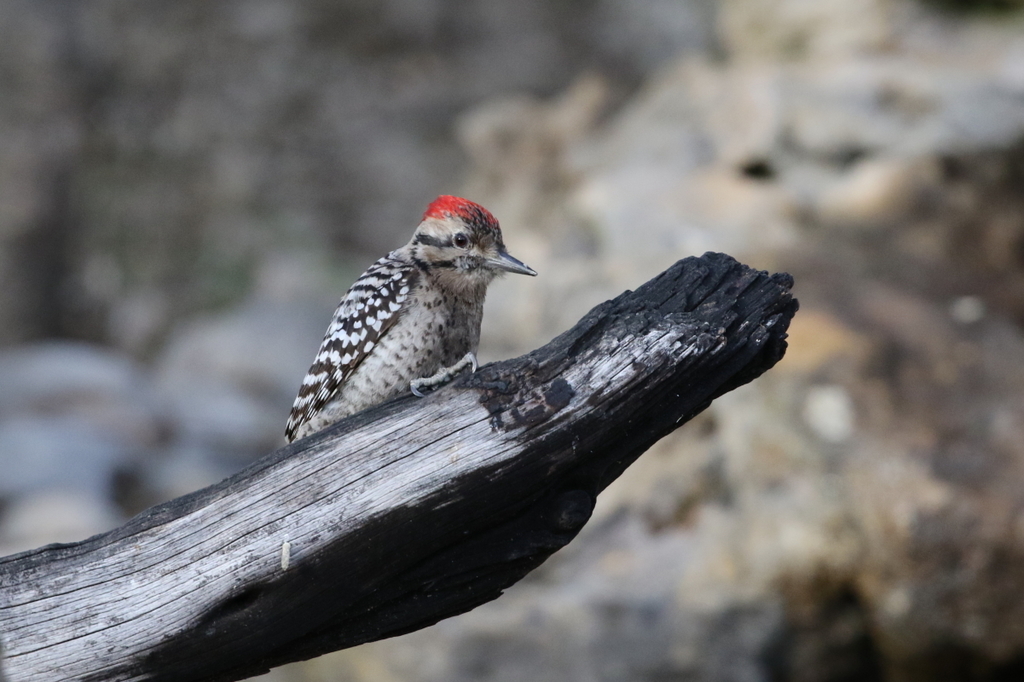
Ladder-backed Woodpecker
Photo © Brooke Smith
Photo © Brooke Smith — CC BY 4.0 — Source: iNaturalist photo #179375890Identification
The ladder-backed woodpecker is a small woodpecker, measuring 6½ to 7½ inches in length. Its most distinctive feature is the black-and-white barred pattern on its back and wings, resembling the rungs of a ladder. The bird is primarily black and white overall, with a speckled black rump and cream-colored underparts on the breast and flanks. Southern populations tend to have duskier buff breasts and noticeably smaller bills. Adult males display a red crown patch, which is smaller in immature birds and entirely absent in adult females.
The ladder-backed woodpecker closely resembles Nuttall's woodpecker, but can be distinguished by its much less black coloring on the head and upper back. The two species' ranges overlap only minimally in southern California and northern Baja California, where hybrids occasionally occur.
Range & Habitat
This species is fairly common across a rather large range and is found year-round in dry brushy areas and thickets throughout the southwestern United States, most of Mexico, and locally in Central America. In the north, its range extends to extreme southern Nevada and extreme southeastern Colorado, while it reaches south to Nicaragua in Central America.
Behaviour & Diet
Like most woodpeckers, the ladder-backed woodpecker uses its chisel-like bill to bore into tree trunks in search of insects and their larvae. In addition to this primary diet, it supplements its feeding by consuming fruit produced by cacti, an adaptation particularly useful in the arid environments it frequents.
The species nests in cavities that it excavates from tree trunks, or in more arid environments, it will nest in a large cactus instead. The female lays between 2 and 7 plain white eggs, which are incubated by both sexes, though other details of the nesting period remain poorly documented.
Best Time & Places to See It
As a year-round resident throughout its range, the ladder-backed woodpecker can be observed in any season in the southwestern United States, Mexico, and Central America. Look for it in dry brushy areas and thickets, particularly in arid regions where cacti are present. The species' preference for such habitats makes it most visible in desert scrubland and semi-arid woodlands.
Photography Tips
The ladder-backed woodpecker's bold black-and-white pattern and small size make it an attractive photographic subject. Position yourself in dry brushy habitat early in the day when the bird is most active. The contrast between its dark barring and white underparts photographs well in bright southwestern sunlight, though be prepared for quick movements as it forages on tree trunks and cacti. Males with their red crown patches offer particularly striking shots, especially when perched or in profile.
Big Bend National Park
Bitter Lake National Wildlife Refuge
Bosque del Apache National Wildlife Refuge
Cabeza Prieta National Wildlife Refuge
Carlsbad Caverns National Park
Cave Creek Canyon
Chiricahua Mountains
Death Valley National Park
Dzibilchantún National Park
Nothing matches these filters.
No community photos yet. Log in to add the first one.
No community observations of this species yet.