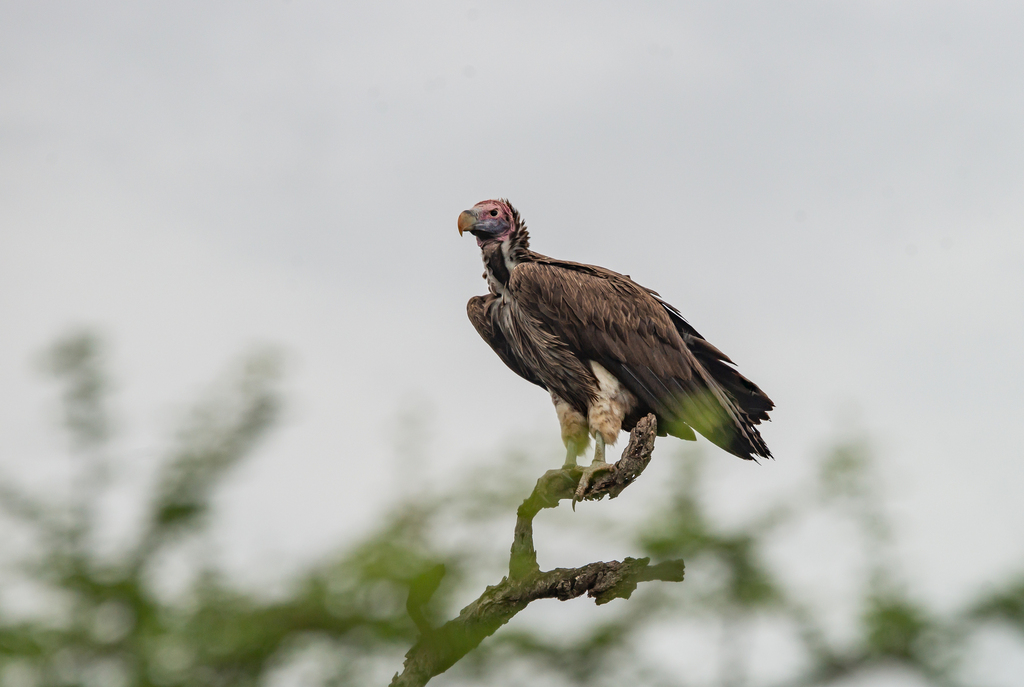
Lappet-faced Vulture
Photo © martin ingemansson
Photo © martin ingemansson — CC BY 4.0 — Source: iNaturalist photo #476581769Identification
The lappet-faced vulture is a massive bird, ranking as the longest and largest winged vulture across much of Africa and the Arabian Peninsula. It measures around 95–115 cm in body length, with a wingspan of 2.5–2.9 m. Among its most striking features is a very large bill—up to 10 cm long and 5 cm deep—one of the largest of any bird of prey in its family.
Plumage patterns vary by subspecies and region. African birds are blackish above with strongly contrasting white thigh feathers, while the feathers on the back are lined with brown. Arabian birds are darker brown rather than black above. The underside ranges from pure white to buff-brown. Like all vultures, it has a distinctive bald head, with coloration varying from reddish in southern Africa to dull pink elsewhere, to pink on the back of the head and gray on the front in the Arabian Peninsula. The colorful head and fleshy folds on its sides are highly distinctive. In flight, look for large, broad wings held with front edges parallel and slightly pointed, serrated-looking wingtips. It is considerably larger than the similarly marked hooded vulture and can only be confused at great distance.
Range & Habitat
This species is patchily distributed across much of Africa and the Arabian Peninsula. In Africa, it breeds in countries spanning from Senegal and Mali in the west through Chad, Sudan, and Egypt to Ethiopia, Somalia, Kenya, Tanzania, and southern Africa—including South Africa, Zimbabwe, Botswana, and Namibia. On the Arabian Peninsula, it breeds in Yemen, Oman, the United Arab Emirates, and Saudi Arabia. However, it is absent from much of central and western Africa and is declining elsewhere in its range.
The lappet-faced vulture prefers dry savannah, thornbush, arid plains, and deserts with scattered trees in wadis and open mountain slopes. It typically inhabits undisturbed open country with scattered trees and minimal grass cover. While foraging, birds may venture into denser habitats and even human-inhabited areas, particularly when attracted to roadkill. Elevation ranges from sea-level to 4,500 m.
Behaviour & Diet
This is a scavenging vulture that feeds mostly on animal carcasses, locating food by sight or by watching other vultures. The lappet-faced vulture is the most powerful and aggressive of African vultures—other vultures will typically cede a carcass to it if it asserts dominance. This aggression is often beneficial to weaker vultures, as the lappet-faced can tear through the tough hides and knotty muscles of large mammals that others cannot penetrate. Interestingly, lappet-faced vultures frequently hang around the edges of large feeding gatherings, waiting until other vultures finish before consuming remnant skin, tendons, and other coarse tissues.
Large game animals, up to the size of elephants, are preferred as carrion since they provide substantial sustenance from a single meal. A full crop can contain up to 1.5 kg of meat. More than most vultures, lappet-faced vultures have been recorded regularly feeding on freshly killed smaller mammals, birds, and reptiles, including roadkills. They are also believed to occasionally attack live animals, particularly young and weak individuals, and may raid the nests and young of other birds, including flamingo colonies.
Best Time & Places to See It
The lappet-faced vulture is found across a vast range in Africa and the Arabian Peninsula, though distribution is patchy. Throughout their range—from the savannahs and arid regions of East Africa and southern Africa to the deserts of the Arabian Peninsula—they inhabit open country with scattered trees. The species is most likely to be encountered in protected wildlife areas and national parks across their breeding range, from countries like Kenya and Tanzania to Botswana, Namibia, and South Africa in the south.
Your best opportunities come by scanning open skies and savannah landscapes, particularly near large mammal populations where carcasses may attract vultures. Early morning is often productive for observing vultures in flight as they begin their daily thermals.
Photography Tips
The lappet-faced vulture's large size and distinctive silhouette make it an impressive photographic subject. Capture its massive wingspan and powerful build in soaring flight against clear skies—a telephoto lens (400mm or longer) will be essential for distant birds. The contrasting white thigh feathers are a key identification feature, so try to compose shots that show the bird's underside profile when perched or banking in flight.
When photographing perched birds, focus on the unique colorful head and fleshy facial folds—these are crucial identifying marks and create striking portraits. The bird's large, powerful bill is also distinctive; try to include it clearly in close-up shots. Given this species' preference for open country with scattered trees, you'll often have good visibility with uncluttered backgrounds, which will help isolate the bird in your images.
Nothing matches these filters.
Bwindi Impenetrable National Park
Lake Mburo National Park
Mabamba Swamp
Murchison Falls National Park
Queen Elizabeth National Park
Abijata-Shalla Lakes National Park
Amboseli National Park
Arusha National Park
Awash National Park
Nothing matches these filters.
No community photos yet. Log in to add the first one.
No community observations of this species yet.