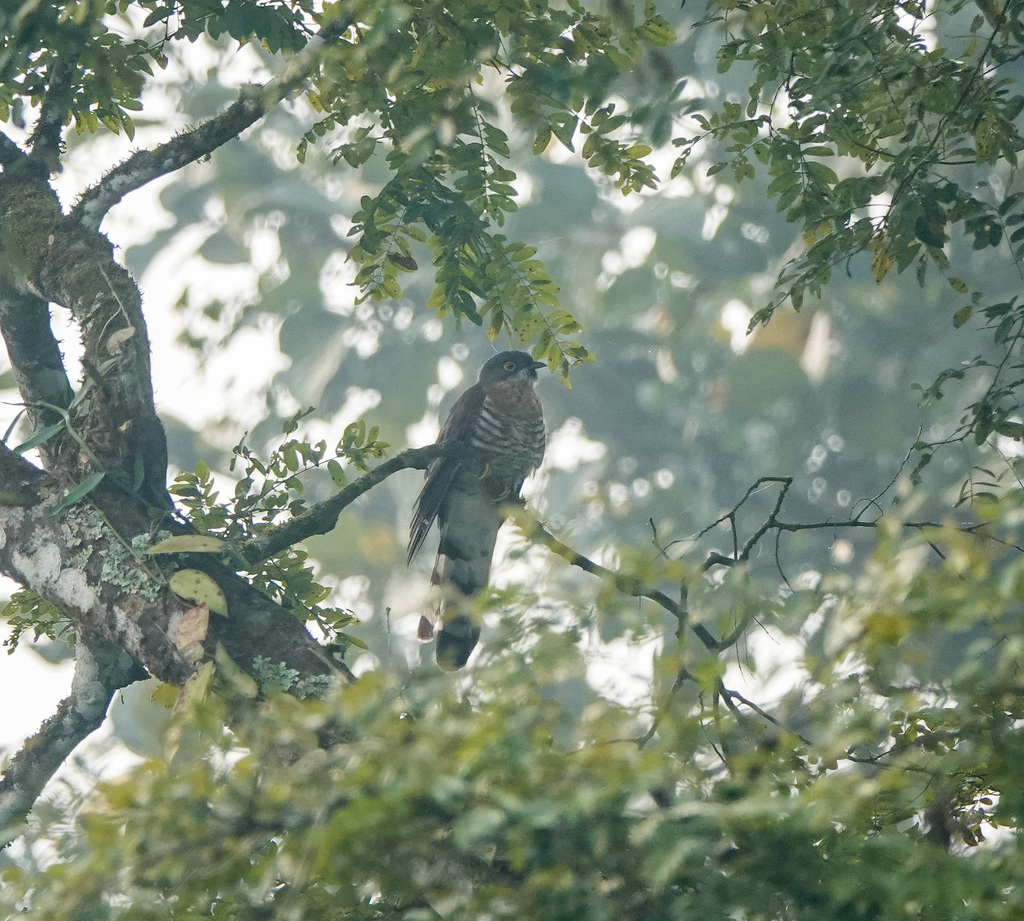
Large Hawk-Cuckoo
Photo © Rejoice Gassah
Photo © Rejoice Gassah — CC BY 4.0 — Source: iNaturalist #171335818Identification
The Large Hawk-Cuckoo is a distinctive member of the cuckoo family, readily distinguished from its smaller relative, the Common Hawk-Cuckoo, by its larger size and a conspicuous black patch on the chin. This feature makes field identification straightforward for birdwatchers familiar with both species. Like other hawk-cuckoos, it has a hawk-like appearance that helps it blend into woodland environments, though its true nature as a brood parasite sets it apart behaviorally from the raptors it superficially resembles.
Range & Habitat
This species boasts an impressive breeding distribution across temperate and subtropical Asia, spanning from the Himalayas through to East Asia. Its range encompasses Bangladesh, Bhutan, Cambodia, China, India, Laos, Malaysia, Myanmar, Nepal, Pakistan, the Philippines, Singapore, Taiwan, Thailand, and Vietnam. Many populations undertake seasonal migrations, retreating to southern wintering grounds when breeding concludes. The species has occasionally been recorded as a vagrant on Christmas Island, extending beyond its typical range.
Large Hawk-Cuckoos favor temperate forests and subtropical or tropical mangrove forests as their preferred habitats, making them birds of well-wooded regions rather than open country. Their adaptability to both highland temperate zones and tropical lowlands reflects their broad geographic success across Asia.
Behaviour & Diet
These cuckoos are most vocal during summer breeding months, producing loud and highly repetitive calls that characterize their presence in breeding territories. Their vocalizations continue well into the evening, often extending after dusk—a useful clue for nocturnal birdwatchers. In stark contrast, birds occupying winter grounds tend to fall silent, making them far less detectable during the non-breeding season.
Like all cuckoos, the Large Hawk-Cuckoo is an obligate brood parasite, laying its eggs in the nests of other bird species rather than raising its own young. Laughing-thrushes and babblers serve as primary hosts, though some host species have evolved impressive defenses: certain laughing-thrushes, such as Pterorhinus sannio, are capable of detecting and rejecting cuckoo eggs. In response, the cuckoos have evolved eggs that closely mimic those of their hosts, an evolutionary arms race spanning generations.
Best Time & Places to See It
Summer is unquestionably the best season for locating and observing Large Hawk-Cuckoos, as their loud, repetitive calls make them conspicuous during breeding months. Their vocalizations extending past dusk mean that dawn and dusk surveys, or even evening listening sessions, can be particularly productive. Winter offers considerably fewer opportunities, as birds in their southern wintering grounds become largely silent and therefore difficult to detect.
Birders should focus on temperate forests and subtropical or tropical mangrove habitats across the species' broad range. The Himalayan foothills and adjacent regions of South and Southeast Asia represent prime locations, particularly during the breeding season when vocal activity peaks.
Photography Tips
Photographing Large Hawk-Cuckoos presents challenges owing to their often skulking behavior and preference for dense forest cover. However, their summer calling behavior provides an opportunity: patient photographers can use vocalizations to locate birds and position themselves accordingly. Early morning and late evening hours, when both calling intensity and light conditions favor activity, offer the best windows for successful photography.
The distinctive black chin patch is a key identifying feature worth capturing in images, as it separates this species from the smaller Common Hawk-Cuckoo. Focus on obtaining clear head shots that showcase this diagnostic mark. Patience and a willingness to spend time listening and waiting in suitable forest habitat will yield the best results.
Langtang National Park
Helambu, Nepal
+364 birds+14 mammals
Where the southern slopes of the Himalayan highlands descend toward the subtropical valleys of central Nepal, Langtang National Park sprawls across one of the subcontinent's most…
VIEW NATIONAL PARKOrang National Park
Rangagarapathar, India
+298 birds+1 mammals
Where the Brahmaputra's floodplains meet the foothills of Assam, Orang National Park unfolds across a mosaic of riverine grasslands, forests and wetlands that pulse with the…
VIEW NATIONAL PARKSagarmatha National Park
Khumjung, Nepal
+219 birds+7 mammals
Soaring peaks and deep glacial valleys define this alpine wilderness in northeastern Nepal, where the terrain rises from forested foothills into a realm of high-altitude tundra…
VIEW NATIONAL PARKKhangchendzonga National Park
Sakkyong, India
+290 birds+1 mammals
Where the eastern Himalayas surge toward their crowning peaks, Khangchendzonga National Park embraces a landscape of almost overwhelming vertical drama. Rising from subtropical river valleys into…
VIEW NATIONAL PARKHat Noppharat Thara-Mu Ko Phi Phi National Park
Ao Nang, Thailand
+253 birds+9 mammals
Where limestone karsts rise dramatically from turquoise waters, Hat Noppharat Thara-Mu Ko Phi Phi National Park unfolds across a mosaic of beach, mangrove forest, and island…
VIEW NATIONAL PARKKhao Yai National Park
Prachantakham District, Thailand
+377 birds+46 mammals
Evergreen dipterocarp forest blankets the rolling terrain of this national park in eastern Thailand, where limestone hills rise abruptly from the forest floor and seasonal streams…
VIEW NATIONAL PARKMu Ko Similan National Park
Lam Kaen, Thailand
+82 birds+1 mammals
Granite islands rise from the Andaman Sea in a scattered archipelago where limestone cliffs meet turquoise shallows, their steep faces weathered into caves and overhangs that…
VIEW NATIONAL PARKGiant Panda National Park
Mianyang, China
+447 birds+47 mammals
Where the eastern slopes of China's Sichuan plateau descend into cloud-wrapped valleys, one of Asia's most biodiverse landscapes unfolds across more than 350,000 square kilometres. This…
VIEW NATIONAL PARKMount Nanling Forest Park
Ruyang Forest Farm, China
+179 birds+3 mammals
Granite ridges and weathered peaks rise through a canopy of subtropical montane forest where Ruyang Forest Farm anchors one of southern China's most biodiverse landscapes. Across…
VIEW FOREST & JUNGLEJiuzhai Valley
Jiuzhaigou County, China
+226 birds+7 mammals
Where crystalline alpine streams cascade through limestone gorges and karst terrain rises in dramatic vertical walls, Jiuzhai Valley unfolds across nearly 1,300 square kilometers of southwestern…
VIEW NATURAL MONUMENTHuanglong Scenic and Historic Interest Area
Ngawa Tibetan and Qiang Autonomous Prefecture, China
+194 birds+7 mammals
Across the high plateau of northwestern Sichuan, a geological wonder unfolds where limestone terraces and mineral-rich springs have sculpted one of China's most distinctive natural monuments.…
VIEW NATURAL MONUMENTKanha Tiger Reserve
Kanha Kisli F.V., India
+321 birds+23 mammals
Where sal forests give way to emerald meadows and crystalline streams carve through ancient valleys, one of India's finest wilderness reserves unfolds across the Maikal Range.…
VIEW NATIONAL PARKKaziranga National Park
Kohora, India
+422 birds+26 mammals
Dawn breaks over the floodplains of the Brahmaputra, where tall grasslands stretch endlessly beneath monsoon-heavy skies. This sprawling wilderness of northeastern Assam is a mosaic of…
VIEW NATIONAL PARKNanda Devi National Park
Garpak, India
+218 birds+5 mammals
Where the Himalayas surge into their most dramatic alpine amphitheater, a wilderness of raw geological power unfolds across 624 square kilometers of pristine terrain. Nanda Devi,…
VIEW NATIONAL PARKPeriyar National Park
Mlappara, India
+232 birds+4 mammals
Dawn breaks over mist-shrouded ridges where the Western Ghats tumble toward Kerala's spice-scented lowlands. Here, ancient tropical forests envelope a glittering artificial lake, creating a mosaic…
VIEW NATIONAL PARKPampadum Shola National Park
Vattavada, India
+258 birds+14 mammals
Where misty shola forests cling to the high plateaus of the Nilgiri Mountains, ancient evergreen remnants create a world apart. This 2,316-hectare reserve protects one of…
VIEW NATIONAL PARKNagarahole Tiger Reserve
Nalkeri Forest, India
+323 birds+23 mammals
Where granite escarpments rise above dense deciduous forests and the Kabini River carves through pristine wilderness, one of India's most biodiverse landscapes unfolds across the Western…
VIEW NATIONAL PARKTaman Negara National Park
Kampong Samas, Malaysia
+393 birds+48 mammals
Where ancient rainforest meets limestone peaks, one of Southeast Asia's oldest protected wilderness preserves sprawls across 4,343 square kilometers of primordial landscape. Dipterocarp giants tower overhead,…
VIEW NATIONAL PARKHainan Tropical Rainforest National Park
Haikou, China
+69 birds+1 mammals
Tropical forests blanket the volcanic slopes of central Hainan, where moisture-laden winds from the South China Sea collide with mountainous terrain to create some of China's…
VIEW NATIONAL PARKWuyishan National Park
Yanshan County, China
+141 birds+2 mammals
Where subtropical monsoon rains sustain a perpetually humid landscape, Wuyishan National Park rises from Fujian's eastern plateau as a realm of forested ridges, cascading streams, and…
VIEW NATIONAL PARKWolong National Nature Reserve
Wenchuan County, China
+333 birds+17 mammals
Where the Qingyi River cuts through the eastern flanks of the Minshan Range, a temperate montane forest cloaks steep valleys in dense canopy that thins dramatically…
VIEW NATURE RESERVEPoyang Lake National Nature Reserve
Shangrao, China
+270 birds+7 mammals
Where the Yangtze River's massive floodplain spreads across central China, Poyang Lake National Nature Reserve encompasses one of the continent's most dynamic and water-rich wetland systems.…
VIEW NATURE RESERVEGaoligong Mountain National Nature Reserve
Nujiang Lisu Autonomous Prefecture, China
+443 birds+13 mammals
VIEW NATURE RESERVEBaima Snow Mountain National Nature Reserve
Diqing Tibetan Autonomous Prefecture, China
+204 birds+3 mammals
High-altitude ridges and steep-sided valleys define this reserve in northwestern Yunnan, where elevations surge from around 3,000 metres to peaks above 4,100 metres. The terrain supports…
VIEW NATURE RESERVENo community photos yet. Log in to add the first one.
No community observations of this species yet.