Large-tailed Nightjar
Photo © Artem Abdukakharov
Photo © Artem Abdukakharov — CC BY 4.0 — Source: iNaturalist #330440200Identification
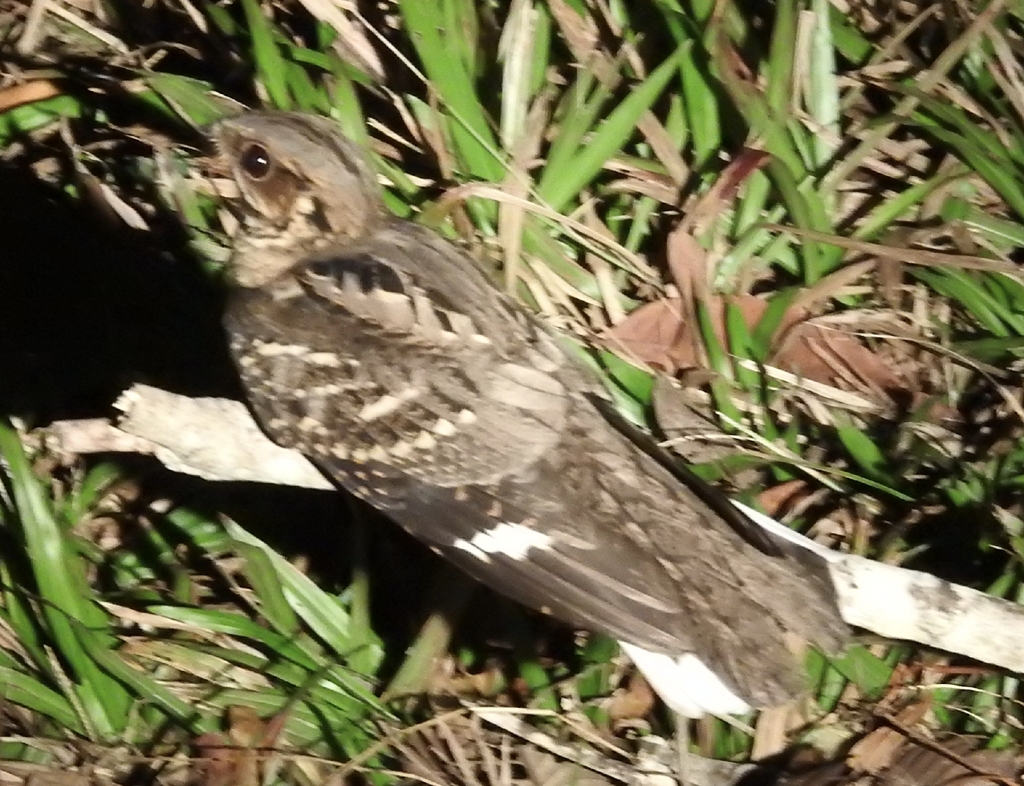
The large-tailed nightjar measures approximately 31.5 to 33 cm in length and is instantly recognizable by its distinctive long, broad tail and cryptic plumage. Males display striking markings: a pale crown with a dark median stripe, a prominent row of black scapular feathers bordered by broad buff or whitish-buff fringes, and a white throat patch. Their long, broad brown tail is marked with uneven dark bars, and they show large white patches on their primaries and outer tail feathers in flight. Females are considerably drabber, with paler and greyer plumage overall, smaller buff-coloured wing patches, and less vibrant tail markings. The species' exceptional camouflage allows it to blend seamlessly into its natural surroundings, making field identification a rewarding challenge.
Range & Habitat
The large-tailed nightjar inhabits a vast range spanning from northern India through eastern China and Indonesia to northern Australia. It is found across 18 countries including Bangladesh, Bhutan, Brunei, Cambodia, China, India, Laos, Malaysia, Myanmar, Nepal, Pakistan, Papua New Guinea, the Philippines, Singapore, Thailand, Timor-Leste, and Vietnam. The species favours subtropical and tropical moist lowland forests, mangrove forests, and moist montane forests, but has proven adaptable to secondary forests, forest edges, plantations, wooded parks, and even agricultural landscapes.
In agricultural areas, large-tailed nightjars are of significant economic interest to farmers as they are believed to play an important role in biological control of insect pests through their nocturnal feeding habits.
Behaviour & Diet
Large-tailed nightjars are primarily nocturnal and aerial insectivores, hunting flying insects—particularly beetles and moths—while in flight. Occasionally they may walk on the ground and peck at terrestrial ants, though this behaviour was once thought to be rare. Recent observations suggest ground foraging may occur more frequently than previously believed, particularly when flying insects are scarce. These birds rely heavily on acoustic communication rather than visual cues, employing a distinctive monotonous territorial song typically given by males from perches or occasionally during pursuit-flights. They also produce deep, low-pitched grunting calls described as "wroww" sounds or fast-repeated "wrrrog" or "grrrog" notes. Vocal activity occurs year-round but varies with breeding activity, population density, and moon phase.
Best Time & Places to See It
Large-tailed nightjars are most vocal and active during the breeding season, which extends from mid-March to late September, making this the optimal period for locating them by sound. Listening for their distinctive monotonous territorial songs after dusk offers the best chance of detection. Search secondary forests, forest edges, plantations, and wooded parks throughout their extensive Asian and Australian range. Their cryptic nocturnal nature and excellent camouflage mean that spotting them visually requires patience and careful searching around roosting sites at dawn or dusk.
Photography Tips
Photographing large-tailed nightjars presents considerable challenges due to their nocturnal habits and exceptional camouflage. Locate birds by listening for their territorial songs during the breeding season, then use a headlamp with a red filter to avoid disturbing them. Photograph males in flight to capture the striking white patches on primaries and outer tail feathers, and the distinctive long tail. Early morning or late evening light offers the best opportunities. patience is essential—these masterfully camouflaged birds blend into leaf litter and branches, making them difficult to spot even when their location is known. If lucky enough to find a roosting bird, approach slowly and avoid sudden movements to prevent flushing.
Orang National Park
Rangagarapathar, India
+298 birds+1 mammals
Where the Brahmaputra's floodplains meet the foothills of Assam, Orang National Park unfolds across a mosaic of riverine grasslands, forests and wetlands that pulse with the…
VIEW NATIONAL PARKHat Noppharat Thara-Mu Ko Phi Phi National Park
Ao Nang, Thailand
+253 birds+9 mammals
Where limestone karsts rise dramatically from turquoise waters, Hat Noppharat Thara-Mu Ko Phi Phi National Park unfolds across a mosaic of beach, mangrove forest, and island…
VIEW NATIONAL PARKKhao Yai National Park
Prachantakham District, Thailand
+377 birds+46 mammals
Evergreen dipterocarp forest blankets the rolling terrain of this national park in eastern Thailand, where limestone hills rise abruptly from the forest floor and seasonal streams…
VIEW NATIONAL PARKKhao Laem Ya-Mu Ko Samet National Park
Mueang Rayong District, Thailand
+159 birds+3 mammals
Where limestone hills meet the Gulf of Thailand, Khao Laem Ya–Mu Ko Samet National Park stitches together a mosaic of terrestrial and marine worlds that few…
VIEW NATIONAL PARKKroombit Tops National Park
Valentine Plains, Australia
+152 birds+6 mammals
Where eucalypt woodlands rise into sandstone plateaus, Kroombit Tops unfolds across nearly 906 square kilometres of northeastern Queensland's most biodiverse terrain. The park's defining feature is…
VIEW NATIONAL PARKKakadu National Park
Kakadu, Australia
+273 birds+46 mammals
Kakadu National Park is Australia’s largest national park and one of the world’s most remarkable protected areas, covering nearly 20,000 square kilometres in the tropical north…
VIEW NATIONAL PARKDaintree National Park
Dedin, Australia
+362 birds+37 mammals
Daintree National Park is one of the world’s oldest and most biologically diverse tropical rainforests, protecting an extraordinary landscape where ancient forests meet the Great Barrier…
VIEW NATIONAL PARKEndeavour River National Park
Philadelphia, Australia
+203 birds+1 mammals
Where the Endeavour River winds through northeastern Queensland's tropical lowlands, a compact mosaic of rainforest, open woodland, and riverine corridor creates one of Australia's most ecologically…
VIEW NATIONAL PARKKanha Tiger Reserve
Kanha Kisli F.V., India
+321 birds+23 mammals
Where sal forests give way to emerald meadows and crystalline streams carve through ancient valleys, one of India's finest wilderness reserves unfolds across the Maikal Range.…
VIEW NATIONAL PARKKaziranga National Park
Kohora, India
+422 birds+26 mammals
Dawn breaks over the floodplains of the Brahmaputra, where tall grasslands stretch endlessly beneath monsoon-heavy skies. This sprawling wilderness of northeastern Assam is a mosaic of…
VIEW NATIONAL PARKKeoladeo National Park
Shreenagar Rural, India
+326 birds+14 mammals
Where shallow wetlands shimmer beneath vast Rajasthani skies, one of Asia's finest bird sanctuaries pulses with extraordinary life. This former maharaja's hunting reserve, now spanning 29…
VIEW NATIONAL PARKBako National Park
Kuching, Malaysia
+210 birds+17 mammals
Weathered sandstone cliffs rise dramatically from the South China Sea, their ochre faces sculpted by millennia of wind and tide into a landscape of extraordinary geological…
VIEW NATIONAL PARKTaman Negara National Park
Kampong Samas, Malaysia
+393 birds+48 mammals
Where ancient rainforest meets limestone peaks, one of Southeast Asia's oldest protected wilderness preserves sprawls across 4,343 square kilometers of primordial landscape. Dipterocarp giants tower overhead,…
VIEW NATIONAL PARKGunung Mulu National Park
Long Seridan, Malaysia
+280 birds+39 mammals
Where granite monoliths pierce the rainforest canopy of Sarawak, an ancient limestone karst landscape reveals one of Southeast Asia's most biodiverse strongholds. Soaring peaks cloaked in…
VIEW NATIONAL PARKAketajawe Lolobata National Park
Oba Tengah, Indonesia
+123 birds+2 mammals
Across the northeastern arm of Halmahera, where the Wallace Line once marked the boundary between Asian and Australasian fauna, lies a sprawling wilderness of over 13,800…
VIEW NATIONAL PARKManusela National Park
Maluku Tengah, Indonesia
+112 birds+3 mammals
Across the Maluku Tengah district of Indonesia's eastern archipelago, a sprawling expanse of 4,175 square kilometers of largely intact tropical forest rises from coastal lowlands toward…
VIEW NATIONAL PARKGunung Ciremai National Park
Majalengka, Indonesia
+116 birds+1 mammals
Volcanic slopes rise sharply from West Java's interior, where Gunung Ciremai's 3,078-metre summit dominates a landscape carved by geological upheaval and shaped by equatorial monsoon rainfall.…
VIEW NATIONAL PARKWay Kambas National Park
Lampung Timur, Indonesia
+237 birds+20 mammals
Across the low swamplands of eastern Lampung, where freshwater wetlands merge into tidal mangrove forests along the Sunda Strait, sprawls one of Sumatra's most vital sanctuaries.…
VIEW NATIONAL PARKNitmiluk National Park
Australia
+186 birds+27 mammals
Dramatic sandstone gorges carved by the Katherine River slice through the tropical savanna of Australia's Top End, creating a landscape where escarpments tower above crystalline pools…
VIEW NATIONAL PARKGreat Sandy National Park
Australia
+306 birds+40 mammals
Where coastal dunes rise inland from the Queensland coastline, Great Sandy National Park encompasses a landscape of remarkable ecological diversity shaped by subtropical humid conditions year-round.…
VIEW NATIONAL PARKGirringun National Park
Australia
+231 birds+10 mammals
Where granite gorges cleave through subtropical woodland in North Queensland, Girringun National Park unfolds across rugged terrain shaped by millions of years of weathering and erosion.…
VIEW NATIONAL PARKWooroonooran National Park
Australia
+240 birds+28 mammals
Where the Great Dividing Range rises sharply inland from Queensland's tropical coast, Wooroonooran National Park encompasses a landscape of steep, forested gorges and cascading waterways carved…
VIEW NATIONAL PARKGaoligong Mountain National Nature Reserve
Nujiang Lisu Autonomous Prefecture, China
+443 birds+13 mammals
VIEW NATURE RESERVENo community photos yet. Log in to add the first one.
No community observations of this species yet.