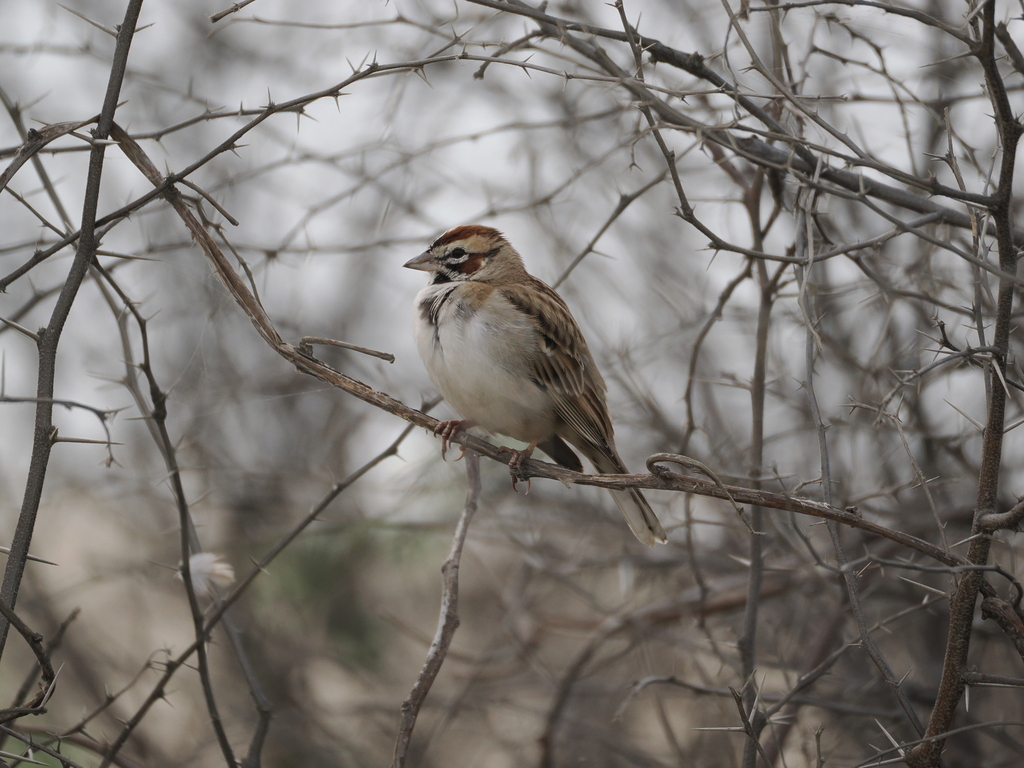
Lark Sparrow
Photo © Justin Philbois
Photo © Justin Philbois — CC0 1.0 — Source: iNaturalist photo #622612320Identification
The lark sparrow is a distinctive and fairly large New World sparrow, making it relatively easy to identify in the field. Adults are characterized by a dark-streaked brown back and white underparts with a striking dark central spot on the breast. The head pattern is particularly distinctive: chestnut cheeks and crown sides are framed by bold white eyebrow and crown stripes, creating a striking facial appearance. The dark tail has white corners that are visible in flight. Young lark sparrows are duller overall, with streaked underparts. The species measures 5.9–6.7 inches in length, with a wingspan of 11.0 inches and weighs 0.8–1.2 ounces.
Range & habitat
The lark sparrow breeds across southern Canada, much of the United States, and northern Mexico. However, it is much less common in eastern regions, where its range is contracting—an important consideration for birders in that area. Resident populations persist in Mexico and adjacent southwestern U.S. states, while northern populations are migratory, wintering in the southern United States, Mexico, and south to Guatemala. The species is a very rare vagrant to western Europe, with only two accepted records in Great Britain (1981 and 1991).
Behaviour & diet
Lark sparrows forage on the ground or in low bushes, mainly consuming seeds but supplementing their diet with insects, particularly grasshoppers during the breeding season. They are gregarious outside the breeding season, forming flocks during migration and winter. Females exhibit a notable distraction display when predators approach occupied nests, a defensive behavior that makes them particularly interesting to observe during breeding season.
Best time & places to see it
The breeding habitat consists of various open habitats including grasslands and cultivated areas across their range in North America. Migratory populations can be found in their wintering grounds in the southern United States, Mexico, and Guatemala. For the best viewing experience, target open country during the breeding season in the western and central portions of their range, and visit appropriate wintering habitats in the south during winter months. The contracting eastern range means sightings there are increasingly uncommon.
Photography tips
The lark sparrow's distinctive head pattern and white underparts with central breast spot make it a rewarding photographic subject. Frame shots to capture the bold white eyebrow stripe and chestnut cheek patch in good light. Ground-foraging behavior provides opportunities for natural perching shots. The white tail corners are particularly striking in flight photographs, so capture birds in flight when possible. Open habitat photography allows clean backgrounds that emphasize the bird's striking facial markings.
Acadia National Park
Alaska Maritime National Wildlife Refuge
Algonquin Provincial Park
Alligator River National Wildlife Refuge
Arches National Park
Badlands National Park
Banff National Park
Bear River Migratory Bird Refuge
Big Bend National Park
Nothing matches these filters.
No community photos yet. Log in to add the first one.
No community observations of this species yet.