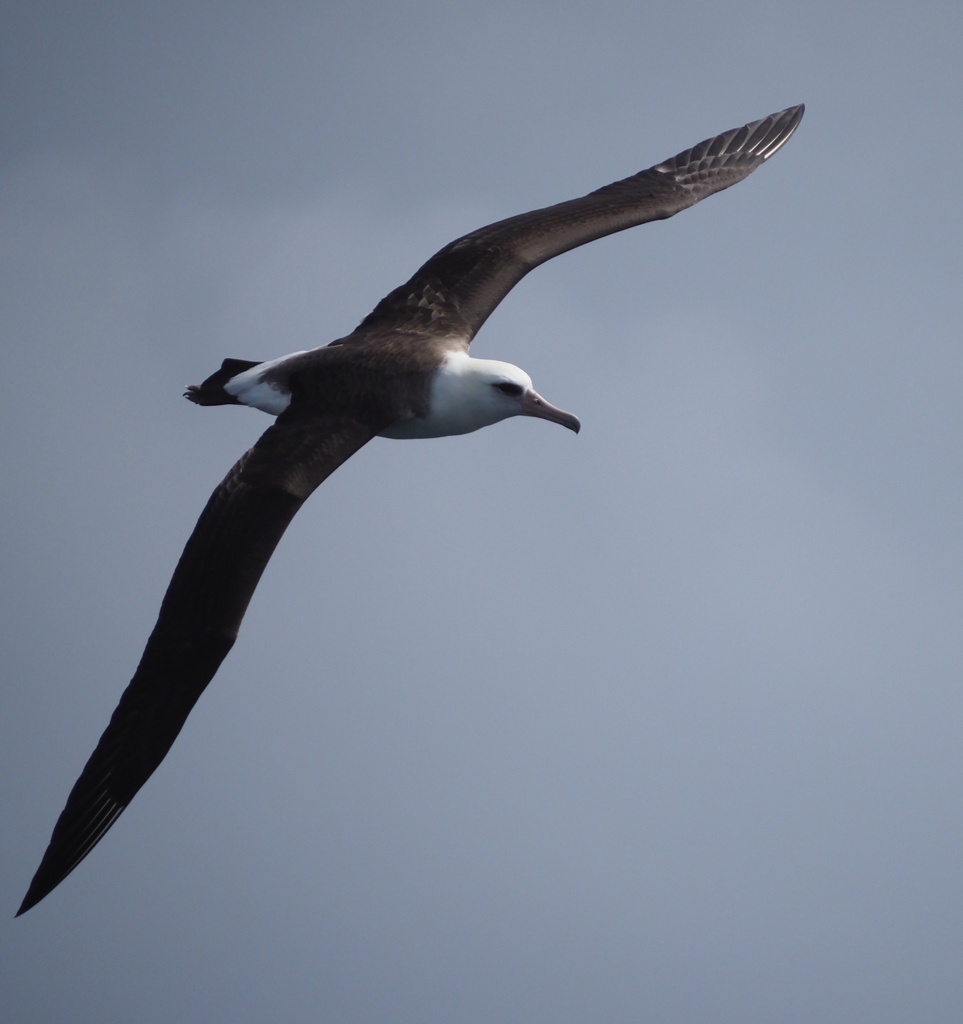
Laysan Albatross
Photo © yongestation
Photo © yongestation — CC BY 4.0 — Source: iNaturalist #317476949The Laysan albatross (Phoebastria immutabilis) is a large seabird that ranges across the North Pacific. The Northwestern Hawaiian Islands are home to 99.7% of the population. This small (for its family) gull-like albatross is the second-most common seabird in the Hawaiian Islands, with an estimated population of 1.18 million birds, and is currently expanding (or possibly re-expanding) its range to new islands. The Laysan albatross was first described as Diomedea immutabilis by Lionel Walter Rothschild, in 1893, on the basis of a specimen from Laysan Island. == Etymology == It is named for Laysan, one of its breeding colonies in the Northwestern Hawaiian Islands and the island where the type specimen was collected. The genus name, Phoebastria, comes from Greek phoibastria, meaning a prophetess. The species name, immutabilis, is Latin for "unchanging" and refers to the similarity of immature birds' plumage to that of adults. == Description == The Laysan albatross averages 81 cm (32 in) in length and has a wingspan of 195 to 203 cm (77–80 in). Males, which weigh 2.4 to 4.1 kg (5.3–9.0 lb), are larger than females, which weigh 1.9 to 3.6 kg (4.2–7.9 lb). This albatross has blackish-gray upperwing, mantle, back, upper rump, and…
Hawaiʻi Volcanoes National Park
Hawaiʻi County, United States
+84 birds+2 mammals
Where volcanic slopes descend toward the Pacific across more than five thousand square kilometers, Hawaiʻi Volcanoes National Park presents one of Earth's most dynamic laboratories of…
VIEW NATIONAL PARKSt. Paul Island
Saint Paul, United States
+255 birds+8 mammals
Windswept tundra rolls across this remote Pribilof island, where volcanic basalt cliffs plunge into the Bering Sea and fog rolls in thick enough to erase the…
VIEW PROTECTED LANDSCAPEEl Vizcaíno
Laguna San Ignacio, Mexico
+317 birds+29 mammals
Where the Baja California peninsula thins into a tapestry of salt lagoons and coastal desert, one of Mexico's most biodiverse reserves sprawls across half a million…
VIEW BIOSPHERE RESERVEKodiak National Wildlife Refuge
United States
+221 birds+22 mammals
Where temperate rainforest meets subarctic coast, Kodiak National Wildlife Refuge sprawls across Alaska's largest island, a sanctuary defined by steep valleys carved by tidewater glaciers and…
VIEW WILDLIFE SANCTUARYAlaska Maritime National Wildlife Refuge
Alaska, United States
+391 birds+58 mammals
Where the North Pacific collides with Alaska's rugged coastline, a sprawling archipelago of islands, rocky outcrops, and coastal headlands forms one of North America's most remote…
VIEW WILDLIFE SANCTUARYFarallon National Wildlife Refuge
San Francisco, United States
+384 birds+16 mammals
Windswept granite peaks rising abruptly from the Pacific, the Farallon Islands form a wildlife sanctuary of extraordinary seabird abundance and ecological significance just twenty-seven miles west…
VIEW WILDLIFE SANCTUARYKīlauea Point National Wildlife Refuge
Kilauea, United States
+79 birds+1 mammals
At the northernmost tip of Kauai, where the Pacific trades collide with volcanic rock, Kīlauea Point National Wildlife Sanctuary crowns a dramatic headland overlooking one of…
VIEW WILDLIFE SANCTUARYMidway Atoll National Wildlife Refuge
United States
+91 birds+1 mammals
Straddling the international date line roughly midway between North America and Asia, this atoll sanctuary rises from the North Pacific as a cluster of coral and…
VIEW WILDLIFE SANCTUARYNo community photos yet. Log in to add the first one.
No community observations of this species yet.