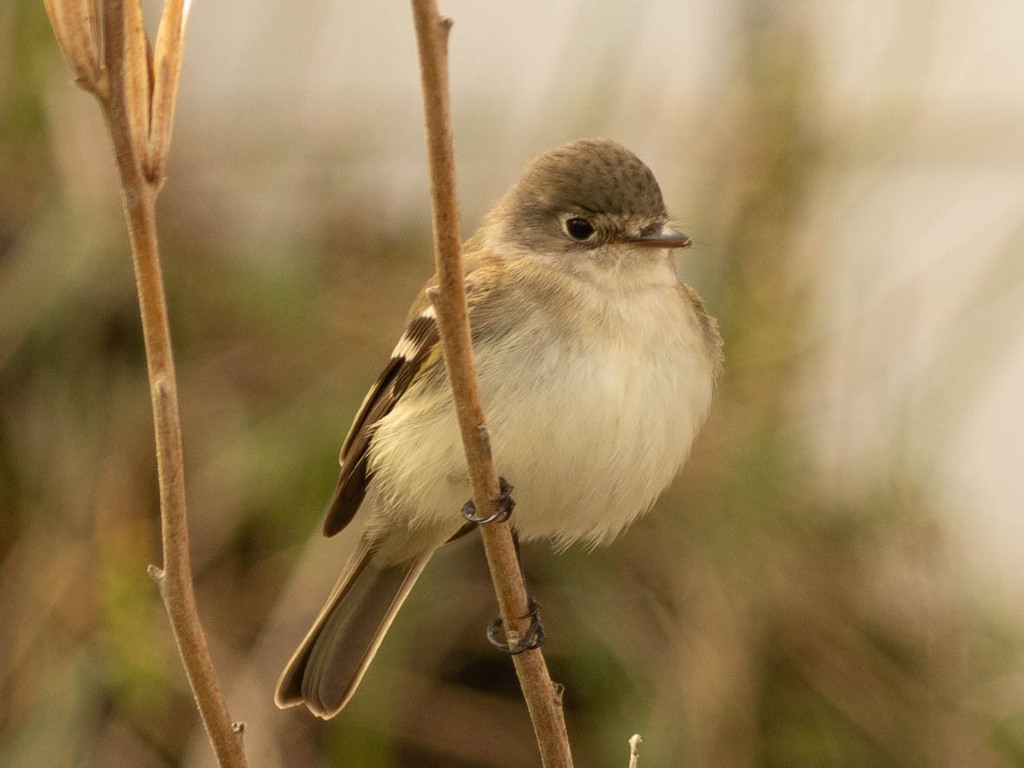
Least Flycatcher
Photo © Kathlin Simpkins
Photo © Kathlin Simpkins — CC0 1.0 — Source: iNaturalist photo #671992814Identification
The least flycatcher is one of the smallest members of the Empidonax genus, measuring 12 to 14 cm in height with a wingspan of 19 to 22 cm and weighing approximately 10.3 g. Its plumage is dull olive-gray on the back and whitish on the belly, notably brighter than other Empidonax species. The bird displays two white wing bars and distinctive white eye-rings, with a short beak featuring a yellowish lower mandible. Juveniles resemble adults but have slightly darker wing bars with tawny or olive hues. Because field marks are shared among congeners, the most reliable identification method is by call and habitat preference.
Range & Habitat
The least flycatcher inhabits the Eastern Rockies of Canada and the Central-North and Northeastern United States. It is highly migratory, wintering in Central America from Mexico to Panama. This adaptable species breeds in deciduous or mixed forests and occasionally in coniferous groves, favoring sites near clearings and forest edges. It also thrives in open country, nesting in village shade trees, orchards, and along rural roads. During winter in Central America, the species settles in forest edges and second growth areas.
Behaviour & Diet
The least flycatcher is named for its characteristic dry, piercing "che-bec" call, with the second syllable louder than the first. Males establish territories through relentless singing, delivering the call about 60 times per minute during morning hours, often in unison with neighboring males. Females rarely sing, instead using a "chweep" call-note when feeding nestlings or defending their nest. The species feeds primarily on small insects caught mid-air, including flies, wasps, ants, beetles, caterpillars, midges, bugs, grasshoppers, and spiders, with occasional berries. When foraging, birds perch and watch for prey, switching positions about 10 times per minute and hovering extensively to catch insects—a method accounting for over 81% of their prey captures.
Best Time & Places to See It
Least flycatchers arrive to breed in spring throughout their North American range, with males singing most intensively during early summer mornings. Listen for the distinctive "che-bec" call in aspen clusters, open woods, orchards, and village parks with shade trees. The species is more easily located by sound than sight. Winter months are not ideal for observation in North America, as the species migrates entirely to Central America.
Photography Tips
The least flycatcher's small size and preference for perching in the lower portions of trees make photography challenging. Position yourself near aspen groves or mixed woodlands during breeding season, particularly in early morning when males sing most actively and are most responsive. The bird's habit of switching perches frequently and hovering to catch prey offers fleeting photographic opportunities. Focus on capturing the white eye-rings and wing bars that aid identification, and consider recording audio of the distinctive "che-bec" call to complement visual documentation.
Tombstone Territorial Park
Acadia National Park
Alaska Maritime National Wildlife Refuge
Algonquin Provincial Park
Alligator River National Wildlife Refuge
Arenal Volcano National Park
Badlands National Park
Banff National Park
Barra del Colorado National Wildlife Refuge
Nothing matches these filters.
No community photos yet. Log in to add the first one.
No community observations of this species yet.