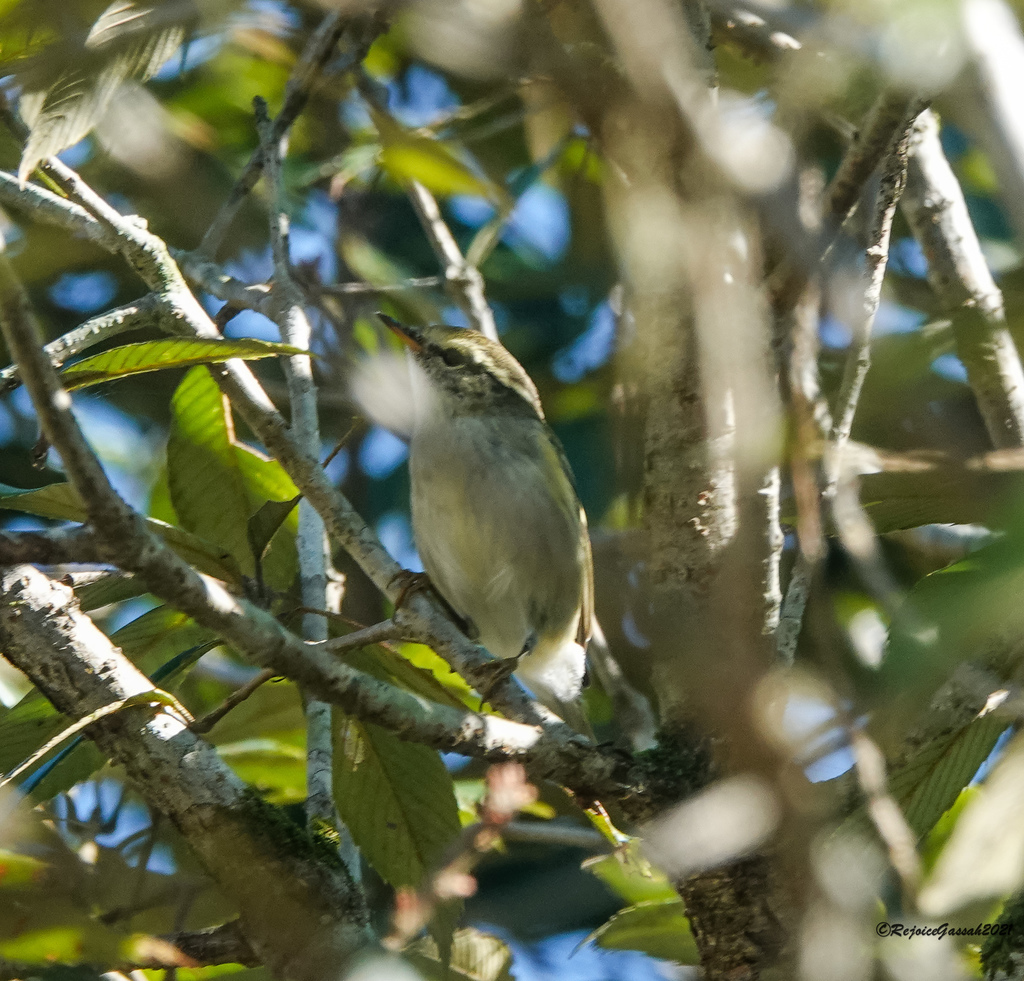
Lemon-rumped Warbler
Photo © Rejoice Gassah
Photo © Rejoice Gassah — CC BY 4.0 — Source: iNaturalist #104801053Identification
The Lemon-rumped Warbler is a tiny warbler, measuring just 9–10 cm and weighing approximately 4.6–5.1 g. Its most distinctive feature is its yellowish or whitish rump, which inspired its common name. The bird displays a whitish crown stripe bordered by darker olive-brown sides, a pale eyebrow line, and a dark eyestripe that often curves downward. Its upperparts are greenish-grey, while the wings are grey-brown with green edging and typically show one or two pale wingbars. The underparts are whitish or buff with grey toning along the breast sides. The bill is dark with a yellowish or orange base on the lower mandible, and the legs are dark grey. Males and females are similar in appearance, though females are slightly smaller. Juveniles resemble adults closely.
Range & Habitat
This Himalayan specialist breeds across a wide montane range from northern Pakistan through Nepal into India, Bhutan, and China, with wintering populations reaching Assam and occasionally Myanmar. The species inhabits montane forests between 2,200 and 4,200 meters above sea level during breeding season, descending to lower elevations of 300–2,700 m in winter, generally above 1,000 m. Two subspecies are recognized, with populations in the west showing greener and more buff-toned plumage compared to central and eastern Himalayan birds. Breeding habitat includes spruce and fir forests interspersed with rhododendron and broadleaf trees, as well as oak stands and lower-elevation broadleaf forests near the conifer zone.
Behaviour & Diet
The Lemon-rumped Warbler is an insectivore, feeding primarily on insects and larvae. It forages alone or in pairs during winter months but readily joins mixed-species flocks during migration and seasonal movements. The bird hunts in both canopy and understory, employing flycatching techniques involving short hovering flights and aerial sallies to snatch prey from the air. Breeding occurs from April to July, with peak activity in May and June. Females construct distinctive ball-shaped nests with side entrances from grass, moss, lichen, and birch bark, lined with feathers and positioned 2–15 m above the ground, usually in conifers. Clutches typically contain four eggs, though three to five may be laid. Both parents feed the young, though only females incubate.
Best Time & Places to See It
The breeding season from May to June offers the best opportunity to encounter Lemon-rumped Warblers in their montane forest habitat across the Himalayas. Nepal, particularly at elevations around 3,000–4,000 m, and Bhutan are excellent destinations. Pakistan's higher-elevation forests (2,200–2,700 m) are also productive. In winter, lower-elevation sites in Nepal's foothills and across Assam may yield sightings. Much of the species' range falls within protected areas, making national parks and nature reserves ideal bases for observation.
Photography Tips
The Lemon-rumped Warbler's small size and active foraging behavior present challenges for photographers. Position yourself near flowering rhododendrons or in areas where mixed-species flocks congregate, as this increases encounter probability. Early morning light in conifer forests often produces the best conditions for capturing detail. The pale rump and eyebrow stripe are key identification features worth emphasizing in images. Patient waiting near fruiting or flowering areas during breeding season may reward you with active foraging shots. A telephoto lens (at least 400 mm) and fast film speed are essential given the bird's height in the canopy and the often-dim montane forest lighting.
Bardiya National Park
Chitwan National Park
Gangotri National Park
Giant Panda National Park
Khangchendzonga National Park
Khaptad National Park
Langtang National Park
Makalu Barun National Park
Nanda Devi National Park
Nothing matches these filters.
No community photos yet. Log in to add the first one.
No community observations of this species yet.