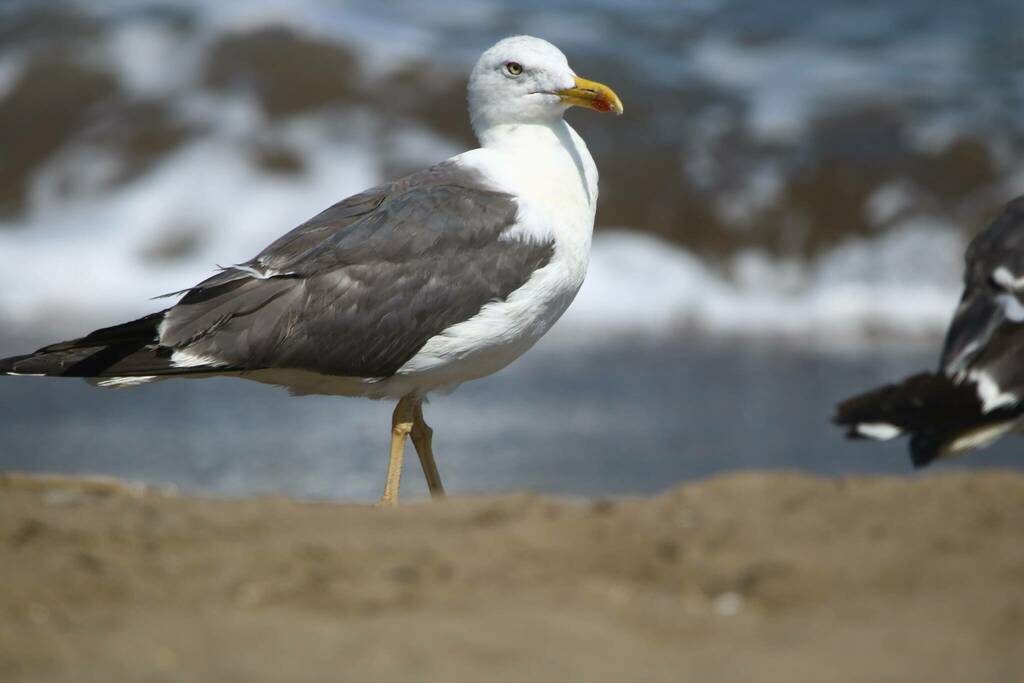
Lesser Black-backed Gull
Photo © Mourad Harzallah
Photo © Mourad Harzallah — CC BY 4.0 — Source: iNaturalist photo #353756251Identification
The lesser black-backed gull is a large gull measuring 51–64 cm in length with a wingspan of 124–150 cm. It is noticeably smaller than the European herring gull, with a slimmer build and more elegant proportions. Adults display black or dark grey wings and back depending on their subspecies, contrasting with a white head and underparts. The bill is bright yellow with a distinctive red spot, which chicks peck to stimulate feeding. Legs are yellow rather than pinkish, a key distinguishing feature from the great black-backed gull. In winter, the head becomes greyer. Young birds take four years to reach maturity and can be identified by their scaly black-brown upperparts and neat wing pattern, particularly their solidly dark tertial feathers which help separate them from juvenile herring gulls. Males average slightly larger than females, weighing around 824 g compared to 708 g respectively.
Range & Habitat
The lesser black-backed gull breeds on the Atlantic and Arctic coasts of Europe and is highly migratory, wintering from the British Isles south to West Africa. The species has dramatically expanded its range westwards in recent decades, first colonising Greenland in the 1980s and increasingly appearing in North America, particularly along the east coast. Once merely a winter visitor to North America, it now occurs in large numbers in some winters with birds recorded year-round. However, the species faces serious conservation concerns, with decline documented across many parts of its range. The UK is particularly significant, supporting 40 per cent of the European population, though alarmingly more than half of these birds breed at fewer than ten sites, earning the species a place on the UK Amber List.
Behaviour & Diet
Lesser black-backed gulls breed colonially on coasts and lakes, constructing lined nests on the ground or cliff ledges. Typically, three eggs are laid per breeding season. In some urban areas, they nest within cities, often in association with herring gulls. These birds are highly adaptable omnivores with a diverse diet including fish, insects, crustaceans, worms, starfish, molluscs, seeds, berries, small mammals, eggs, small birds, chicks, scraps, offal, and carrion. Their call is a distinctive "laughing" cry similar to herring gulls but with a markedly deeper pitch. Adults undergo a complete annual moult beginning between May and August, which may not finish until November, with an additional partial prebreeding moult occurring between January and April.
Best Time & Places to See It
Lesser black-backed gulls are best observed during their breeding season on Atlantic and Arctic coasts of Europe, where they gather in colonies. Winter months offer excellent opportunities for viewing along the British Isles and further south to West Africa. In North America, particularly the east coast, birds can increasingly be found during winter months and year-round, making this an emerging destination for observing the species outside its traditional range. Urban locations where they nest alongside herring gull colonies provide reliable viewing opportunities.
Photography Tips
Photographers should focus on the distinctive yellow legs and bill with its red spot—key identification features. The contrast between the dark wings and back against white plumage creates strong compositional opportunities. In winter, capture the greyer head plumage which differs notably from the great black-backed gull. Colonial breeding sites offer chances to photograph nesting behaviour and chicks, while winter gatherings on coasts provide action shots of birds in flight. Younger birds offer interesting photographic subjects with their scaly plumage patterns, though four-year maturation means juveniles of varying ages will be present simultaneously at colonies.
Nothing matches these filters.
Mabamba Swamp
Murchison Falls National Park
Acadia National Park
Algonquin Provincial Park
Alligator River National Wildlife Refuge
Alta Murgia National Park
Arabuko Sokoke Forest Reserve
Åsnens National Park
Avesnois Regional Nature Park
Nothing matches these filters.
No community photos yet. Log in to add the first one.
No community observations of this species yet.