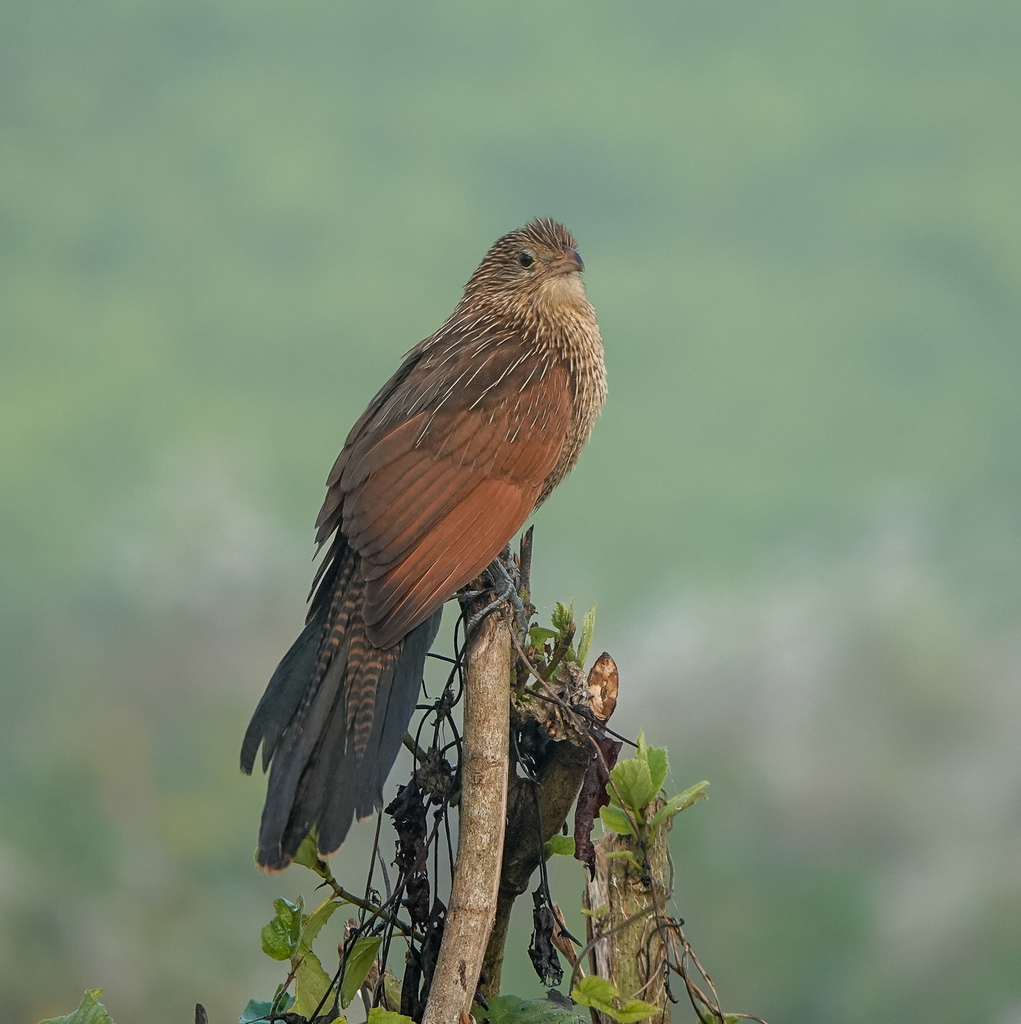
Lesser Coucal
Photo © Rejoice Gassah
Photo © Rejoice Gassah — CC BY 4.0 — Source: iNaturalist #95625313Identification
The lesser coucal is a compact member of the cuckoo family, distinguished by its smaller size and less prominent bill compared to larger coucal species. Its overall plumage is predominantly blackish with a long tail and distinctive rufous wings. The most striking feature is an exceptionally long hind claw—the longest within the entire genus Centropus—which gives the bird its generic name, derived from the Greek words for "spur" and "foot."
Seasonal plumage changes make identification more complex. During breeding season, the head and upper back display glossy dark plumage with dark feather shafts, while non-breeding birds show a duller appearance with pale whitish streaks on the head and back. The wing coverts also exhibit pale shafts creating whitish streaks across brown feathers. Unlike the greater coucal, the lesser coucal has a darker brown iris rather than crimson red. Juveniles are browner overall with black spots and bars. In the field, the sexes are indistinguishable, but the bird's distinctive calls—a series of accelerating low double "whoot-woot" or "kurook" notes descending in pitch—provide reliable identification.
Range & Habitat
The lesser coucal is widely distributed across a vast range extending from the Indian subcontinent westward through Southeast Asia, with six recognized subspecies occupying different regions. The nominate form ranges from India to Thailand, while subspecies lignator inhabits southeastern China and Taiwan. Populations in the Malay Peninsula extend eastward across the Philippines and Indonesian archipelago, with distinct forms found in Sulawesi, the Lesser Sunda Islands, and the Moluccas.
These birds favour marshy land with grass and tree cover, typically in lowland regions. They are found singly or in pairs low in undergrowth within grassy or marshy areas adjoining forest, preferring areas with dense vegetation near water.
Behaviour & Diet
Unlike many cuckoo species, the lesser coucal is not a brood parasite and builds its own nest. The breeding season spans May to September, with activity concentrated after the rains in June across much of their range. Both sexes share incubation duties and care for the young, building a distinctive dome-shaped nest constructed from grass blades positioned low in trees. Clutch sizes vary geographically: typically three eggs in India, two in Southeast Asia, and four in Taiwan.
Best Time & Places to See It
The breeding season from June onwards offers the best opportunity to locate lesser coucals, as birds are most vocal and active during this period. Focus your search on marshy grasslands adjacent to forested areas throughout the Indian subcontinent, Thailand, Southeast Asia, and the Indonesian archipelago. Look low in undergrowth and dense vegetation, particularly in wetland habitats with scattered trees.
Photography Tips
Photograph lesser coucals during the breeding season when they are most active and vocal. Work early in the morning when birds are most vocal and active in low vegetation. Their preference for dense undergrowth can make photography challenging, so be patient and use knowledge of their calls to locate individuals. The striking contrast between blackish plumage and rufous wings photographs well, and capturing the bird's characteristic posture low in vegetation adds context to images. Be prepared for the bird's tendency to remain hidden; listening for calls and waiting quietly will often reveal perched birds you can photograph.
Orang National Park
Rangagarapathar, India
+298 birds+1 mammals
Where the Brahmaputra's floodplains meet the foothills of Assam, Orang National Park unfolds across a mosaic of riverine grasslands, forests and wetlands that pulse with the…
VIEW NATIONAL PARKValmiki National Park
Ramnagar, India
+66 birds+6 mammals
Along Bihar's western frontier, where the Gandak River winds through subtropical forest and grassland, Valmiki National Park sprawls across terrain shaped by monsoon rains and seasonal…
VIEW NATIONAL PARKHat Noppharat Thara-Mu Ko Phi Phi National Park
Ao Nang, Thailand
+253 birds+9 mammals
Where limestone karsts rise dramatically from turquoise waters, Hat Noppharat Thara-Mu Ko Phi Phi National Park unfolds across a mosaic of beach, mangrove forest, and island…
VIEW NATIONAL PARKKhao Yai National Park
Prachantakham District, Thailand
+377 birds+46 mammals
Evergreen dipterocarp forest blankets the rolling terrain of this national park in eastern Thailand, where limestone hills rise abruptly from the forest floor and seasonal streams…
VIEW NATIONAL PARKKhao Laem National Park
Sangkhla Buri District, Thailand
+197 birds
Where the Vajiralongkorn Reservoir sprawls across the forested valleys of Kanchanaburi's northern borderlands, Khao Laem National Park protects a landscape where limestone ridges rise dramatically from…
VIEW NATIONAL PARKMount Nanling Forest Park
Ruyang Forest Farm, China
+179 birds+3 mammals
Granite ridges and weathered peaks rise through a canopy of subtropical montane forest where Ruyang Forest Farm anchors one of southern China's most biodiverse landscapes. Across…
VIEW FOREST & JUNGLEKaziranga National Park
Kohora, India
+422 birds+26 mammals
Dawn breaks over the floodplains of the Brahmaputra, where tall grasslands stretch endlessly beneath monsoon-heavy skies. This sprawling wilderness of northeastern Assam is a mosaic of…
VIEW NATIONAL PARKPeriyar National Park
Mlappara, India
+232 birds+4 mammals
Dawn breaks over mist-shrouded ridges where the Western Ghats tumble toward Kerala's spice-scented lowlands. Here, ancient tropical forests envelope a glittering artificial lake, creating a mosaic…
VIEW NATIONAL PARKNagarahole Tiger Reserve
Nalkeri Forest, India
+323 birds+23 mammals
Where granite escarpments rise above dense deciduous forests and the Kabini River carves through pristine wilderness, one of India's most biodiverse landscapes unfolds across the Western…
VIEW NATIONAL PARKBako National Park
Kuching, Malaysia
+210 birds+17 mammals
Weathered sandstone cliffs rise dramatically from the South China Sea, their ochre faces sculpted by millennia of wind and tide into a landscape of extraordinary geological…
VIEW NATIONAL PARKTaman Negara National Park
Kampong Samas, Malaysia
+393 birds+48 mammals
Where ancient rainforest meets limestone peaks, one of Southeast Asia's oldest protected wilderness preserves sprawls across 4,343 square kilometers of primordial landscape. Dipterocarp giants tower overhead,…
VIEW NATIONAL PARKTaman Negara Bukit Lambir National Park
Miri, Malaysia
+153 birds+7 mammals
Rainforest cascades down sandstone ridges where crystal streams carve through ancient geology, creating a landscape of profound biological richness in Sarawak's interior. This 68-square-kilometre sanctuary protects…
VIEW NATIONAL PARKGunung Mulu National Park
Long Seridan, Malaysia
+280 birds+39 mammals
Where granite monoliths pierce the rainforest canopy of Sarawak, an ancient limestone karst landscape reveals one of Southeast Asia's most biodiverse strongholds. Soaring peaks cloaked in…
VIEW NATIONAL PARKTaman Nasional Baluran
Situbondo, Indonesia
+189 birds+9 mammals
Across the northeastern tip of East Java, where monsoon winds sweep down from the Bali Strait, a landscape of contrasts unfolds within 374 square kilometres of…
VIEW NATIONAL PARKTaman Nasional Meru Betiri
Jember, Indonesia
+93 birds+1 mammals
Across East Java's southeastern coast, where the Indian Ocean meets a landscape of volcanic soils and monsoon-fed forests, sprawls a national park that epitomizes the ecological…
VIEW NATIONAL PARKWest Bali National Park
Gerokgak, Indonesia
+240 birds+8 mammals
Across West Bali's northwestern reaches, where the Indian Ocean meets volcanic slopes and limestone cliffs plunge toward turquoise shallows, sprawls a protected realm of roughly 325…
VIEW NATIONAL PARKAketajawe Lolobata National Park
Oba Tengah, Indonesia
+123 birds+2 mammals
Across the northeastern arm of Halmahera, where the Wallace Line once marked the boundary between Asian and Australasian fauna, lies a sprawling wilderness of over 13,800…
VIEW NATIONAL PARKManusela National Park
Maluku Tengah, Indonesia
+112 birds+3 mammals
Across the Maluku Tengah district of Indonesia's eastern archipelago, a sprawling expanse of 4,175 square kilometers of largely intact tropical forest rises from coastal lowlands toward…
VIEW NATIONAL PARKBogani Nani Wartabone National Park
Bolaang Mongondow, Indonesia
+154 birds+4 mammals
Across North Sulawesi's rugged interior, where tectonic uplift has carved steep ridges and deep valleys through ancient volcanic terrain, Bogani Nani Wartabone National Park sprawls across…
VIEW NATIONAL PARKGunung Ciremai National Park
Majalengka, Indonesia
+116 birds+1 mammals
Volcanic slopes rise sharply from West Java's interior, where Gunung Ciremai's 3,078-metre summit dominates a landscape carved by geological upheaval and shaped by equatorial monsoon rainfall.…
VIEW NATIONAL PARKMount Merapi National Park
Hargobinangun, Indonesia
+150 birds+3 mammals
Where the volcanic slopes of central Java rise into mist and montane forest, Mount Merapi National Park guards one of Indonesia's most dynamic landscapes. Spanning roughly…
VIEW NATIONAL PARKLore Lindu National Park
Indonesia
+177 birds+4 mammals
Across the mountainous spine of Central Sulawesi spreads a wilderness of montane forest, rolling ridges, and deep valleys that rises from the island's volcanic bedrock to…
VIEW NATIONAL PARKMutis Timau National Park
Timor Tengah Selatan, Indonesia
+77 birds
Where the volcanic highlands of Timor Tengah Selatan rise above the surrounding lowlands, Mutis Timau National Park unfolds across approximately 224 square kilometres of mountain forest…
VIEW NATIONAL PARKKerinci Seblat National Park
Kerinci, Indonesia
+228 birds+16 mammals
Across nearly 67,000 square kilometres of Sumatra's spine, a mountainous realm of equatorial rainforest rises from steaming lowlands to volcanic peaks shrouded in cloud. Kerinci Seblat…
VIEW NATIONAL PARKWay Kambas National Park
Lampung Timur, Indonesia
+237 birds+20 mammals
Across the low swamplands of eastern Lampung, where freshwater wetlands merge into tidal mangrove forests along the Sunda Strait, sprawls one of Sumatra's most vital sanctuaries.…
VIEW NATIONAL PARKKomodo National Park
Komodo, Indonesia
+155 birds+14 mammals
Where volcanic peaks rise dramatically from turquoise waters, a primordial landscape unfolds across three main islands and countless smaller ones scattered throughout the Lesser Sunda archipelago.…
VIEW NATIONAL PARKPoyang Lake National Nature Reserve
Shangrao, China
+270 birds+7 mammals
Where the Yangtze River's massive floodplain spreads across central China, Poyang Lake National Nature Reserve encompasses one of the continent's most dynamic and water-rich wetland systems.…
VIEW NATURE RESERVENo community photos yet. Log in to add the first one.
No community observations of this species yet.