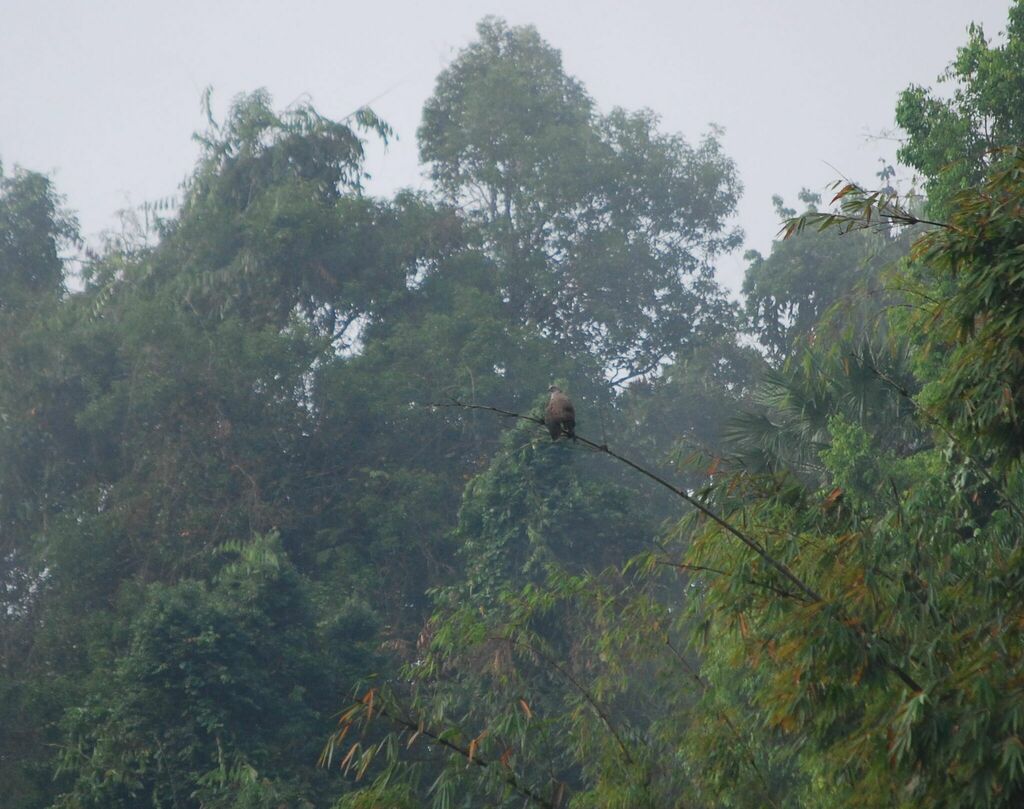
Lesser Fish Eagle
Photo © Mirela
Photo © Mirela — CC0 1.0 — Source: iNaturalist #162630331Identification
The lesser fish eagle is a medium-sized raptor with a distinctive gray-brown plumage, broad blunt wings, and a relatively short, rounded tail. Adults display a brown breast contrasting with white thighs and belly, and possess striking yellow eyes. They measure up to 64 centimetres tall with a wingspan reaching 1.2 metres. Juveniles closely resemble adults but have brown eyes instead of yellow, making age determination possible in the field. Their coarse, featherless legs are a notable feature. Confusion with the larger grey-headed fish eagle (Icthyophaga ichthyaetus) is common, so careful attention to size and plumage details is essential for accurate identification.
Range & Habitat
This species inhabits the Indian subcontinent, with populations concentrated in Himalayan foothills from Kashmir through Nepal and into Southeast Asia, extending across Myanmar, Thailand, Cambodia, Laos, Vietnam, Malaysia, Sumatra, Borneo, and Sulawesi. Historical records exist from Gujarat and central India, with an isolated population documented in southern India's Kaveri river valley. Lesser fish eagles favour hill streams and fast-moving water, typically below 1,000 metres elevation, though they have been recorded at heights exceeding 4,000 metres in Nepal. They inhabit rivers, lakes, and wetlands throughout their range, with some populations showing altitudinal movements.
Behaviour & Diet
Highly specialized fish-eaters, lesser fish eagles possess remarkable adaptations for aquatic hunting: strongly curved talons and spicules (small projections) along their toe undersides provide exceptional grip on slippery prey. They hunt by perching on overhanging branches, rocks, or other elevated positions above the water, scanning for fish below. Upon spotting prey, they swoop down to snatch it from the surface. These eagles maintain multiple personal perches throughout their feeding territories, regularly rotating between them. This predictable behaviour makes them relatively approachable for observers who locate an active hunting site.
Best Time & Places to See It
Lesser fish eagles are most reliably found along clear, fast-flowing hill streams in their core range—particularly in Nepal, northern India, and the Himalayan foothills. Breeding occurs from March to August in northern regions and November to April in southern areas, with birds potentially more vocal and active during these periods. Early morning hours often provide the best viewing opportunities when eagles are most active hunters. Despite their specialized niche, population numbers are estimated at only 1,000 to 10,000 individuals and remain in decline, making sightings increasingly special. Habitat loss and human disturbance continue to threaten their ranges.
Photography Tips
Position yourself along river systems where these eagles hunt, using natural cover to remain unobtrusive. Early light is ideal for capturing the subtle plumage details—the brown breast, white underparts, and gray-brown upperparts. Frame shots to showcase the characteristic short, rounded tail and long neck in profile. Patience is essential; once you locate an active perch, the eagle often returns repeatedly, providing multiple shooting opportunities. Capture the striking yellow eyes of adults and note the brown eyes of juveniles for identification purposes in your field notes. Wide-angle shots showing the eagle in its streamside habitat offer compelling storytelling alongside close-ups of the head and talons.
Bandipur National Park
Bardiya National Park
Bogani Nani Wartabone National Park
Chitwan National Park
Gunung Palung National Park
Kaziranga National Park
Lore Lindu National Park
Nagarahole Tiger Reserve
Pampadum Shola National Park
Nothing matches these filters.
No community photos yet. Log in to add the first one.
No community observations of this species yet.