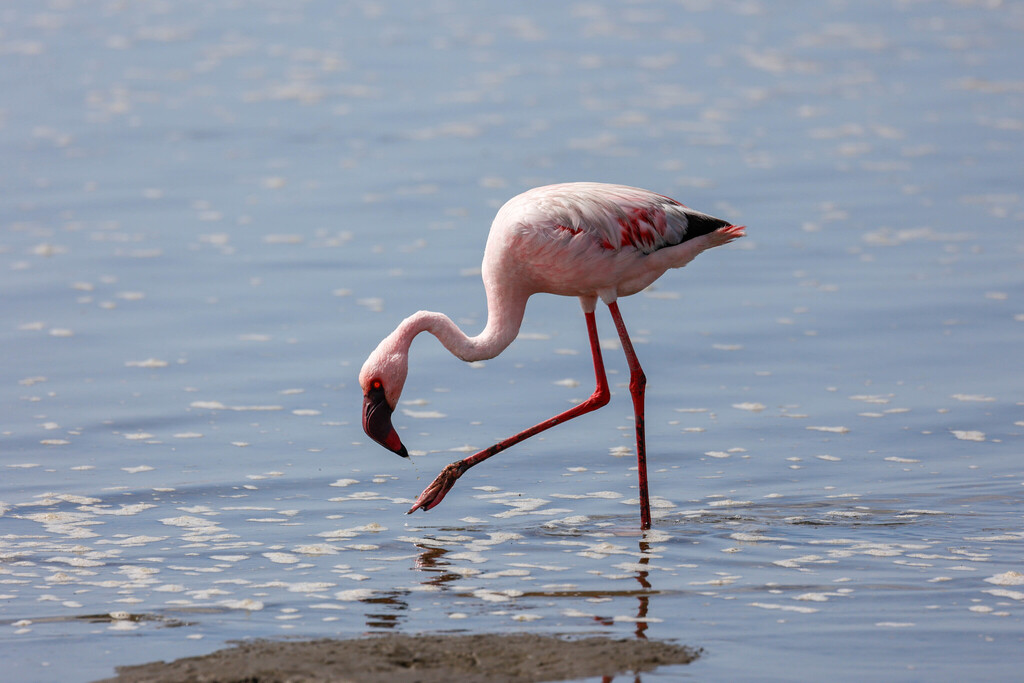
Lesser Flamingo
Photo © Tom Field
Photo © Tom Field — CC BY 4.0 — Source: iNaturalist photo #521830906Identification
The lesser flamingo is the smallest species of flamingo, though it remains a tall and large bird by most standards, standing 80 to 90 cm (31 to 35 in) high and weighing between 1.2 to 2.7 kg (2.6 to 6.0 lb). The total length from beak to tail and wingspan both range from 90 to 105 cm (35 to 41 in). Most of the plumage is pinkish white, a coloration derived from the blue-green algae that forms its primary diet. The clearest distinguishing feature from the greater flamingo—the only other Old World flamingo species—is the much more extensive black on the bill, making this the most reliable identification mark.
Range & Habitat
The lesser flamingo occurs primarily in sub-Saharan Africa and western India, with occasional vagrants reported from farther north. In Africa, this species is most common in the East African soda lakes and alkaline water bodies. Key locations include Lake Natron in Tanzania, Lake Nakuru and Lake Bogoria in Kenya, as well as Etosha Pan and Makgadikgadi Pan in southern Africa, and Kamfers Dam in South Africa. In Asia, the species is found in northwestern India at salt pans including Zinzuwadia and Purabcheria, with some individual movement occurring between African and Asian populations.
Behaviour & Diet
The lesser flamingo may be the most common flamingo species, with populations that have numbered up to two million individuals at their peak. This species feeds primarily on Spirulina, a blue-green algae that grows only in highly alkaline lakes—the algae's photosynthetic pigments are responsible for the birds' distinctive pink coloration. Their deep bill is specially adapted for filtering these microscopic food items. Beyond algae, they consume small invertebrates including copepods, diatoms, and rotifers, as well as cyanobacteria. The presence of lesser flamingo groups near water bodies can indicate sodic alkaline conditions unsuitable for irrigation.
Best Time & Places to See It
Lake Natron in northern Tanzania's Arusha Region is the principal breeding site in Africa and offers excellent opportunities to observe large congregations. Lake Nakuru and Lake Bogoria in Kenya also support significant populations. The species breeds across multiple African locations including Etosha Pan, Makgadikgadi Pan, and Kamfers Dam. In Asia, the Rann of Kutch region and salt pans in northwestern India provide viewing opportunities. Breeding birds gather in enormous colonies, and chicks form creches sometimes numbering over 100,000 individuals, offering spectacular wildlife photography opportunities during breeding season.
Photography Tips
The sheer numbers and vibrant pink coloration of massed lesser flamingos create stunning photographic opportunities, particularly at breeding colonies. Wide-angle lenses are useful for capturing the scale of large congregations, while telephoto lenses allow detailed shots of individual birds and their distinctive bill patterns. Early morning and late afternoon light enhances the pink tones of the plumage. Patience is rewarded when photographing chick creches and the movements of adult birds leading young to fresh water sources. Remember that access to breeding sites may be restricted during sensitive breeding periods; always check local regulations before visiting.
Tanzania Birding & Wildlife Safari
Nothing matches these filters.
Lake Mburo National Park
Queen Elizabeth National Park
Abijata-Shalla Lakes National Park
Addo Elephant National Park
Agulhas National Park
Amboseli National Park
Arabuko Sokoke Forest Reserve
Arusha National Park
Awash National Park
Nothing matches these filters.
No community photos yet. Log in to add the first one.
No community observations of this species yet.