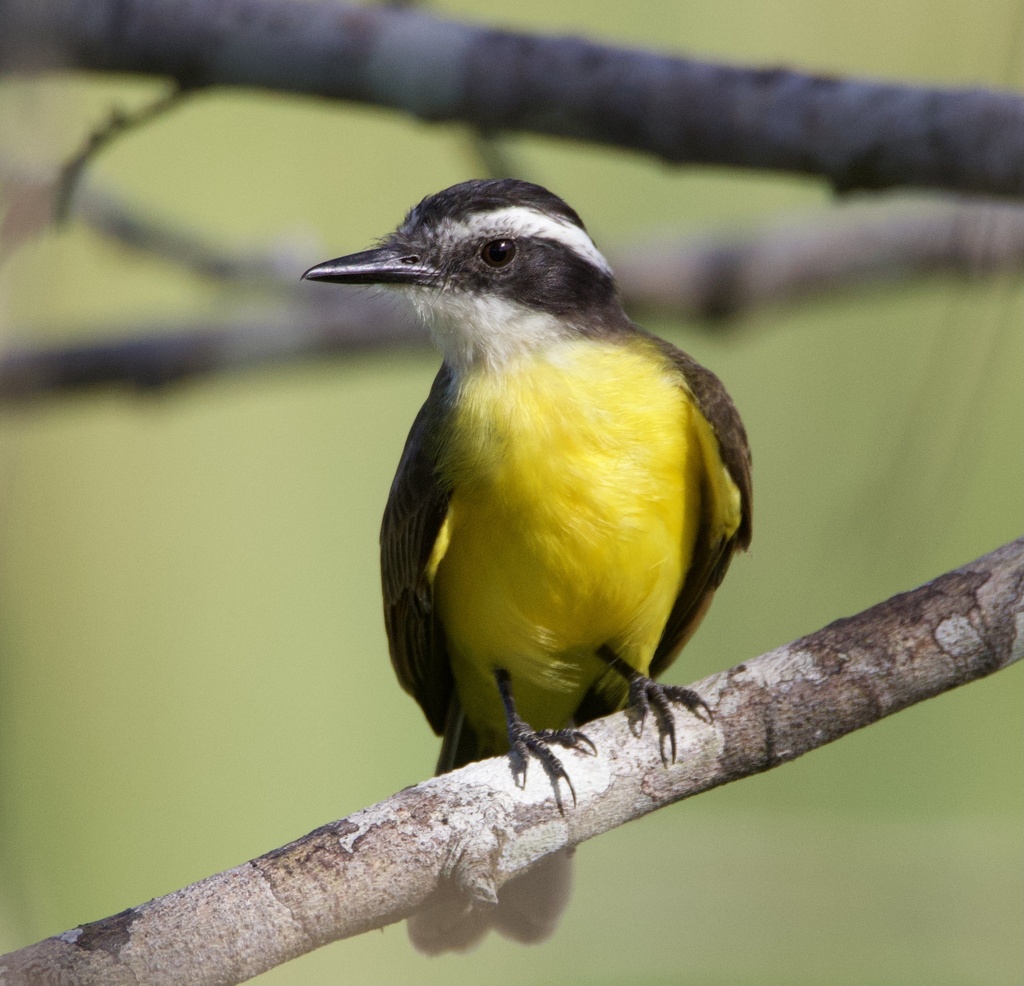
Lesser Kiskadee
Photo © Aitor
Photo © Aitor — CC BY 4.0 — Source: iNaturalist #148632170Identification
The Lesser Kiskadee is a small tyrant flycatcher, measuring 15–18 cm in length and weighing approximately 25 g. Adults have a distinctive black or sooty crown and face with a mostly hidden bright yellow crown patch that becomes visible when the bird is alert. A prominent white eyebrow stripe begins at the forehead and wraps almost completely around the nape, providing an easy field mark. The upperparts are plain olive, while the wings and tail are dark grayish-brown with cinnamon or rusty edging on the flight feathers. The underparts are bright yellow, contrasting sharply with the white chin and throat. Both sexes share identical plumage, though females are slightly smaller than males. Juveniles are duller, with reduced yellow on the crown, more brownish upperparts, and paler underparts overall.
Range & Habitat
The Lesser Kiskadee has a disjunct distribution across Central and South America, occurring in Panama and throughout mainland South America except Chile, Paraguay, and Uruguay; it appears only as a vagrant in Argentina. Two subspecies are recognized: P. l. panamensis in Panama and the Caribbean coast of Colombia, and the nominate P. l. lictor across a larger range spanning eastern Brazil, Colombia, Ecuador, Peru, Bolivia, Venezuela, the Guianas, and Amazonian Brazil. The species is strictly associated with water in all its habitats, preferring marshy shrublands, grasslands along waterways with low trees and snags, wooded stream borders, oxbow lakes, mangroves, and saltwater lagoon edges. Elevational range varies by region, typically sea level to 500 m, though locally higher in some areas.
Behaviour & Diet
The Lesser Kiskadee is a year-round resident throughout its range. It feeds exclusively on insects, foraging in pairs or small family groups, usually from perches up to about 3 m above ground or water. It typically captures prey with quick sallies to snatch insects from vegetation or the water surface, and occasionally drops to the ground to feed. The breeding season varies geographically: June to October in Venezuela, October to January in Peru, June–July in Colombia, and March–April in Panama. Pairs construct open-cup nests from small twigs and grass, typically placed 1.2–2.4 m above the substrate in shrubs, small trees, or stumps near water. Clutches contain two to three eggs, with females performing most incubation and brooding duties while both parents provision nestlings.
Best Time & Places to See It
The Lesser Kiskadee is fairly common throughout its range and occurs in many protected areas. Year-round residency means it can be found in suitable habitat during any season, though breeding displays and vocalizations are most active during the species' breeding period, which varies by region. Search for this species along waterways, marshy areas, and wetland edges where it typically perches conspicuously. Its distinctive bright yellow underparts and white eyebrow stripe make it relatively easy to identify once located. The bird's tendency to forage in pairs and perch in open areas increases sighting opportunities for patient observers.
Photography Tips
The Lesser Kiskadee's bright yellow underparts and contrasting facial pattern provide excellent photographic subjects. Position yourself along waterways and wetland margins where the species forages, as birds often perch openly on low branches or snags. Early morning or late afternoon light will enhance the vibrancy of the yellow plumage. Since the bird forages by making sallies from perches, anticipate these movements to capture dynamic feeding behavior. The white eyebrow stripe and yellow crown patch are key diagnostic features to emphasize in photographs. Patience is rewarded, as pairs often remain in view for extended periods, allowing time to frame detailed shots of the bird's distinctive facial markings and posture.
Nothing matches these filters.
Amacayacu National Park
Amazônia National Park
Anavilhanas National Park
Bahuaja Sonene National Park
Brasília National Park
Campos Amazónicos National Park
Cantão State Park
Carlos Botelho State Park
Chagres National Park
Nothing matches these filters.
No community photos yet. Log in to add the first one.
No community observations of this species yet.