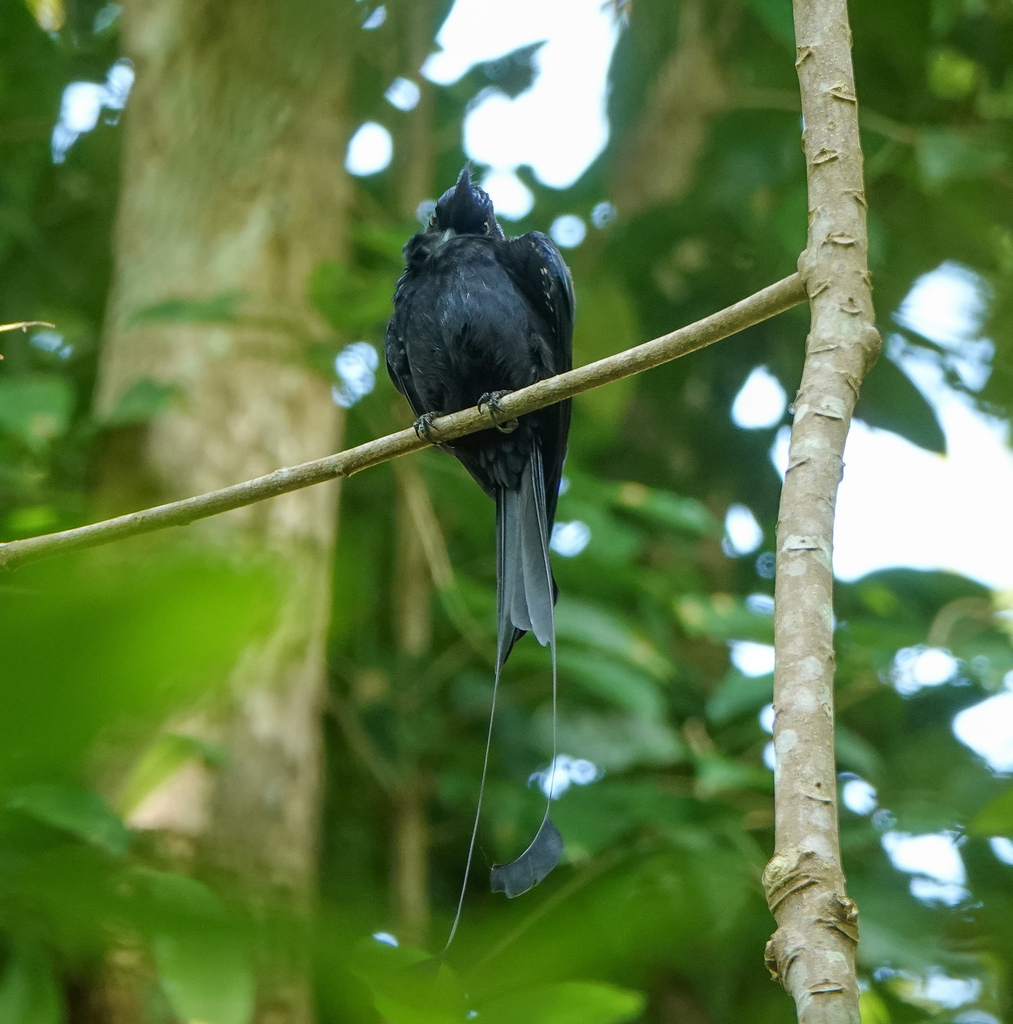
Lesser Racket-tailed Drongo
Photo © Rejoice Gassah
Photo © Rejoice Gassah — CC BY 4.0 — Source: iNaturalist #105300889Identification
The lesser racket-tailed drongo is a striking black bird approximately 25–27.5 cm long (excluding its spectacular tail), with males weighing 39–49 grams and females 35.5–44 grams. Its most distinctive feature is its elongated tail, which extends to 30–40 cm and terminates in long shafts exceeding 50 centimetres. The bird's plumage is entirely black but catches the light with a distinctive bluish metallic gloss, making it shimmer in forest clearings.
In the field, the lesser racket-tailed drongo can be confused with its larger cousin, the greater racket-tailed drongo. However, the key distinguishing feature is the absence of a crest on the head of the lesser species. Additionally, its tail is square-cut rather than forked, providing a useful identification point for keen-eyed observers.
Range & Habitat
This species is distributed across the Indian subcontinent and Southeast Asia, with a range spanning Bangladesh, Bhutan, Cambodia, India, Indonesia, Laos, Malaysia, Myanmar, Nepal, Thailand, and Vietnam. Four recognized subspecies occupy different regions within this broad range, from the lower Himalayas eastward to the mountains of Java and Sumatra, reflecting the species' adaptation to diverse montane environments across tropical Asia.
The lesser racket-tailed drongo favours subtropical and tropical moist montane forests, typically inhabiting areas near the edge of such forests or within them. This preference for elevation and moisture-rich forest environments makes it a bird of upland regions rather than lowland areas, though specific altitude ranges vary across its distribution.
Behaviour & Diet
Like other drongos, the lesser racket-tailed drongo is an active, acrobatic forager, though detailed behavioural observations specific to this species are limited in general literature. Drongos are known for their agility in flight and their insectivorous diet, hunting aerial insects with characteristic aerial sallies and manoeuvres through the forest canopy and mid-storey.
The species' long tail streamers, while visually spectacular, likely serve multiple functions including aerial manoeuvrability during insect-catching pursuits and possibly in courtship or territorial displays, though breeding behaviour specific to this subspecies remains incompletely documented.
Best Time & Places to See It
The lesser racket-tailed drongo can be encountered across its range in montane forests from the Himalayas through Southeast Asia. Key regions for encounters include the hill stations and forested elevations of northeast India, the mountains of Thailand, Cambodia, and peninsular Malaysia, as well as the highlands of Sumatra and Java. The bird's presence in moist montane forests means it is often easier to find during or shortly after rainy seasons when insect activity peaks.
Birdwatchers visiting this species' range should focus on forest edges and semi-open areas within montane forests, where the drongo's active foraging behaviour makes it more visible than it would be in dense forest interior.
Photography Tips
Photographing the lesser racket-tailed drongo presents both challenges and rewards. The bird's glossy black plumage can fool camera metering systems; compensation toward overexposure may help retain detail in the feathers while avoiding a featureless silhouette. The dramatic tail streamers are the species' signature feature—whenever possible, aim for angles that showcase these impressive appendages fully extended.
The drongo's acrobatic foraging behaviour offers dynamic shooting opportunities, though fast shutter speeds will be necessary to freeze wing-beats during aerial hunting. Early morning light in montane forests can beautifully highlight the metallic blue gloss of the plumage. Patience and stillness near forest edges and clearings offer the best chance of capturing this striking species in characteristic poses.
Langtang National Park
Helambu, Nepal
+364 birds+14 mammals
Where the southern slopes of the Himalayan highlands descend toward the subtropical valleys of central Nepal, Langtang National Park sprawls across one of the subcontinent's most…
VIEW NATIONAL PARKOrang National Park
Rangagarapathar, India
+298 birds+1 mammals
Where the Brahmaputra's floodplains meet the foothills of Assam, Orang National Park unfolds across a mosaic of riverine grasslands, forests and wetlands that pulse with the…
VIEW NATIONAL PARKKhao Yai National Park
Prachantakham District, Thailand
+377 birds+46 mammals
Evergreen dipterocarp forest blankets the rolling terrain of this national park in eastern Thailand, where limestone hills rise abruptly from the forest floor and seasonal streams…
VIEW NATIONAL PARKKhao Laem National Park
Sangkhla Buri District, Thailand
+197 birds
Where the Vajiralongkorn Reservoir sprawls across the forested valleys of Kanchanaburi's northern borderlands, Khao Laem National Park protects a landscape where limestone ridges rise dramatically from…
VIEW NATIONAL PARKKaziranga National Park
Kohora, India
+422 birds+26 mammals
Dawn breaks over the floodplains of the Brahmaputra, where tall grasslands stretch endlessly beneath monsoon-heavy skies. This sprawling wilderness of northeastern Assam is a mosaic of…
VIEW NATIONAL PARKTaman Negara National Park
Kampong Samas, Malaysia
+393 birds+48 mammals
Where ancient rainforest meets limestone peaks, one of Southeast Asia's oldest protected wilderness preserves sprawls across 4,343 square kilometers of primordial landscape. Dipterocarp giants tower overhead,…
VIEW NATIONAL PARKTaman Nasional Baluran
Situbondo, Indonesia
+189 birds+9 mammals
Across the northeastern tip of East Java, where monsoon winds sweep down from the Bali Strait, a landscape of contrasts unfolds within 374 square kilometres of…
VIEW NATIONAL PARKGunung Ciremai National Park
Majalengka, Indonesia
+116 birds+1 mammals
Volcanic slopes rise sharply from West Java's interior, where Gunung Ciremai's 3,078-metre summit dominates a landscape carved by geological upheaval and shaped by equatorial monsoon rainfall.…
VIEW NATIONAL PARKKerinci Seblat National Park
Kerinci, Indonesia
+228 birds+16 mammals
Across nearly 67,000 square kilometres of Sumatra's spine, a mountainous realm of equatorial rainforest rises from steaming lowlands to volcanic peaks shrouded in cloud. Kerinci Seblat…
VIEW NATIONAL PARKWay Kambas National Park
Lampung Timur, Indonesia
+237 birds+20 mammals
Across the low swamplands of eastern Lampung, where freshwater wetlands merge into tidal mangrove forests along the Sunda Strait, sprawls one of Sumatra's most vital sanctuaries.…
VIEW NATIONAL PARKXishuangbanna National Nature Reserve
Xishuangbanna Dai Autonomous Prefecture, China
+173 birds+2 mammals
Where subtropical monsoon forests meet the margins of the Yunnan plateau, Xishuangbanna National Nature Reserve sprawls across a landscape of dramatic relief—deep river valleys carved by…
VIEW NATURE RESERVEGaoligong Mountain National Nature Reserve
Nujiang Lisu Autonomous Prefecture, China
+443 birds+13 mammals
VIEW NATURE RESERVENo community photos yet. Log in to add the first one.
No community observations of this species yet.