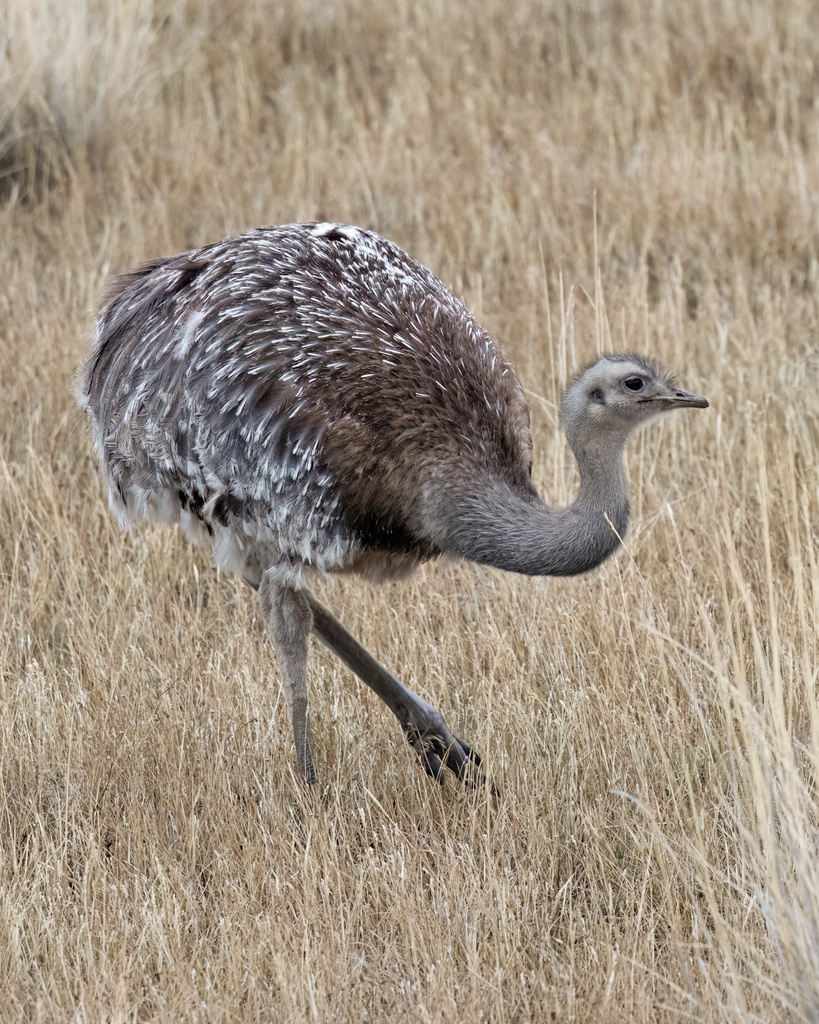
Lesser Rhea
Photo © Paulo Mascaretti
Photo © Paulo Mascaretti — CC0 1.0 — Source: iNaturalist photo #429632121Identification
The lesser rhea is a large flightless bird standing 90 to 100 cm tall, making it notably smaller than its relative, the greater rhea. It has the characteristic ratite body plan: a small head and bill, long neck, and notably long legs. The tarsus measures 28 to 32 cm and features 18 horizontal plates on the front, with sharp claws that serve as effective weapons. Weighing between 15 and 28.6 kg, this species possesses relatively larger wings than other ratites, which aid its remarkable running ability rather than flight.
The plumage is distinctive: spotted brown and white with feathers covering the upper part of the tarsus. Like ostriches, the lesser rhea's feathers lack an aftershaft. These anatomical features, combined with its exceptional speed of up to 60 km/h, make it well-adapted to escape predators across open terrain. The bird's name—Darwin's rhea or ñandú petiso in Spanish—reflects both its scientific significance and its local cultural importance in South America.
Range & Habitat
The lesser rhea inhabits the Altiplano (Andean plateau) and Patagonian grasslands across Argentina, Bolivia, Chile, and Peru. Three subspecies occupy distinct regions: one found in the puna of southeastern Peru, southwestern Bolivia, and northwestern Argentina; another across the puna of northern Chile; and the nominate subspecies in the Patagonian steppes of Argentina and Chile. All subspecies prefer grasslands, brushlands, and marshland environments.
Elevation preferences vary by subspecies: the Patagonian form typically inhabits areas below 1,500 m, while the northern highland subspecies range from 3,000 to 4,500 m on the Altiplano, though locally descending to 1,220 m in the south. This wide elevational and geographical distribution reflects the species' adaptation to diverse open scrub and grassland habitats across the southern cone of South America.
Behaviour & Diet
The lesser rhea is predominantly herbivorous, feeding on saltbush, cactus fruits, grasses, roots, seeds, and leaves, with only occasional consumption of small animals such as lizards, beetles, and grasshoppers. Generally quiet birds, they communicate through mournful whistles as chicks and booming calls from males during breeding season. During breeding, males become highly aggressive while incubating eggs, even toward females, which respond by laying later eggs outside the nest rather than within it. The male retrieves most eggs into the nest, but some remain outside where they rot and attract flies—a food source for both the incubating male and later the chicks.
Outside the breeding season, lesser rheas are highly sociable, living in groups of 5 to 30 birds of mixed sexes and ages. Incubation lasts 30 to 44 days, with clutch sizes ranging from 6 to 50 eggs laid by multiple females. Males provide sole parental care, and young birds reach sexual maturity at 20 to 24 months of age.
Best Time & Places to See It
For travelers seeking the lesser rhea, Argentina hosts the majority of the population and offers the most accessible opportunities. The Patagonian steppes of southern Argentina and Chile provide habitat for the nominate subspecies at lower elevations, making them more accessible than the high-altitude forms. The species' sociable nature outside breeding season means that when encountered, visitors may observe groups rather than solitary birds.
The northern highland subspecies in the puna regions of Peru, Bolivia, and Chile offer more remote and challenging viewing opportunities at elevations above 3,000 m. The birds' wariness—documented since Darwin's time—means that patient, careful approach is essential for close observation or photography. Early morning hours typically offer the best wildlife activity in grassland habitats.
Photography Tips
Photographing the lesser rhea requires patience and distance, as the species remains notably wary and difficult to approach closely. A telephoto lens is essential for capturing detailed images without disturbing the birds. The open grassland and brushland habitats they favor offer minimal cover, so early morning or late afternoon light will provide the most dramatic and flattering angles across the Patagonian steppes or Altiplano.
When photographing groups during the non-breeding season, position yourself downwind and move slowly to minimize disturbance. The birds' spotted brown and white plumage photographs well in natural light, and their characteristic running posture—wings alternately opening and lowering—presents excellent dynamic composition opportunities. High-altitude locations in the northern range demand consideration of thin air and variable weather conditions typical of the Andes.
Torres del Paine National Park
Torres del Paine, Chile
+143 birds+10 mammals
Where granite spires pierce the Patagonian sky, Torres del Paine commands one of South America's most dramatic landscapes. Across 4,106 square kilometres of southern Chile, jagged…
VIEW NATIONAL PARKLauca National Park
Putre, Chile
+139 birds+17 mammals
Where the Andes rise toward the altiplano in Chile's far north, Lauca National Park sprawls across more than 3,000 square kilometres of some of South America's…
VIEW NATIONAL PARKReserva Nacional las Vicuñas
Putre, Chile
+87 birds+6 mammals
High desert plateaus interlace with volcanic ridges across this 4,204-square-kilometre expanse at the border between Chile and Bolivia, where altitudes exceed 3,500 metres and the climate…
VIEW NATIONAL PARKSalar de Surire Natural Monument
Putre, Chile
+61 birds
High across the Altiplano of northern Chile, where the Andes push toward 4,300 metres and the air thins to a crystalline clarity, lies a vast shallow…
VIEW NATURAL MONUMENTReserva Nacional Magallanes
Punta Arenas, Chile
+78 birds+2 mammals
Where windswept steppe meets sub-Antarctic forest near the southern tip of continental South America, Reserva Nacional Magallanes unfolds across roughly 352 square kilometres of profound ecological…
VIEW NATIONAL PARKParque Provincial Península de Magallanes
Argentina
+125 birds+4 mammals
Granite peaks and windswept steppe converge across this 415-square-kilometre peninsula jutting into the cold Atlantic waters of southern Patagonia, where the Magallanes landscape embodies the raw,…
VIEW NATIONAL PARKLos Glaciares National Park
Argentina
+121 birds+3 mammals
Where granite peaks and sprawling ice fields dominate the landscape, Los Glaciares National Park encompasses over ten thousand square kilometres of Patagonian wilderness in southern Argentina.…
VIEW NATIONAL PARKPerito Moreno National Park
Argentina
+78 birds
Where the Patagonian steppe descends into a landscape carved by ancient ice, Perito Moreno National Park sprawls across nearly 1,590 square kilometres of some of South…
VIEW NATIONAL PARKNo community photos yet. Log in to add the first one.
No community observations of this species yet.