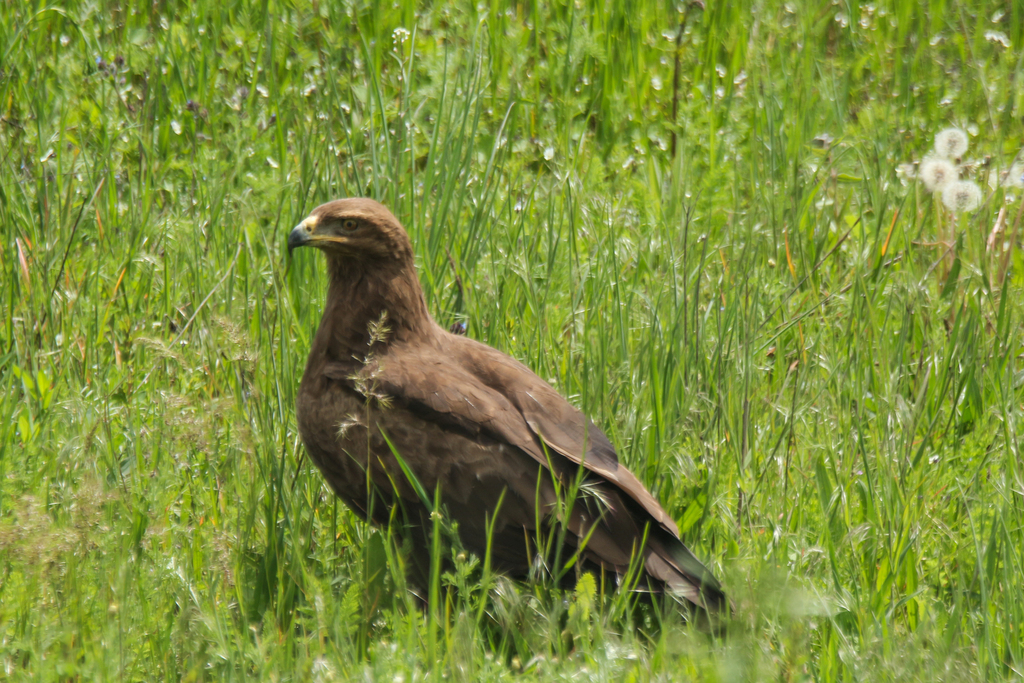
Lesser Spotted Eagle
Photo © Andrew Bazdyrev
Photo © Andrew Bazdyrev — CC BY 4.0 — Source: iNaturalist photo #690658978Identification
The lesser spotted eagle is a medium-sized eagle, measuring approximately 60 cm in length with a wingspan of around 150 cm. It is characterized by pale brown head and wing coverts that contrast strikingly with its generally dark plumage. The bird has a notably small head and bill for an eagle, and typically displays a white patch on the upper wings. Most distinctively, both adults and juveniles show a clearly marked white "V" on the rump—a feature absent or poorly defined in the closely related greater spotted eagle. Juvenile birds are less contrasted in the wings but feature prominent white spots on the remiges (flight feathers) and a distinctive cream-colored neck patch. The lesser spotted eagle's call is described as a dog-like yip.
Range & Habitat
This Eastern European bird of prey breeds across Central and Eastern Europe, extending southeastward to Turkey and Armenia, before migrating to Africa for winter. The lesser spotted eagle is a very wary species that inhabits open or lightly wooded country. It hunts primarily over terrain where its prey is accessible, relying on its keen vision to spot movement in grasslands and sparse woodland.
Behaviour & Diet
The lesser spotted eagle is a specialist hunter of small terrestrial prey, primarily feeding on small mammals such as voles, ground squirrels, rats, and mice. It also takes small birds, amphibians, reptiles, and occasionally insects including termites, supplementing its diet with carrion when the opportunity arises. The species establishes regularly spaced territories that are used consistently between breeding years, particularly in the northwestern part of its range. Breeding success across the region fluctuates in synchrony, suggesting that large-scale environmental factors such as climate fluctuations and prey availability have a greater influence than territory spacing itself.
Reproduction follows typical eagle patterns: females lay one to three white, buff-spotted eggs in tree nests and begin incubation immediately upon laying the first egg. This asynchronous hatching typically results in the first chick outcompeting its siblings, with only one young usually fledging except during years of exceptionally abundant prey.
Best Time & Places to See It
Travelers seeking to observe this species should target Central and Eastern Europe during the breeding season, focusing on open or lightly wooded landscapes where the eagles hunt. Spring and early summer offer the best opportunities for observation. Those interested in following the complete annual cycle might consider African locations during the winter months, though the species remains wary and can be challenging to approach.
Photography Tips
Photographers should capitalize on the lesser spotted eagle's distinctive white rump patch and white upper-wing markings, which are diagnostic field marks worth capturing in flight. The contrast between the pale head and dark plumage creates good photographic opportunities in clear light. Exercise patience and approach carefully, as this is a notably wary species. Early morning light in open country provides ideal conditions for documenting the bird in its natural hunting habitat.
Bwindi Impenetrable National Park
Lake Mburo National Park
Mabamba Swamp
Murchison Falls National Park
Queen Elizabeth National Park
Aberdare National Park
Abijata-Shalla Lakes National Park
Aggtelek National Park
Amboseli National Park
Nothing matches these filters.
No community photos yet. Log in to add the first one.
No community observations of this species yet.