Skip to content
ATLAS
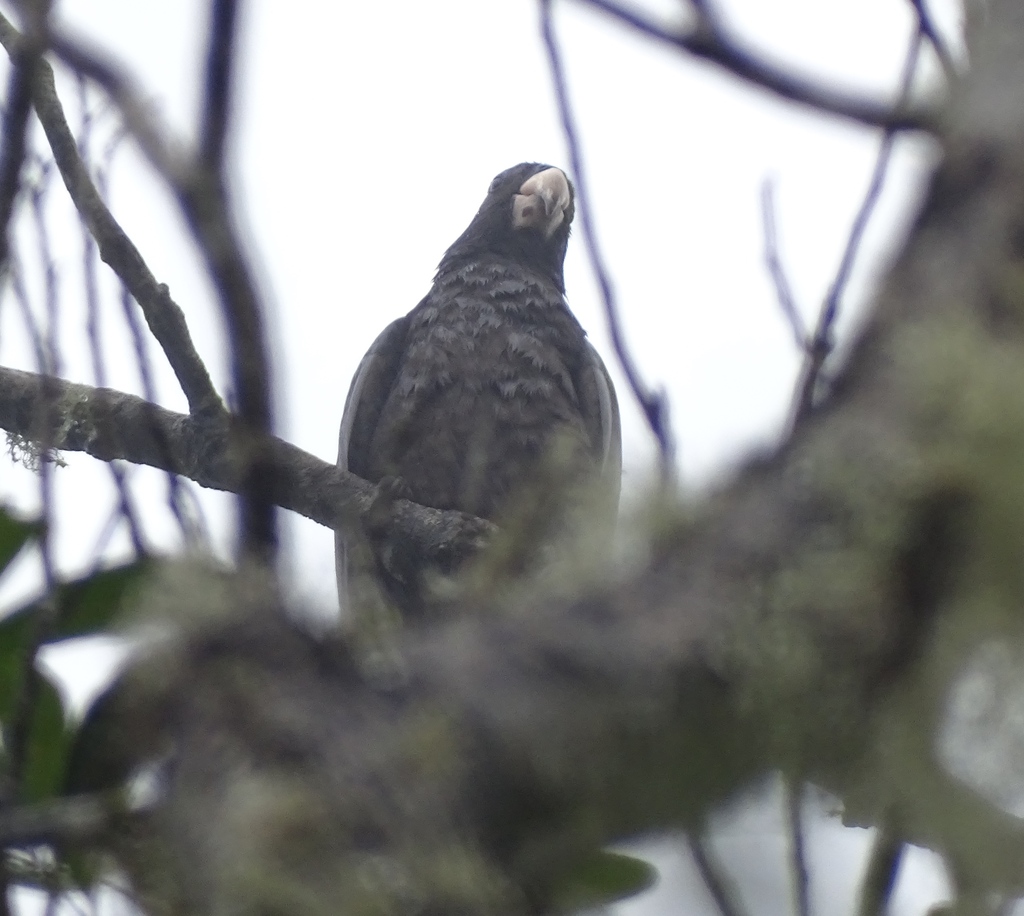
Lesser Vasa Parrot

Lesser Vasa Parrot

Coracopsis nigra
Photo © Sandra KellerPhoto © Sandra Keller — CC BY 4.0 — Source: iNaturalist #192558781
ABOUT
Subspecies of Lesser Vasa Parrot
Black Parrot (nigra)Bangs' Black Parrot

The lesser vasa parrot or black parrot (Coracopsis nigra) is a black coloured parrot endemic to most of Madagascar. It is one of four species of vasa parrots, the others being the greater vasa parrot (C. vasa), the Seychelles black parrot (C. barklyi), and the Comoros black parrot (C. sibilans). The latter two were formerly considered conspecific with the lesser vasa parrot. Lesser vasa parrots inhabit the mangrove swamps and evergreen forests of Madagascar. They eat seeds, blossoms and fruit - especially berries and mangos. They build their nests in tree hollows and go through courtship in February. During this time, the female may shed the feathers on her head giving it a yellowish tone. The male's beak may also turn white during this time. == Taxonomy == In 1743, the English naturalist George Edwards included a picture and a description of the lesser vasa parrot in his A Natural History of Uncommon Birds. He used the English name "Black Parrot from Madagascar". His drawing was made from a live bird owned by the Duke of Richmond. When in 1758 the Swedish naturalist Carl Linnaeus updated his Systema Naturae for the tenth edition, he placed the lesser vasa parrot with…

HOTSPOTS
Sort by
National Park

Andasibe-Mantadia National Park

Falierana·Madagascar
+142 birds+16 mammals
National Park

Andringitra National Park

Madagascar
+50 birds+1 mammal
National Park

Ankarafantsika National Park

Madagascar
+137 birds+12 mammals
National Park

Ankarana National Park

Madagascar
+90 birds+10 mammals
National Park

Isalo National Park

Sakamalio·Madagascar
+89 birds+4 mammals
National Park

Marojejy National Park

Antsirabe·Madagascar
+74 birds+6 mammals
National Park

Masoala National Park

Masoala·Madagascar
+107 birds+7 mammals
National Park

Montagne d’Ambre National Park

Joffreville·Madagascar
+77 birds+6 mammals
National Park

Ranomafana National Park

Madagascar
+129 birds+22 mammals

Nothing matches these filters.

Where to see & photograph the Lesser Vasa Parrot (1 more) →
COMMUNITY
Share your photos of Lesser Vasa Parrot Inspire other photographers and contribute to the atlas.
Drag your photos here or select a file from your device JPG, PNG or WebP · Up to 10 photos of 25 MB

Your photo, your rights. Always credited to you.

Sort by

No community photos yet. Log in to add the first one.

0 Observed by
0 Hotspots reported
0 Countries

No community observations of this species yet.

Wild Atlas Guide

  • About
  • Contact
  • Privacy Policy
  • Terms of Use
  • Send Feedback

Community

  • Submit a Hotspot
  • Operators Directory
  • Add your business
  • Business Terms
© 2026 Wild Atlas Guide — Content & data compilation protected.
Privacy Policy · Cookie settings · Copyright & data use

Contact Us

We'd love to hear from you. We'll reply as soon as possible.

Send Feedback

Found an error? Have a suggestion? We read every message.

Submit a hotspot Add your business
Sign in
MENU
Sign in

or

Enter your username or email and we'll send you a link to reset your password.

or

Biological profile

Lesser Vasa Parrot

A compact view of how this species lives, moves and responds to its environment.

The species at a glance

Select a card to explore the details.

Movement
Does it remain in the same area?
It generally remains in the same region
How does it move?
Local Ranging
Can its movements be anticipated?
Yes, its movements tend to repeat
Do its movements change with the seasons?
Yes, they follow a seasonal cycle
Do all populations follow the same calendar?
Yes, broadly speaking
Activity
When is it active?
Mainly active by day
Does it have inactive periods?
No known inactive period
How to detect it
Is it easy to find?
It takes some patience
How can you detect it?
AcousticVisual
Does it tend to hide?
It hides in some situations
Do you need a specific technique?
Usually not
Which seasonal signs help?
Courtship DisplayVocal Display
Habitat
Which environment does it live in?
Terrestrial
Which places does it prefer?
Forest
Can it adapt to different habitats?
It needs very specific habitats
At what level of the habitat does it move?
CanopyUnderstory
Feeding
What kind of food does it eat?
Frugivore
How does it get its food?
Gleaning
Social life
Does it usually live alone or in a group?
It usually lives in small groups
Does it gather at certain times?
It does not usually gather seasonally
Reproduction
Where does it breed?
Tree
Key moments in its annual cycle
Courtship Display · Annual Cycle ConsistentEgg Laying · Annual Cycle ConsistentHatching · Annual Cycle ConsistentFledging · Annual Cycle ConsistentMoult · Annual Cycle Consistent
Spatial ecology
Does it defend a territory?
Yes, it defends a territory
How far does it usually travel?
Within a local area
In which major regions does it live?
Afrotropical
Environmental response
Does its calendar change from place to place?
Yes, it responds to local conditions
Which factors change its calendar?
Food Pulse
Which conditions influence its behaviour?
Food Availability · Movement
Sensitivity
Is it affected by human disturbance?
Observe it calmly and keep your distance
When does it need the most space?
Nest
Global profile. Local behaviour and timing may vary.
Discover
Book
AllBirdsMammalsCountriesHotspotsHidesExperiencesOperators

Before you choose a photo

Please confirm the photo rights and credit terms first.

Read the photo rights and credit terms

I'm the author of this photo or hold the rights to it, and I keep full ownership. I grant Wild Atlas Guide a free, non-exclusive licence to display it on the site and in Wild Atlas Guide's own channels, including social media, always credited to me by my display name or the Instagram handle I choose to provide. I confirm it does not reveal a sensitive wildlife location or a recognisable person without their permission. I can withdraw future social use for this photo or ask for it to be removed at any time.

Please accept the photo rights and credit terms to continue.

Add your photo

    Uploading…

    We use cookies to measure traffic and improve Wild Atlas Guide. You decide. Privacy policy