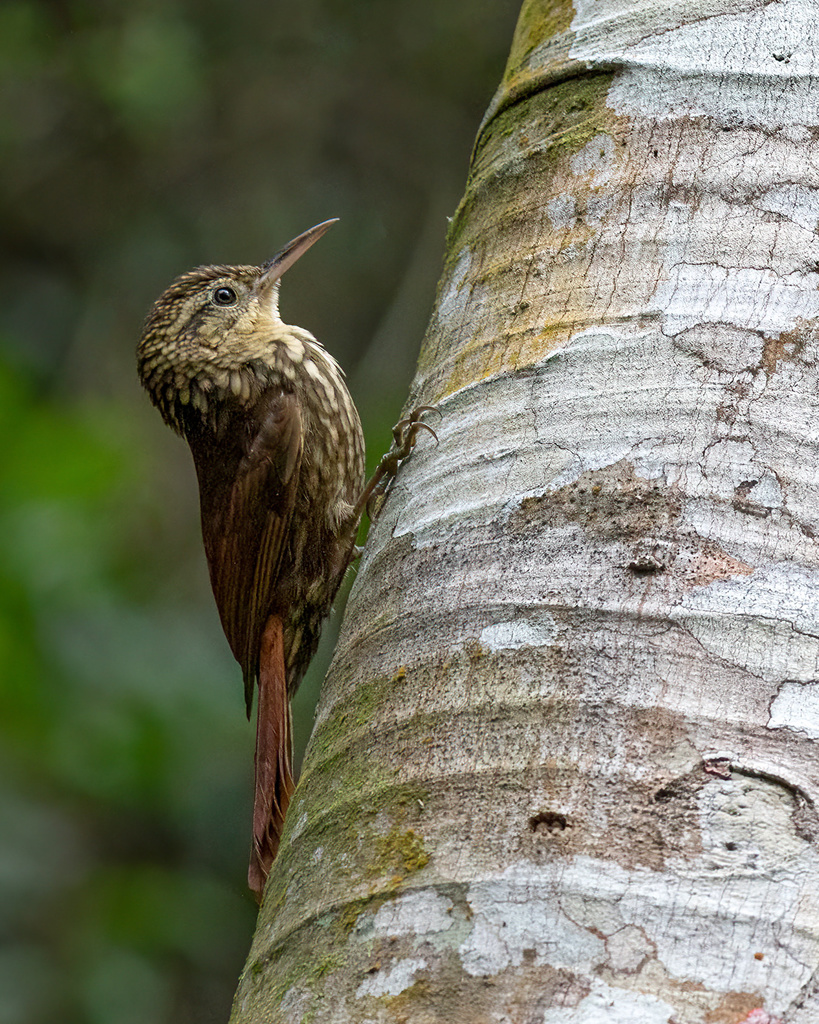
Lesser Woodcreeper
Photo © Paulo Mascaretti
Photo © Paulo Mascaretti — CC0 1.0 — Source: iNaturalist photo #199076725Identification
The lesser woodcreeper is a small, slender member of the woodcreeper family, measuring 15 to 18.5 cm long and weighing 15.5 to 25 grams. It is characterized by a longish, slightly curved bill and distinctive plumage. Adults display a dusky face with a prominent creamy to yellowish buff stripe above the eye and often a pale eye-ring. The crown and nape are blackish brown with small yellowish buff spots that become streaks on the nape and neck. The back is olive-brown to reddish brown, while the flight feathers, rump, and tail are rufous-chestnut. The throat is plain creamy yellow, and the breast and belly are smoky brown with a bold scaly pattern created by dark-edged buff spots. The bill is blackish brown above and pinkish to white below, with legs and feet that are olive-gray to bluish gray. Males and females are identical in plumage.
Range & Habitat
The lesser woodcreeper is found in Argentina, Brazil, and Paraguay, with different subspecies occupying distinct regions. The nominate subspecies is the most widespread, occurring from southeastern Brazil (Goiás, Minas Gerais, and Espírito Santo) south through Paraguay into Argentina's Misiones Province. The species inhabits diverse forested landscapes, including lowland rainforest, humid montane forest, semi-deciduous forest, gallery forest, and Araucaria-dominated forest in the south. It favors primary forest interiors and edges, as well as mature secondary forest, and occasionally ventures into younger growth adjacent to forest. The species typically occurs below 1,200 meters elevation but can range up to 1,500 meters or higher.
Behaviour & Diet
The lesser woodcreeper is believed to be a year-round resident throughout its range. It forages predominantly on arthropods, gleaning and pecking prey from tree trunks and branches, usually in the understory and mid-story levels but occasionally in the canopy. The species shows a preference for trees with rough, moss-covered bark and frequently searches among dead leaf clusters and dead bromeliads. It forages equally often alone and in mixed-species feeding flocks, and less frequently follows army ant swarms. The breeding season occurs from September to December, with birds nesting in tree cavities lined with dried leaves and bark chips. Clutches typically consist of two eggs, sometimes three, with evidence suggesting that only the female incubates.
Best Time & Places to See It
The lesser woodcreeper is fairly common to common throughout most of its Brazilian range but less frequent in Rio Grande do Sul, Paraguay, and Argentina. It is a year-round resident, making it potentially observable in any season. Look for this species in primary forest interiors and edges, particularly in areas with mature secondary forest and rough-barked trees. The species can survive in moderate numbers in selectively logged forest and forest fragments of reasonable size, expanding opportunities for observation beyond pristine habitats. Early morning hours are typically best for locating woodcreepers, when they are most vocal and active.
Photography Tips
Photograph the lesser woodcreeper on vertical tree trunks and branches where it habitually forages. The species' small size and understory to mid-story preference require patient positioning and careful light management, as forest interiors can be dim. Focus on capturing the distinctive plumage details: the facial pattern with its prominent supercilium, the scaly breast pattern, and the rufous-chestnut tail. Early morning light filtering through the canopy often provides excellent opportunities. Use a telephoto lens to maintain distance and avoid disturbing this species, which has been noted as sensitive to human disturbance. Recording its distinctive fast, sharp rattle and stuttered song will enhance your documentation of encounters.
Tijuca National Park
Brazil
+317 birds+13 mammals
Where the Atlantic forest rises steeply from Rio de Janeiro's urban edge, Tijuca National Park encompasses a landscape of dramatic granite peaks, cascading waterfalls, and closed-canopy…
VIEW NATIONAL PARKSerra do Cipó National Park
Brazil
+379 birds+5 mammals
Where granite escarpments rise above the Atlantic Forest transition zone in southeastern Brazil, Serra do Cipó National Park unfolds across a landscape of dramatic ridges, cascading…
VIEW NATIONAL PARKItatiaia National Park
Brazil
+519 birds+12 mammals
Where granite peaks pierce the Atlantic rainforest canopy in southeastern Brazil, Itatiaia National Park rises as one of the country's oldest and most ecologically vital protected…
VIEW NATIONAL PARKSuperagui National Park
Brazil
+246 birds+2 mammals
Where the Atlantic rainforest meets the subtropical coast of Paraná, Superagui National Park sprawls across more than 1,000 square kilometres of one of Brazil's most biodiverse…
VIEW NATIONAL PARKSaint-Hilaire/Lange National Park
Brazil
+225 birds
Subtropical Atlantic forests rise and fall across the plateaus of inland Paraná, where Saint-Hilaire/Lange National Park protects nearly 578 square kilometres of Brazil's most biodiverse woodland…
VIEW NATIONAL PARKSerra do Itajaí National Park
Brazil
+227 birds+2 mammals
Where the Atlantic rainforest rises steeply from the coastal plains of Santa Catarina, Serra do Itajaí National Park spreads across 1,136 square kilometres of montane wilderness…
VIEW NATIONAL PARKSerra da Bocaina National Park
Brazil
+441 birds+5 mammals
Where the escarpment of the Serra da Bocaina rises sharply from the Atlantic coastal plain, tropical rainforest cloaks steep mountainsides that climb toward peaks exceeding 2,000…
VIEW NATIONAL PARKIguaçu National Park
Brazil
+387 birds+17 mammals
Where the Paraná Plateau plunges toward the Atlantic watershed, six thousand square kilometers of subtropical rainforest cling to steep gorges and river valleys in this corner…
VIEW NATIONAL PARKSão Joaquim National Park
Brazil
+222 birds+9 mammals
Where the southern Brazilian highlands rise above the Atlantic Forest, São Joaquim National Park protects nearly 1,000 square kilometers of montane terrain that shifts between temperate…
VIEW NATIONAL PARKPau Brasil National Park
Brazil
+211 birds
Tropical Atlantic forest cloaks the rolling terrain of northeastern Bahia, where Pau Brasil National Park protects nearly 390 square kilometers of one of Brazil's most biodiverse…
VIEW NATIONAL PARKSerra dos Órgãos National Park
Brazil
+446 birds+13 mammals
Granite peaks thrust skyward through the Atlantic Forest canopy in the mountains immediately north of Rio de Janeiro, their bare rock faces rising above a landscape…
VIEW NATIONAL PARKChapada Diamantina National Park
Brazil
+346 birds+5 mammals
Where granite peaks and sandstone cliffs rise abruptly from the Brazilian interior, Chapada Diamantina National Park sprawls across 4,215 square kilometers of some of Brazil's most…
VIEW NATIONAL PARKSerra do Gandarela National Park
Brazil
+333 birds+3 mammals
Where granite massifs rise through Atlantic Forest in southeastern Brazil's highlands, Serra do Gandarela National Park protects nearly 1,000 square kilometres of montane terrain that few…
VIEW NATIONAL PARKBrasília National Park
Plano Piloto, Brazil
+338 birds+15 mammals
Cerrado grassland and scattered woodland sweep across the central Brazilian plateau where this national park sprawls across more than a thousand square kilometres of the Federal…
VIEW NATIONAL PARKAraucárias National Park
Brazil
+231 birds+3 mammals
Where the southern Brazilian highlands rise into cool temperate forest, Araucárias National Park protects one of the Atlantic Forest's most distinctive ecosystems across 506 square kilometres…
VIEW NATIONAL PARKSerra Geral National Park
Brazil
+211 birds+2 mammals
Where basalt cliffs and sandstone escarpments rise above the subtropical forests of southern Brazil, Serra Geral National Park preserves one of the Atlantic region's most dramatic…
VIEW NATIONAL PARKIguazú National Park
Puerto Iguazú, Argentina
+346 birds+15 mammals
Where the Paraná Plateau plunges toward the Atlantic watershed, nearly 800 square kilometers of subtropical rainforest drape across Misiones Province in a landscape carved by millennia…
VIEW NATIONAL PARKNo community photos yet. Log in to add the first one.
No community observations of this species yet.