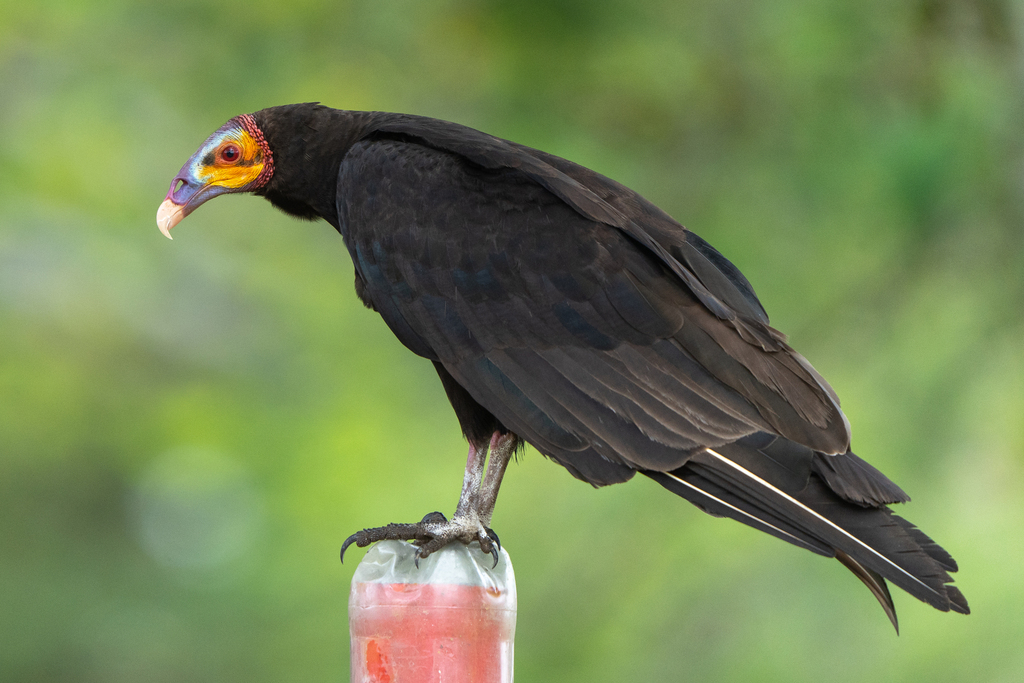
Lesser Yellow-headed Vulture
Photo © Anthony Batista
Photo © Anthony Batista — CC BY 4.0 — Source: iNaturalist photo #254277476Identification
The lesser yellow-headed vulture is a large New World vulture measuring 53–66 cm in length with a distinctive wingspan of 150–165 cm. Its most striking feature is its bare head and neck, coloured pale orange with a reddish forehead and nape and a grey-blue crown. The body plumage is black with a green sheen, and it has red irises, white legs, and a flesh-coloured, hooked beak. Despite its size, it is the lightest and smallest of the extant New World vultures.
Distinguishing it from the similar greater yellow-headed vulture requires careful observation: the lesser is smaller and less heavily built, with a shorter and thinner tail, browner plumage, lighter-coloured legs, and a more orange-tinged head. Immature birds are duller, with browner plumage, a dusky head, and a white nape. Unlike most birds, this species is completely silent, possessing no syrinx and capable only of low hisses or grunts.
Range & Habitat
The lesser yellow-headed vulture, also known as the savannah vulture, is found across a vast range from Mexico through Central America to South America, including countries from Argentina north to Colombia. Its range extends through Argentina, Belize, Bolivia, Brazil, Chile, Colombia, Costa Rica, Ecuador, El Salvador, French Guiana, Guatemala, Guyana, Honduras, Nicaragua, Panama, Paraguay, Peru, Suriname, Uruguay, and Venezuela.
This species inhabits seasonally wet or flooded lowland grasslands, swamps, mangroves, and heavily degraded former forest. It may wander over dry fields and clearings but is not generally found in high-altitude regions. It shows a preference for savanna habitats, which distinguishes it from its close relative, the greater yellow-headed vulture, which favours forest environments.
Behaviour & Diet
The lesser yellow-headed vulture is a carrion feeder with a remarkable ability rare among birds: it can locate carcasses by both sight and smell. It flies solitarily with wings held in a dihedral position, gliding at low altitude over wetlands in search of food, and typically perches on fence posts or other low perches. Like other New World vultures, it utilizes thermals to stay aloft with minimal energy expenditure.
However, this species has a significant dependency on larger vultures, particularly the king vulture, to open the hides of large animal carcasses—its bill is not strong enough to breach them independently. For breeding, it lays its eggs on flat surfaces such as cave floors or hollow stumps, and feeds its young by regurgitation. Its complete lack of a functional syrinx means it communicates only through low hisses and grunts.
Best Time & Places to See It
The lesser yellow-headed vulture can be found throughout its range in seasonally wet lowlands and wetland habitats. Its dependence on carrion means sightings are unpredictable, but persistence in observing these habitats increases your chances. The species' preference for savannas and open, degraded areas means it is more visible than forest-dwelling vultures, often perching conspicuously on low posts or gliding low over grasslands and swamps.
Notable locations include areas like the Quebrada de los Cuervos in Uruguay, where the species dwells alongside black vultures and turkey vultures. Early morning observations when vultures begin their daily foraging flights may yield better sightings. The bird's solitary nature means you are more likely to encounter individuals rather than flocks.
Photography Tips
Photographing the lesser yellow-headed vulture requires patience and positioning in open wetland habitats where the bird hunts at low altitude. Early morning light is ideal for capturing the striking colours of the bare head—the pale orange skin, reddish forehead and nape, and blue-grey crown. The bird's characteristic low, steady glide over grasslands and swamps provides opportunities for flight photography.
Focus on the bare head details to showcase its distinctive facial pattern, which differs subtly from the greater yellow-headed vulture. Its habit of perching on low posts and fence lines makes static portraiture possible. The rounded, relatively short tail and the dihedral wing position during flight are distinctive features worth capturing. Telephoto lenses are essential given the bird's tendency to stay alert and maintain distance, and shooting against clear sky during midday thermals may highlight its dark plumage and bare head colouration.
Tijuca National Park
Brazil
+317 birds+13 mammals
Where the Atlantic forest rises steeply from Rio de Janeiro's urban edge, Tijuca National Park encompasses a landscape of dramatic granite peaks, cascading waterfalls, and closed-canopy…
VIEW NATIONAL PARKEmas National Park
Brazil
+333 birds+23 mammals
Across the high plateaux of central Brazil, where the cerrado grasslands roll toward distant horizons under an immense sky, Emas National Park anchors one of South…
VIEW NATIONAL PARKSerra do Cipó National Park
Brazil
+379 birds+5 mammals
Where granite escarpments rise above the Atlantic Forest transition zone in southeastern Brazil, Serra do Cipó National Park unfolds across a landscape of dramatic ridges, cascading…
VIEW NATIONAL PARKYasuní National Park
Aguarico, Ecuador
+601 birds+43 mammals
Where the western Amazon basin converges with Ecuador's Orellana Province, lowland rainforest reaches toward the horizon in an unbroken canopy of staggering botanical density. Yasuní National…
VIEW NATIONAL PARKNatural Sierra de Chiribiquete National Park
Solano, Colombia
+359 birds+27 mammals
Massive table-top mountains rise abruptly from the lowland rainforest of southeastern Colombia, their sheer sandstone cliffs and isolated summits creating some of the most dramatic topography…
VIEW NATIONAL PARKNatural Utría National Park
Alto Baudó (Pie de Pató), Colombia
+372 birds+11 mammals
Where the Chocó's coastal mountains plunge toward the Pacific, Utría National Park preserves one of Colombia's most biodiverse and least-visited wilderness expanses. Sprawling across 1,287 square…
VIEW NATIONAL PARKNatural Farallones de Cali National Park
Buenaventura, Colombia
+733 birds+27 mammals
Where the Pacific coastal plain meets the western slopes of the Andes, Farallones de Cali National Park sprawls across nearly 3,500 square kilometers of dramatic topography…
VIEW NATIONAL PARKNatural el Cocuy National Park
Güicán, Colombia
+313 birds+3 mammals
Where the Andes rise to their highest peaks in Colombia's eastern cordillera, El Cocuy National Park sprawls across more than 6,600 square kilometers of some of…
VIEW NATIONAL PARKMorrocoy National Park
Municipio Silva
+290 birds
Where the Caribbean coast of northwestern Venezuela meets protected coastal waters, a mosaic of mangrove forests, sandy beaches, and coral reef systems defines Morrocoy National Park.…
VIEW NATIONAL PARKNatural Bahía Portete Kaurrele National Park
Colombia
+80 birds
Where the Caribbean coast of La Guajira rises to meet arid scrubland and seasonal wetlands, Natural Bahía Portete Kaurrele National Park spans 251 square kilometres of…
VIEW NATIONAL PARKNatural Sumapaz National Park
Cubarral, Colombia
+368 birds+1 mammals
Where the Andes descend toward the Amazon basin, the high páramo grasslands of Sumapaz National Park sprawl across more than five thousand square kilometers of Meta…
VIEW NATIONAL PARKNatural Sierra de la Macarena National Park
Vista Hermosa, Colombia
+566 birds+15 mammals
Across nearly 20,000 square kilometres of Colombia's Meta Department, the terrain rises from lowland savanna into Andean foothills through a mosaic of gallery forests, palm-fringed wetlands,…
VIEW NATIONAL PARKAmacayacu National Park
Leticia, Colombia
+567 birds+25 mammals
Where the Rio Amazonas curves through the tri-border region where Colombia, Peru, and Brazil converge, Amacayacu National Park sprawls across more than 5,250 square kilometres of…
VIEW NATIONAL PARKItatiaia National Park
Brazil
+519 birds+12 mammals
Where granite peaks pierce the Atlantic rainforest canopy in southeastern Brazil, Itatiaia National Park rises as one of the country's oldest and most ecologically vital protected…
VIEW NATIONAL PARKPeixe National Park Lagoon
Brazil
+293 birds+4 mammals
Where the coastal plains of Rio Grande do Sul meet the Atlantic, Peixe National Park Lagoon sprawls across nearly 2,200 square kilometres of shallow waters, reed…
VIEW NATIONAL PARKSuperagui National Park
Brazil
+246 birds+2 mammals
Where the Atlantic rainforest meets the subtropical coast of Paraná, Superagui National Park sprawls across more than 1,000 square kilometres of one of Brazil's most biodiverse…
VIEW NATIONAL PARKSerra da Bocaina National Park
Brazil
+441 birds+5 mammals
Where the escarpment of the Serra da Bocaina rises sharply from the Atlantic coastal plain, tropical rainforest cloaks steep mountainsides that climb toward peaks exceeding 2,000…
VIEW NATIONAL PARKViruá National Park
Brazil
+389 birds+6 mammals
Across the northern frontier of Roraima, where the forest canopy rises from ancient Amazonian lowlands, Viruá National Park protects nearly 3,700 square kilometres of terra firme…
VIEW NATIONAL PARKIguaçu National Park
Brazil
+387 birds+17 mammals
Where the Paraná Plateau plunges toward the Atlantic watershed, six thousand square kilometers of subtropical rainforest cling to steep gorges and river valleys in this corner…
VIEW NATIONAL PARKIlha Grande National Park
Brazil
+233 birds
Across the subtropical plateaus and Atlantic forest remnants of southern Brazil, a vast protected landscape spanning nearly 4,600 square kilometers safeguards one of the continent's most…
VIEW NATIONAL PARKSerra do Teixeira National Park
Brazil
+160 birds+5 mammals
Rugged plateaus and deep escarpments define this 3,112-square-kilometre sweep of the Brazilian Northeast, where the crystalline bedrock of the Borborema Plateau rises abruptly from the surrounding…
VIEW NATIONAL PARKSerra da Capivara National Park
Brazil
+156 birds+6 mammals
Across the semi-arid plateaus and deeply incised canyons of northeastern Brazil, where Piauí's ancient sandstone formations rise and fall in weathered waves, Serra da Capivara National…
VIEW NATIONAL PARKPau Brasil National Park
Brazil
+211 birds
Tropical Atlantic forest cloaks the rolling terrain of northeastern Bahia, where Pau Brasil National Park protects nearly 390 square kilometers of one of Brazil's most biodiverse…
VIEW NATIONAL PARKSerra dos Órgãos National Park
Brazil
+446 birds+13 mammals
Granite peaks thrust skyward through the Atlantic Forest canopy in the mountains immediately north of Rio de Janeiro, their bare rock faces rising above a landscape…
VIEW NATIONAL PARKSete Cidades National Park
Brazil
+125 birds+1 mammals
Sete Cidades sprawls across 113 square kilometres of northeastern Brazil's interior plateau, where weathered sandstone formations rise dramatically from the cerrado landscape. The park's geology tells…
VIEW NATIONAL PARKChapada dos Guimarães National Park
Brazil
+450 birds+1 mammals
Where weathered sandstone plateaus rise above the cerrado grasslands of central Brazil, Chapada dos Guimarães National Park protects 624 square kilometres of ecological transition zone that…
VIEW NATIONAL PARKChapada dos Veadeiros National Park
Brazil
+324 birds+6 mammals
Where granite plateaus rise above the cerrado savanna in central Brazil, Chapada dos Veadeiros National Park unfolds across 6,665 square kilometres of some of the world's…
VIEW NATIONAL PARKPantanal Matogrossense National Park
Brazil
+322 birds+17 mammals
Where the flooded forests of central Brazil meet vast seasonally inundated grasslands, Pantanal Matogrossense National Park sprawls across nearly 2,900 square kilometers of one of the…
VIEW NATIONAL PARKLençóis Maranhenses National Park
Brazil
+98 birds+2 mammals
Where white sand dunes rise in dramatic ridges across a coastal lowland, Lençóis Maranhenses National Park reveals one of Brazil's most otherworldly landscapes. Spanning 3,670 square…
VIEW NATIONAL PARKChapada Diamantina National Park
Brazil
+346 birds+5 mammals
Where granite peaks and sandstone cliffs rise abruptly from the Brazilian interior, Chapada Diamantina National Park sprawls across 4,215 square kilometers of some of Brazil's most…
VIEW NATIONAL PARKSerra do Gandarela National Park
Brazil
+333 birds+3 mammals
Where granite massifs rise through Atlantic Forest in southeastern Brazil's highlands, Serra do Gandarela National Park protects nearly 1,000 square kilometres of montane terrain that few…
VIEW NATIONAL PARKCatimbau National Park
Brazil
+118 birds+6 mammals
Where sandstone plateaus rise from the semi-arid scrublands of northeastern Brazil, Catimbau National Park unfolds across more than 1,000 square kilometres of geological drama and surprising…
VIEW NATIONAL PARKBrasília National Park
Plano Piloto, Brazil
+338 birds+15 mammals
Cerrado grassland and scattered woodland sweep across the central Brazilian plateau where this national park sprawls across more than a thousand square kilometres of the Federal…
VIEW NATIONAL PARKAmazônia National Park
Brazil
+439 birds+6 mammals
Where the Rio Amazonas and its tributaries weave through the heart of Pará state, a vast tapestry of rainforest stretches across 23,611 square kilometers of unbroken…
VIEW NATIONAL PARKSerra Geral National Park
Brazil
+211 birds+2 mammals
Where basalt cliffs and sandstone escarpments rise above the subtropical forests of southern Brazil, Serra Geral National Park preserves one of the Atlantic region's most dramatic…
VIEW NATIONAL PARKJaú National Park
Brazil
+354 birds+3 mammals
Vast floodplain forests and blackwater rivers define this remote corner of western Amazonas, where the Rio Negro and its tributaries have carved an intricate mosaic of…
VIEW NATIONAL PARKAnavilhanas National Park
Brazil
+468 birds+8 mammals
Across the Rio Negro in central Amazonas, an archipelago of over a thousand islands rises from the world's largest rainforest river system, creating a labyrinth of…
VIEW NATIONAL PARKSierra del Divisor National Park
Alto Tapiche, Peru
+298 birds+2 mammals
Where the western Amazon meets the Andes foothills, nearly 41,000 square kilometres of pristine rainforest rise across Peru's Alto Tapiche region in a landscape of extraordinary…
VIEW NATIONAL PARKBahuaja Sonene National Park
San Pedro de Putina Punco, Peru
+602 birds+8 mammals
Where the Madre de Dios and Heath rivers converge in southeastern Peru rises one of South America's most biodiverse wilderness regions: a vast protected realm of…
VIEW NATIONAL PARKTingo Maria National Park
Mariano Dámaso Beraún, Peru
+423 birds
Where the eastern slopes of the Peruvian Andes descend toward the Amazon basin, the landscape fractures into a maze of limestone ridges, humid gorges, and cloud-wrapped…
VIEW NATIONAL PARKCoiba National Park
Montijo, Panama
+260 birds+10 mammals
An archipelago of volcanic and sedimentary islands rises from the Pacific waters off Panama's southwestern coast, its densest rainforest canopy unbroken for millennia. Coiba National Park…
VIEW NATIONAL PARKSoberanía National Park
Cristóbal, Panama
+495 birds+34 mammals
Rainforest and riverine woodland blanket the rolling terrain of this 714-square-kilometre national park in Colón Province, where the Caribbean watershed feeds a maze of streams and…
VIEW NATIONAL PARKChagres National Park
Caimitillo, Panama
+486 birds+19 mammals
Where the Chagres River carves through the humid tropics of central Panama, a vast montane and lowland forest sprawls across more than 2,300 square kilometers, anchoring…
VIEW NATIONAL PARKDarién National Park
Tucutí, Panama
+534 birds+13 mammals
Where the spine of Central America crumbles into wetland and rainforest, Darién National Park sprawls across more than 20,000 square kilometres of some of the tropics'…
VIEW NATIONAL PARKPortobelo National Park
Portobelo, Panama
+366 birds+9 mammals
Where the Caribbean's turquoise waters meet the Darién's verdant shore, Portobelo National Park sprawls across 570 square kilometers of coastal forest, mangrove wetland, and coral-fringed islands…
VIEW NATIONAL PARKMarino Golfo de Chiriquí National Park
Boca Chica, Panama
+82 birds+2 mammals
Where mangrove forests meet tropical Pacific waters, Marino Golfo de Chiriquí National Park spans 463 square kilometers of one of Central America's most biodiverse coastal systems.…
VIEW NATIONAL PARKEl Palmar National Park
Distrito Sexto, Argentina
+244 birds+14 mammals
Across the Paraná River floodplain in northeastern Argentina, palms rise from wetland and grassland in a landscape shaped by water and time. El Palmar National Park…
VIEW NATIONAL PARKRío Pilcomayo National Park
Argentina
+271 birds+13 mammals
Where the Río Pilcomayo cuts through northeastern Argentina's subtropical lowlands, a sprawling mosaic of wetlands, grasslands, and seasonally flooded forests creates one of South America's most…
VIEW NATIONAL PARKIguazú National Park
Puerto Iguazú, Argentina
+346 birds+15 mammals
Where the Paraná Plateau plunges toward the Atlantic watershed, nearly 800 square kilometers of subtropical rainforest drape across Misiones Province in a landscape carved by millennia…
VIEW NATIONAL PARKCalilegua National Park
Municipio de Calilegua, Argentina
+288 birds+8 mammals
Where the eastern Andean slopes plunge into northwestern Argentina's humid subtropics, nearly 2,645 square kilometers of steep terrain and luxuriant forest compose one of South America's…
VIEW NATIONAL PARKParque Provincial Pampa del Indio
Laguna Limpia, Argentina
+231 birds+4 mammals
Across the flat horizons of Chaco Province, where the Paraná River system spills into vast wetlands and grasslands, Parque Provincial Pampa del Indio protects one of…
VIEW NATURE RESERVEChaco National Park
Municipio de Presidencia de la Plaza, Argentina
+258 birds+7 mammals
Across the humid subtropical lowlands of northeastern Argentina, where the Paraná River basin feeds vast seasonal wetlands and gallery forests, Chaco National Park protects one of…
VIEW NATIONAL PARKSian Ka’an
Chunyaxché, Mexico
+350 birds+16 mammals
Where the Yucatán Peninsula dissolves into wetland and mangrove, a vast mosaic of forest, lagoon, and coastal margin creates one of Mexico's most biodiverse strongholds. Across…
VIEW BIOSPHERE RESERVEMontes Azules
Candelaria, Mexico
+395 birds+47 mammals
Where jungle-clad limestone plateaus plunge into canyon systems carved by the Usumacinta River, Mexico's most pristine rainforest reserve unfolds across the Lacandón region of Chiapas. Montes…
VIEW BIOSPHERE RESERVETikal National Park
Tikal, Guatemala
+399 birds+16 mammals
Dense rainforest canopy rises above the limestone plateau of Petén, where archaeological wonder and ecological richness merge seamlessly across one of Central America's most biodiverse landscapes.…
VIEW NATIONAL PARKLaguna del Tigre National Park
Petén, Guatemala
+399 birds+29 mammals
Where the Petén lowlands dissolve into wetland and forest, Laguna del Tigre National Park protects one of Guatemala's most ecologically vital landscapes. This sprawling reserve encompasses…
VIEW NATIONAL PARKSierra del Lacandón National Park
Petén, Guatemala
+348 birds+7 mammals
Where the Petén rainforest rises into limestone ridges and deep ravines, Sierra del Lacandón National Park protects one of Central America's most intact tropical wilderness zones.…
VIEW NATIONAL PARKCaño Negro National Wildlife Refuge
Caño Negro District, Costa Rica
+486 birds+16 mammals
Where the San Juan River's seasonal floodplain opens into expansive wetlands, Caño Negro Wildlife Sanctuary sprawls across one of Central America's most productive freshwater ecosystems. This…
VIEW WILDLIFE SANCTUARYBarra del Colorado National Wildlife Refuge
Tortuguero, Costa Rica
+462 birds+36 mammals
Where the Caribbean's restless waters meet the Limón Province coastline, Barra del Colorado National Wildlife Sanctuary unfolds across a landscape of extraordinary ecological complexity. This equatorial…
VIEW WILDLIFE SANCTUARYNo community photos yet. Log in to add the first one.
No community observations of this species yet.