Light-mantled Albatross
Photo © Tim
Photo © Tim — CC BY 4.0 — Source: iNaturalist #296772120Identification
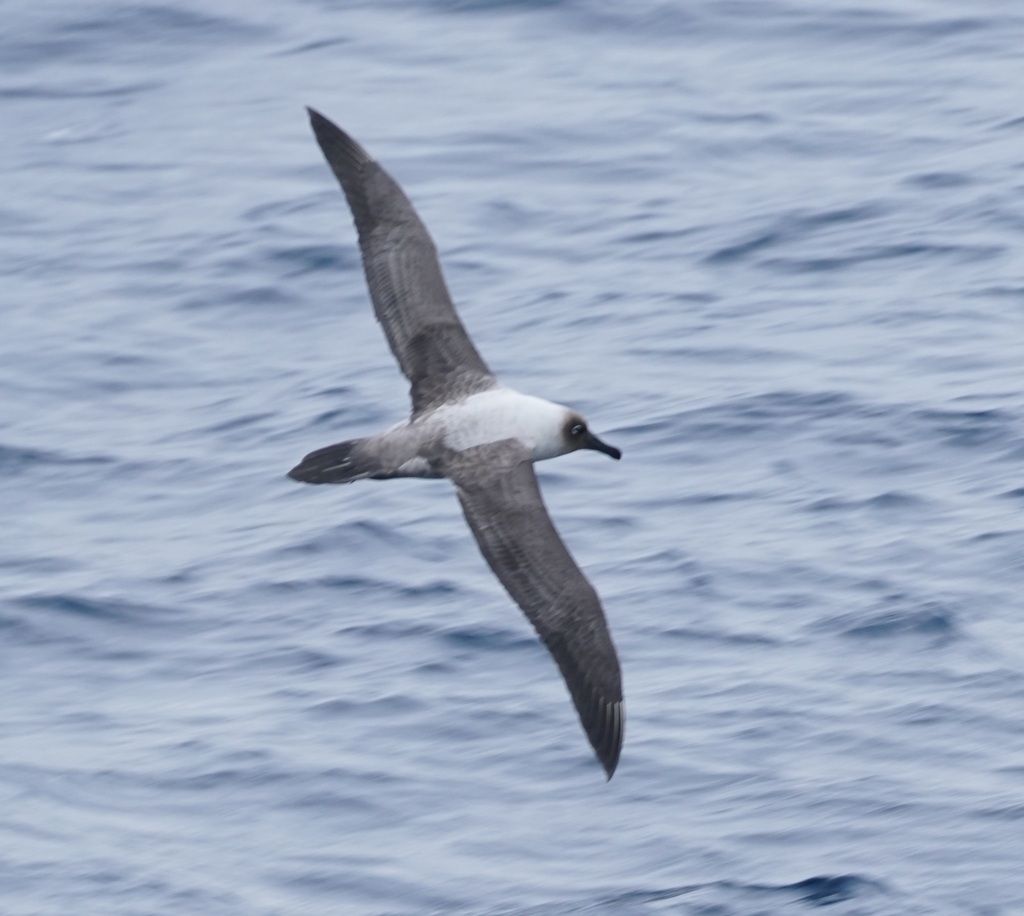
The light-mantled albatross is a small albatross with distinctive plumage often described as resembling a Siamese cat in colouration. It is largely sooty-brown or blackish on the head and underparts, but characteristically features paler, grey to light-grey upperparts from the nape to the upper tail-coverts, with the palest colouring on the mantle and back. Thin post-orbital crescents of short grey feathers partly encircle the eyes. The black bill features a blue sulcus and a greyish-yellow line along the lower mandible, measuring about 105 mm. Males and females are similar in size, averaging 79–89 cm in length with a wingspan of 183–232 cm and weighing 2.5–3.7 kg.
Range & Habitat
This species has a circumpolar pelagic distribution throughout the Southern Ocean, ranging from pack-ice around Antarctica (with the southernmost record at 78°S in the Ross Sea) to about 35°S, with occasional sightings further north along the Humboldt Current. It breeds on numerous subantarctic islands including South Georgia, the Crozet Islands, Kerguelen Islands, Heard Island, Macquarie Island, Campbell Island, and Auckland Islands, as well as on King George Island in the maritime Antarctic. Except during breeding, its habitat is entirely marine, foraging from the Antarctic pack-ice edge to approximately 40°S.
Behaviour & Diet
Light-mantled albatrosses are vocal birds with a loud, shrill trumpet-like call, and they snap their bills or produce a throaty 'gaaaa' when threatened. Courtship involves elaborate aerial displays, formation flying, mutual calling with tone variations achieved through head positioning, and distinctive tail displays. The species breeds in loose colonies, small groups, or sometimes solitarily, with pairs forming long-lasting pair-bonds renewed through complex courtship displays. They breed biennially on average, fledging a chick approximately every five years, and are capable of breeding until at least 32 years old.
Their principal diet consists of squid and krill, supplemented by other crustaceans, fish, and carrion from seals, penguins, and petrels. They often feed in association with pilot whales and southern right whale dolphins, and occasionally follow ships. Food is typically taken on or near the ocean surface within 5 metres depth, though dives of up to 12 metres have been recorded.
Best Time & Places to See It
The light-mantled albatross is best observed at its breeding colonies on subantarctic islands such as South Georgia, the Crozet Islands, Kerguelen Islands, and Campbell Island, where breeding occurs from October through June. At sea, the species can be encountered throughout the Southern Ocean during pelagic voyages, particularly in waters between the Antarctic pack-ice and 40°S latitude.
Photography Tips
Photographers should position themselves on stable vantage points overlooking breeding colonies to capture courtship displays and aerial manoeuvres. The bird's striking grey-and-black plumage contrasts well in Southern Ocean light; shoot during overcast conditions to avoid harsh shadows on dark plumage. When photographing at colonies, maintain respectful distances and use longer focal lengths to avoid disturbing nesting birds. At sea, morning light often provides optimal conditions for capturing the pale mantle colouring and subtle grey feather details around the eyes.
Kidney Island
Stanley, Falkland Islands
+47 birds
Wind-scoured tussock grassland sweeps across this remote South Atlantic outcrop, where peaty soils and exposed rock formations create a landscape as austere as it is vital.…
VIEW ISLAND & ARCHIPELAGOCabo de Hornos National Park
Cape Horn, Chile
+88 birds+9 mammals
Where the Andes plunge into the Southern Ocean and the Drake Passage churns between two continents, Cabo de Hornos National Park sprawls across one of Earth's…
VIEW NATIONAL PARKDeception Island
Gabriel de Castilla Base, Antarctica
+26 birds+10 mammals
Steaming geothermal vents pierce a landscape of blackened volcanic sand and ice, where the earth's raw power still trembles beneath your feet. This horseshoe-shaped caldera, flooded…
VIEW ISLAND & ARCHIPELAGOBrown Bluff
Brown Bluff, Antarctica
+23 birds+9 mammals
Where rust-colored volcanic peaks pierce the Antarctic Peninsula's icy realm, a geologist's dreamscape unfolds beneath towering cliffs of iron oxide and ancient lava. Brown Bluff rises…
VIEW PROTECTED LANDSCAPEPort Lockroy
Port Lockroy, Antarctica
+19 birds+9 mammals
Towering peaks of black rock pierce through Antarctic pack ice on the Gerlache Strait, where one of the continent's most accessible harbors cradles a living microcosm…
VIEW PROTECTED LANDSCAPEHalf Moon Island
Cámara Base, Antarctica
+25 birds+8 mammals
Jagged volcanic peaks rise from the cobalt waters of the South Shetland Islands, their slopes carpeted in moss and lichen where hardy vegetation clings to windswept…
VIEW ISLAND & ARCHIPELAGOLemaire Channel
Orne Harbour, Antarctica
+25 birds+13 mammals
Where granite peaks plunge into steel-grey waters, the Lemaire Channel carves one of Antarctica's most dramatic passages. This narrow strait, squeezed between the Antarctic Peninsula and…
VIEW PROTECTED LANDSCAPESalisbury Plain
South Georgia, South Georgia and the South Sandwich Islands
+33 birds+4 mammals
Where tussock grasses bow to relentless Antarctic winds and glacial meltwater carves braided channels through obsidian volcanic soil, one of Earth's most remote wildlife sanctuaries reveals…
VIEW PROTECTED LANDSCAPESt. Andrews Bay
South Georgia, South Georgia and the South Sandwich Islands
+34 birds+6 mammals
Where windswept tundra dissolves into obsidian beaches, one of the planet's most extraordinary wildlife theaters unfolds across St. Andrews Bay. This remote corner of South Georgia…
VIEW PROTECTED LANDSCAPEFortuna Bay
Stromness, South Georgia and the South Sandwich Islands
+37 birds+5 mammals
Where tussock grasslands sweep down to black-sand beaches and elephant seals haul out in thunderous colonies, the raw sub-Antarctic landscape reveals itself in its most dramatic…
VIEW PROTECTED LANDSCAPEPrion Island
Prince Olav Harbour, South Georgia and the South Sandwich Islands
+36 birds+2 mammals
Windswept tussock grasslands rise sharply from boulder-strewn beaches where the Southern Ocean hurls its grey swells against black volcanic rock. This remote speck in South Georgia's…
VIEW ISLAND & ARCHIPELAGOCooper Bay
Cooper Bay, South Georgia and the South Sandwich Islands
+28 birds+5 mammals
Where black-sand beaches meet towering cliffs striped with cascading meltwater, one of the Southern Ocean's most dramatic amphitheaters reveals itself. Cooper Bay cuts a deep indent…
VIEW PROTECTED LANDSCAPEElsehul Bay
Bird Island Station, South Georgia and the South Sandwich Islands
+33 birds+4 mammals
Granite peaks rise sheer from the Southern Ocean, their weathered faces streaked with cascading meltwater and cloaked in tussock grass that bends beneath relentless winds. This…
VIEW PROTECTED LANDSCAPEGreat Sandy National Park
Australia
+306 birds+40 mammals
Where coastal dunes rise inland from the Queensland coastline, Great Sandy National Park encompasses a landscape of remarkable ecological diversity shaped by subtropical humid conditions year-round.…
VIEW NATIONAL PARKNo community photos yet. Log in to add the first one.
No community observations of this species yet.