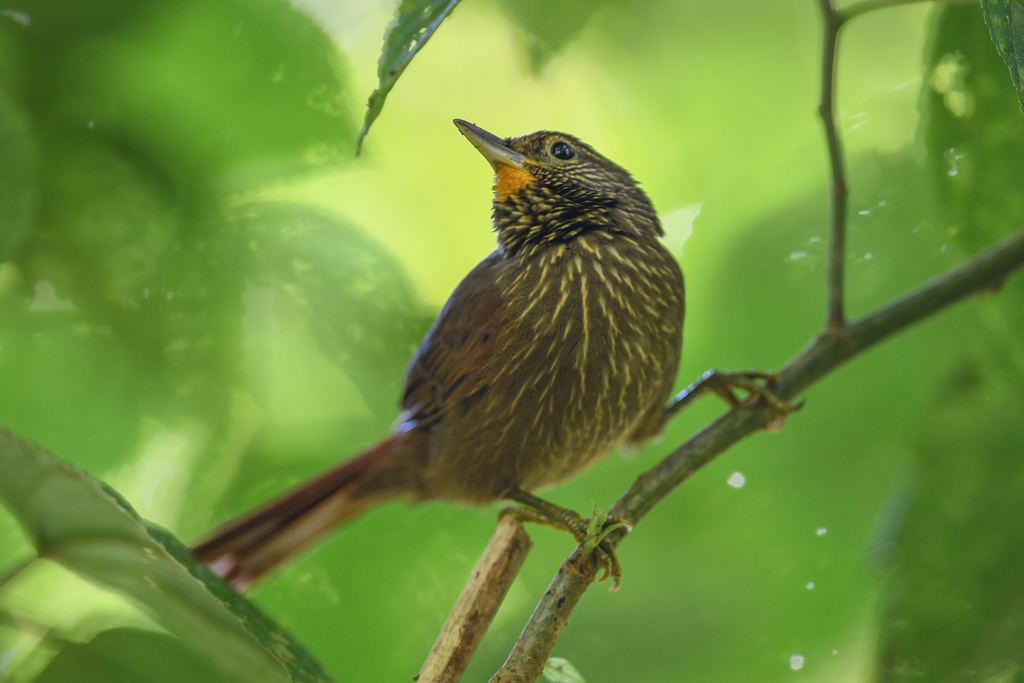
Lineated Foliage-gleaner
Photo © Trevor Van Loon
Photo © Trevor Van Loon — CC BY 4.0 — Source: iNaturalist photo #177986736Identification
The lineated foliage-gleaner is a small ovenbird measuring 17 to 19 cm in length and weighing 26 to 40 grams. Both sexes are identical in plumage. Adults display a characteristic discontinuous buff supercilium extending to the nape, set against a blackish-brown face with fine buff markings. The crown is dark brown with thin buff streaks, and a narrow ill-defined collar features wide buff streaks. The back is rich dark brown with long thin buff streaks, while the rump remains plain dark brown. The tail is dark chestnut, and the wings are rich dark brown with lighter rufescent-brown at the bend. The underparts are buff to pale brown with streaking that fades toward the rear. The iris is brown to dark brown, the bill varies from dark brown to black on the maxilla with a grayish-horn to ivory mandible, and the legs and feet are olive-green to greenish-gray. Juveniles are brighter overall with a blacker, cinnamon-streaked crown and more ochraceous tones.
Six recognized subspecies exist across the species' range, showing subtle variations in coloration. S. s. lineata has a paler, more rufescent back, while S. s. striolata displays darker, less rufescent features. Other subspecies differ in crown darkness, throat coloration, and the extent of streaking on the underparts.
Range & Habitat
The lineated foliage-gleaner has a disjunct distribution across Central and South America, found in Costa Rica, Panama, Colombia, Ecuador, Venezuela, and Peru. Different subspecies occupy specific geographic regions: S. s. lineata inhabits the mountains of Costa Rica and western Panama, while S. s. subalaris occurs in Colombia's Western and Central Andes through western Ecuador. The species ranges from the foothill and subtropical zones of mountain ranges, typically between 1,000 and 2,300 meters elevation, though it occasionally descends to 600 meters and in Colombia ascends to 2,800 meters.
This species favors evergreen forest with dense undergrowth, particularly areas along streams. It remains a year-round resident throughout its entire range, showing no migratory tendency.
Behaviour & Diet
The lineated foliage-gleaner feeds primarily on arthropods, including insects and spiders, with occasional small vertebrate prey such as frogs and lizards. It typically forages singly or in pairs, readily joining mixed-species feeding flocks. The bird works from the forest understory to mid-story levels, gleaning and probing among live and dead leaves, debris, moss, and epiphytes as it moves along large branches and vines. It often hangs nearly upside down to access the undersides of branches—a characteristic feeding behavior of its family.
The species is assumed to be monogamous, though detailed breeding biology remains poorly documented. The only fully described nest was a cup of soft fibers built on a twig platform inside a tree hole, containing two eggs. The lineated foliage-gleaner produces a distinctive song described as a fast, accelerating series of 6 to 10 dry, harsh, scratchy, nasal notes that may ascend and descend or accelerate and decelerate before ending abruptly. Its calls are equally harsh and dry, variously rendered as 'tzuk', 'tcheck', 'skanh', 'jert', or 'kr-rk'.
Best Time & Places to See It
As a year-round resident throughout its range, the lineated foliage-gleaner can be encountered in any season within its mountain forest habitat. However, the species' preference for dense undergrowth along streams makes it challenging to observe. Birdwatchers should focus on foothill and subtropical evergreen forests between 1,000 and 2,300 meters elevation in Costa Rica's mountains, Panama's ranges, Colombia's Andean slopes, and the Andean regions of Ecuador, Venezuela, and Peru.
Listening for its distinctive, harsh, accelerating song will greatly aid in locating this bird. The species readily joins mixed-species feeding flocks, providing an opportunity to encounter it alongside other forest species. Early mornings are typically the most productive time for bird activity in cloud forests and montane habitats.
Photography Tips
The lineated foliage-gleaner's small size, preference for dense undergrowth, and subtle plumage make it a challenging photographic subject. Success requires patience and positioning near areas of dense vegetation along streams where the species is known to occur. The bird's habit of hanging upside down while foraging offers unique angles; position yourself to anticipate these acrobatic movements.
Because the bird often works in the shadowed understory and mid-story levels of dense forest, a fast lens (f/4 or wider) and high ISO capability are essential for handheld shooting. The streaked, brownish plumage requires careful exposure metering to avoid underexposure in forest shade. Focus on capturing the diagnostic buff supercilium, streaked underparts, and chestnut tail, which aid in identification. Recording the harsh, distinctive call will complement field documentation of this secretive species.
Arenal Volcano National Park
Peñas Blancas, Costa Rica
+551 birds+21 mammals
Straddling the border between Alajuela and Guanacaste in northwestern Costa Rica, this national park rises dramatically around one of Central America's most active volcanic systems. The…
VIEW NATIONAL PARKChirripó National Park
Rivas, Costa Rica
+274 birds+6 mammals
Where the volcanic spine of Costa Rica's Central Cordillera reaches its apex, Chirripó National Park encompasses a landscape that shifts dramatically with elevation, from montane cloud…
VIEW NATIONAL PARKBraulio Carrillo National Park
Las Horquetas, Costa Rica
+547 birds+18 mammals
Where the Caribbean slope descends from the central volcanic cordillera toward the humid lowlands of Heredia, Braulio Carrillo National Park preserves one of Costa Rica's most…
VIEW NATIONAL PARKVolcán Poás National Park
Toro Amarillo, Costa Rica
+237 birds+4 mammals
Where volcanic slopes rise sharply from the Central Valley floor, Volcán Poás National Park protects one of Costa Rica's most active and accessible volcanic systems. The…
VIEW NATIONAL PARKPodocarpus National Park
Zamora, Ecuador
+496 birds+6 mammals
Where the Andes descend toward the Amazon basin, Podocarpus National Park sprawls across nearly 2,800 square kilometres of the most biodiverse terrain in Ecuador's southern highlands.…
VIEW NATIONAL PARKSumaco Napo-Galeras National Park
Loreto, Ecuador
+563 birds+4 mammals
Where Ecuador's Amazon transitions into cloud forest, a massive shield volcano rises from the emerald lowlands of Orellana Province, anchoring one of the continent's most biodiverse…
VIEW NATIONAL PARKAntisana National Park
Quijos, Ecuador
+432 birds+21 mammals
Where the eastern Andean slopes descend into the Amazon basin, Antisana National Park sprawls across roughly 2,500 square kilometers of some of South America's most dramatic…
VIEW NATIONAL PARKNatural Serranía de los Yariguíes National Park
El Carmen de Chucurí, Colombia
+320 birds+3 mammals
Where the northern cordilleras of Colombia rise toward cloud forest, the Serranía de los Yariguíes unfolds across nearly 1,820 square kilometers of some of the most…
VIEW NATIONAL PARKNatural Farallones de Cali National Park
Buenaventura, Colombia
+733 birds+27 mammals
Where the Pacific coastal plain meets the western slopes of the Andes, Farallones de Cali National Park sprawls across nearly 3,500 square kilometers of dramatic topography…
VIEW NATIONAL PARKNatural Chingaza National Park
Junín, Colombia
+285 birds+6 mammals
Where the Andes rise above three thousand metres in the Cundinamarca region, high-altitude grasslands and cloud forests converge in a landscape shaped by both geology and…
VIEW NATIONAL PARKGuácharos Cave National Natural Park
Acevedo, Colombia
+359 birds
High in the Andean foothills of southern Huila, where mist-laden slopes rise above 1,600 metres, lies a landscape carved by underground rivers and crowned by karst…
VIEW NATIONAL PARKYanachaga–chemillén National Park
Palcazu, Peru
+639 birds+6 mammals
Where the eastern slopes of Peru's central cordillera plunge into cloud forest, Yanachaga–Chemillén National Park protects nearly three thousand square kilometres of montane wilderness that few…
VIEW NATIONAL PARKCordillera Azul National Park
Pampa Hermosa, Peru
+322 birds+1 mammals
Where the eastern Andes descend into the western Amazon basin, Cordillera Azul National Park sprawls across nearly 38,000 square kilometres of some of Peru's most pristine…
VIEW NATIONAL PARKBaru Volcano National Park
Cerro Punta, Panama
+402 birds+6 mammals
Where the land rises sharply toward the Caribbean's western spine, Baru Volcano National Park sprawls across roughly 220 square kilometres of southwestern Panama, anchored by the…
VIEW NATIONAL PARKGeneral de División Omar Torrijos Herrera National Park
La Pintada, Panama
+401 birds+2 mammals
Across the highlands of central Panama, where the continental divide funnels moisture-laden trade winds into steep river valleys, the terrain rises and falls in a landscape…
VIEW NATIONAL PARKDarién National Park
Tucutí, Panama
+534 birds+13 mammals
Where the spine of Central America crumbles into wetland and rainforest, Darién National Park sprawls across more than 20,000 square kilometres of some of the tropics'…
VIEW NATIONAL PARKParque Internacional la Amistad
Teribe, Panama
+325 birds+11 mammals
Where the continental divide rises between the Caribbean and Pacific watersheds, a wilderness of extraordinary biological richness unfolds across the Talamanca Range and into lowland rainforest—a…
VIEW NATIONAL PARKLos Quetzales National Park
Copey, Costa Rica
+232 birds+3 mammals
Cloud forest sweeps across the upper slopes of the Central Valley watershed, where elevation and persistent moisture forge an ecosystem unlike any other in Costa Rica.…
VIEW NATIONAL PARKTapantí Macizo de la Muerte National Park
Orosi, Costa Rica
+503 birds+18 mammals
Where montane cloud forest rises steeply from the Orosi Valley, Tapantí Macizo de la Muerte National Park enfolds a landscape of perpetual moisture and emerald complexity.…
VIEW NATIONAL PARKLa Amistad International Park
Crorina, Costa Rica
+532 birds+20 mammals
Where the Caribbean slopes of Costa Rica's Talamanca Mountains rise steeply inland from Limón, the boundary between two nations dissolves into an unbroken expanse of rainforest.…
VIEW NATIONAL PARKNo community photos yet. Log in to add the first one.
No community observations of this species yet.